






Guida alla richiesta di preventivo per parco giochi indoor
Lista di controllo per richieste di preventivo per attrezzature per parchi giochi indoor: cosa preparare prima di richiedere un preventivo
Una richiesta di preventivo (RFQ) utile per un parco giochi indoor è un capitolato di progetto, non una semplice richiesta di prezzo. Dovrebbe identificare l'area effettivamente utilizzabile per le attrezzature, l'altezza libera sotto travi e impianti, le fasce d'età target, la capacità operativa desiderata, le zone di gioco richieste e opzionali, la destinazione, la base di consegna, la responsabilità dell'installazione e i documenti che l'acquirente si aspetta di ricevere. I parchi giochi indoor commerciali sono solitamente personalizzati in base a un sito reale, quindi i preventivi basati su presupposti diversi non possono essere confrontati in modo affidabile. Questa guida mostra agli acquirenti cosa inviare, come etichettare le informazioni sconosciute, quali standard potrebbero essere pertinenti per diverse zone di gioco e cosa dovrebbe restituire un fornitore in modo che la successiva revisione del progetto e del preventivo si basi sullo stesso ambito.
Perché una richiesta di offerta per attrezzature per parchi giochi indoor necessita di più di un semplice “Si prega di inviare il prezzo”
Attrezzature per parco giochi indoor commerciali è normalmente configurato attorno a una stanza specifica, un gruppo di utenti e un modello operativo. Un fornitore non può determinare in modo affidabile l'altezza della struttura, la combinazione di attrezzature, la circolazione, l'imballaggio, la base di consegna o il supporto all'installazione solo dall'area totale.
Una RFQ utile fornisce a ogni fornitore selezionato la stessa base di progetto. Ciò rende più facile identificare se una differenza di prezzo deriva dalla quantità di attrezzature, dall'ambito della progettazione, dai materiali, dalla pavimentazione, dal lavoro a tema, dall'imballaggio, dal trasporto, dal supporto all'installazione o dalle esclusioni.
Un errore comune nella quotazione si verifica quando un fornitore prezza la struttura principale, la pavimentazione, l'imballaggio per l'esportazione e i disegni di installazione, mentre un altro prezza solo la struttura. Il totale inferiore non è automaticamente il costo di progetto inferiore perché gli ambiti non sono equivalenti.
Un flusso di lavoro RFQ pratico per acquirenti di parchi giochi indoor
L'RFQ dovrebbe progredire dagli input verificati del sito a una risposta comparabile del fornitore. Gli acquirenti non hanno bisogno di ogni risposta il primo giorno, ma gli elementi sconosciuti dovrebbero essere contrassegnati chiaramente invece di essere sostituiti da congetture.
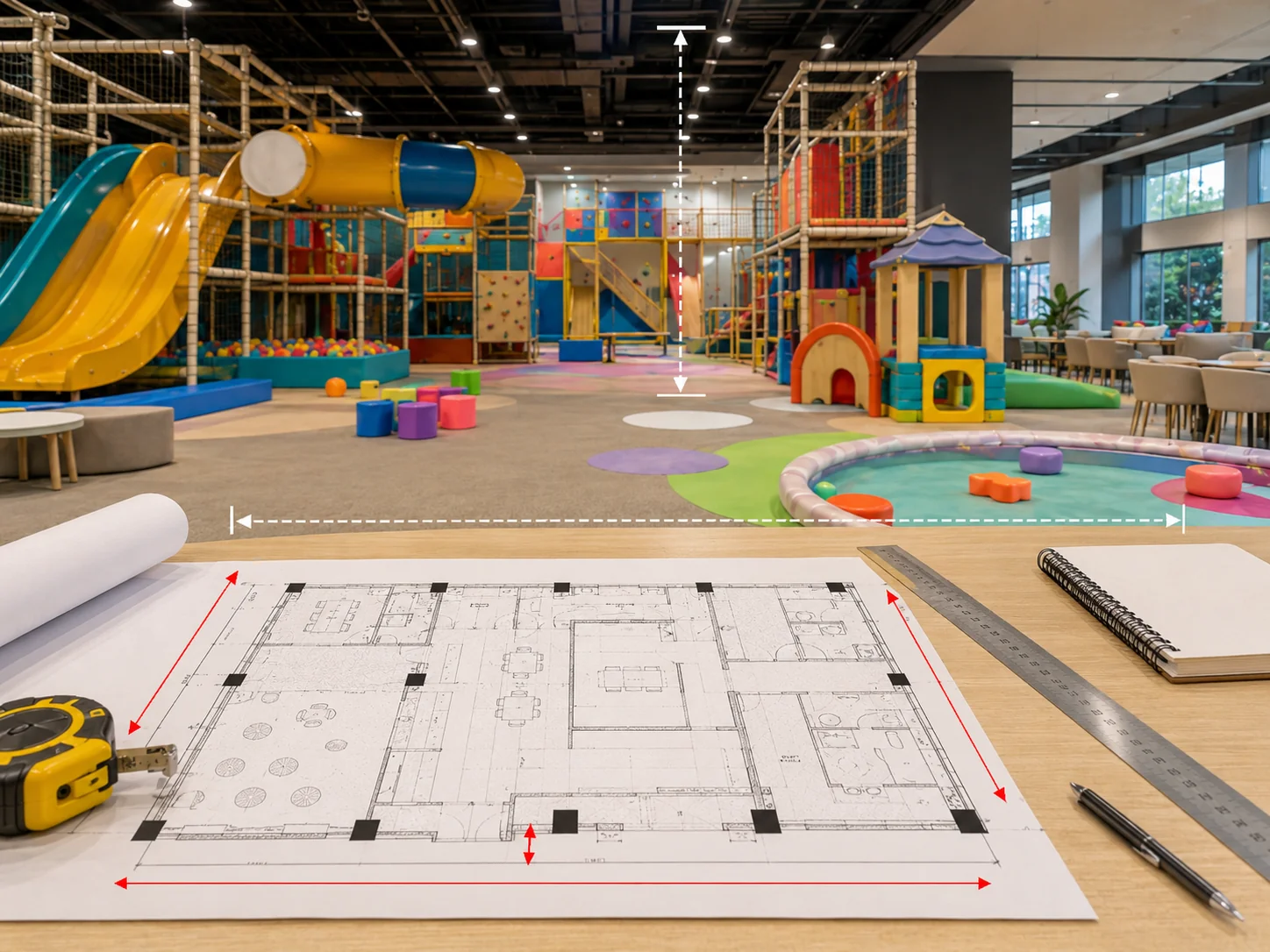
Raccogli una planimetria quotata, l'area utilizzabile, le altezze libere, le restrizioni, le dimensioni di accesso e le foto del sito.
Indica fasce d'età, modello di supervisione, controllo accessi, direzione prevista della frequentazione e tipo di locale.
Segna le attrezzature come richieste, opzionali o escluse e identifica il livello di budget richiesto.
Richiedi disegni, programma delle attrezzature, inclusioni, esclusioni, base di consegna, documenti e numero di revisione.
L'output di un RFQ non è necessariamente un prezzo contrattuale finale. Dovrebbe essere un pacchetto di quotazione tracciabile che può passare alla revisione del layout, alla chiarificazione e al controllo dell'ordine finale.
Inizia con il tipo di locale e il modello operativo
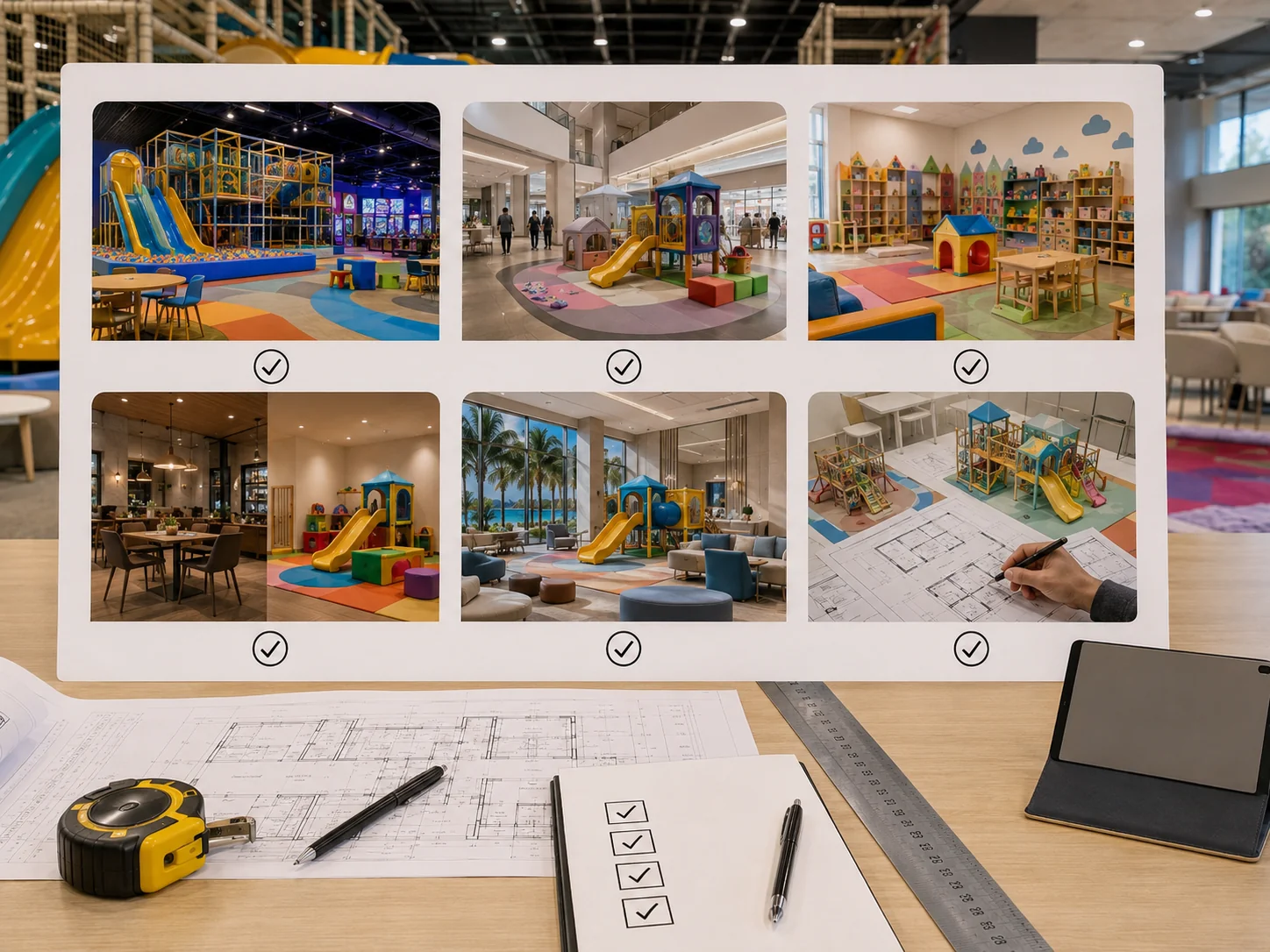
La richiesta di preventivo (RFQ) dovrebbe descrivere come opererà il locale, non solo dove si trova. Un FEC a pagamento, un'attrazione in un centro commerciale, una sala giochi per asili nido, un locale per famiglie in un hotel e un progetto per distributori possono richiedere diverse densità di gioco, supervisione, documentazione e pianificazione dell'installazione.
| Locale / acquirente | Priorità operativa | Informazioni da indicare nella RFQ | Rischio in caso di omissione |
|---|---|---|---|
| Centro di intrattenimento familiare | Direzione della capacità, visite ripetute, traffico per feste e attrazioni miste | Modello a pagamento, periodi di punta, sale per feste, aree per genitori, zone centrali e opzionali | Un layout visivamente accattivante potrebbe non supportare il check-in, la supervisione o il traffico nei periodi di punta. |
| Centro commerciale | Confine dell'inquilino, regole del locatore, visibilità e finestra di installazione | Confine in locazione, vetrina, corridoio del centro commerciale, accesso per carico/scarico, revisione del locatore e orari di lavoro consentiti | Il progetto potrebbe essere in conflitto con la linea di locazione, le vie di fuga o le restrizioni di allestimento del centro commerciale. |
| Asilo nido / Scuola dell'infanzia | Young users, direct supervision, cleaning and low-height play | Exact ages, staff positioning, classroom use, cleaning practice and local licensing inputs | The equipment may be unsuitable for the user group or block teacher sightlines. |
| Restaurant / play cafe | Compact footprint, parent visibility and food-service circulation | Seating relationship, play-entry control, cleaning access and customer flow | Play traffic may cross service routes or create unsupervised blind areas. |
| Hotel / resort | Guest experience, mixed users, branding and maintenance | Guest profile, hours, nearby amenities, theme direction and maintenance expectations | The equipment may not fit the property’s operation or visual standard. |
| Appaltatore / distributore | Scope clarity, documents, packing and local execution | Tender requirements, document list, delivery term, installer plan and handover responsibilities | Local installation and approval teams may receive incomplete information. |
On smaller screens, swipe horizontally to review all columns.
State whether the supplier is quoting equipment supply only, a landed-equipment estimate or a broader project package. These are different commercial requests.
Send a Dimensioned Floor Plan, Marked Usable Area and Clear Height
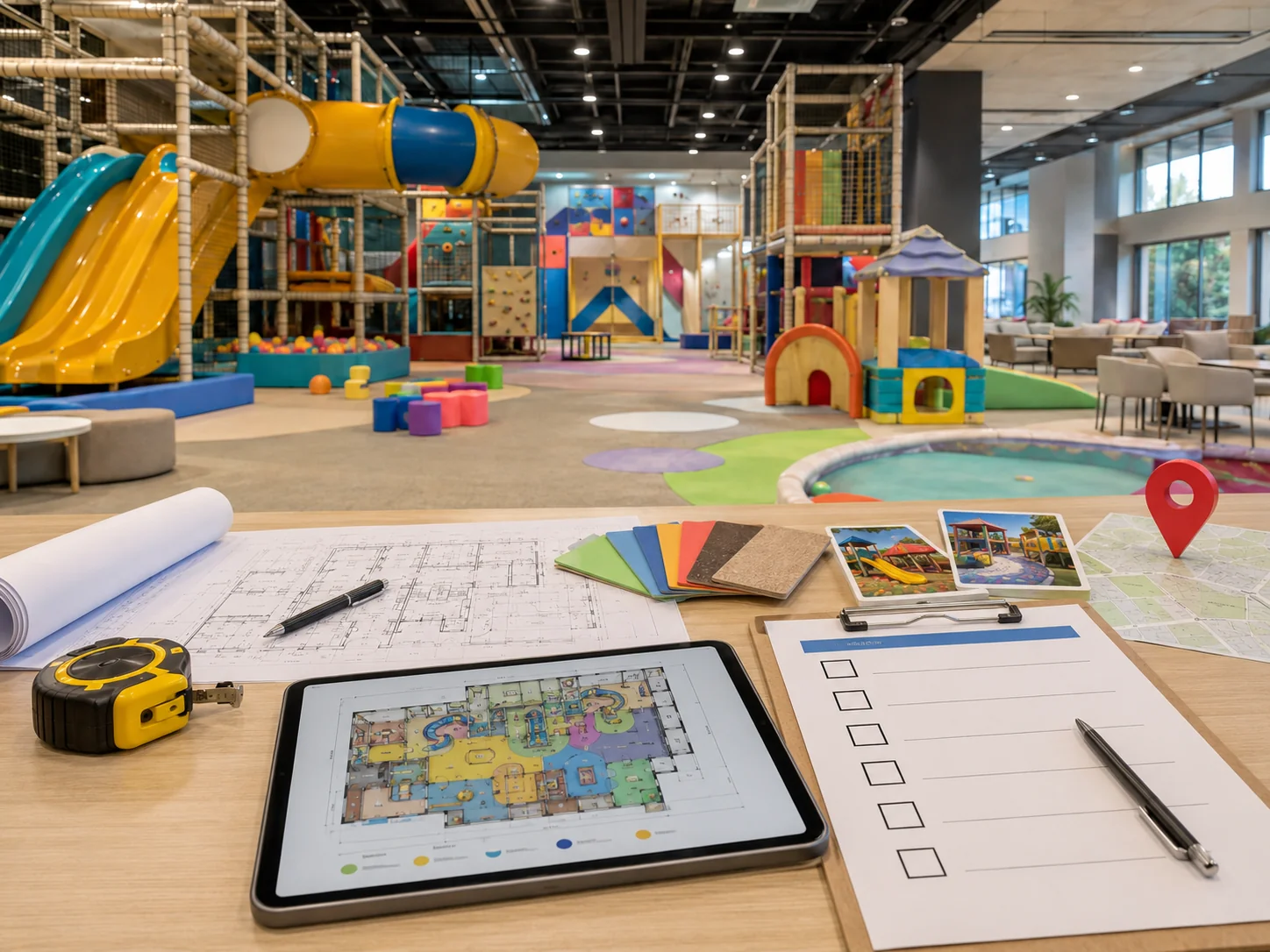
The supplier needs more than the gross leased area. Mark the space that may actually receive playground equipment after reception, shoe storage, parent seating, party rooms, toilets, staff space, circulation, egress and restricted areas are removed.
Site Inputs to Include
- CAD, dimensioned PDF, survey or measured sketch with units
- Gross room area and separately marked usable equipment area
- Wall lengths, irregular boundaries, columns and structural walls
- Finished floor level and clear height below beams, ducts, lights, sprinklers and other services
- Entrances, emergency exits, door swings and required egress paths
- Reception, shoe storage, seating, party rooms, toilets, cafe and staff areas
- Restricted zones, glazing, electrical panels, radiators and existing MEP services
- Floor condition and any landlord limits on anchoring or penetrations
- Loading route, door width, corridor turns, stairs and elevator dimensions
- Current site photos or a slow walk-through video
In a typical mall project, the architectural ceiling can appear high enough while a beam, duct or sprinkler branch creates a much lower local clearance. If the RFQ states only the nominal ceiling height, slides or upper play levels may need redesign after the first layout.
Buyers still organizing their site data can use Playtime’s Playtime before issuing the RFQ.
Confirm Age Groups, Capacity Direction and Supervision Model
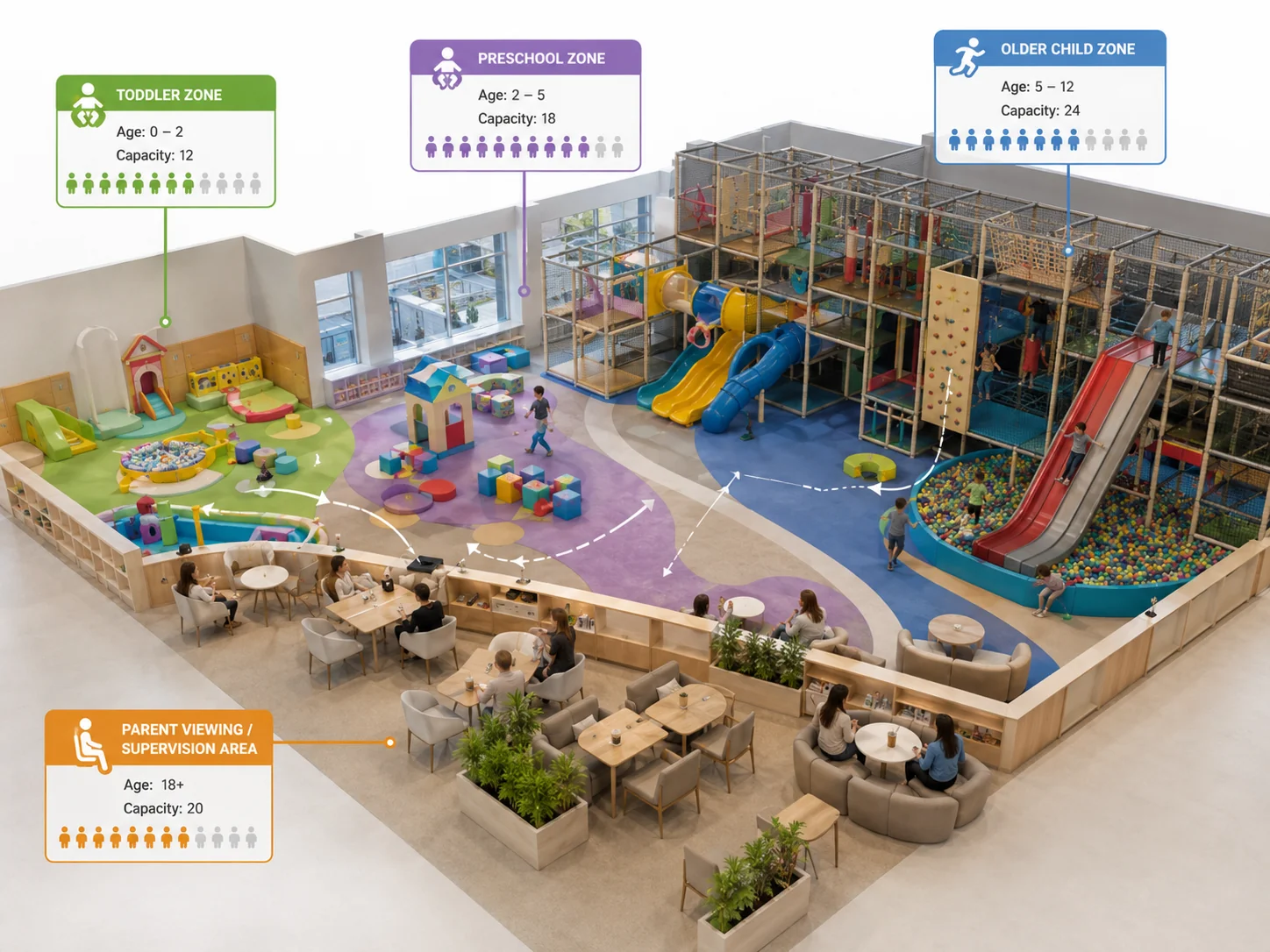
The RFQ should identify the real users by age or developmental group. Avoid a broad statement such as “for ages 2–12” without explaining whether toddlers need a separate zone, whether older children need higher-intensity activities and how staff or parents will supervise each area.
| Input | What to state | Why it affects the quotation | Boundary |
|---|---|---|---|
| Age groups | Exact operating groups and whether infants, toddlers, preschool or school-age users are separated | Changes equipment type, access, challenge, padding and zoning | Product suitability and local rules must be confirmed for each group. |
| Expected attendance | Normal attendance direction, peak attendance direction and group-visit pattern | Influences circulation, entry control, seating and equipment mix | Do not use one universal users-per-square-meter formula. |
| Supervisione | Staff positions, parent viewing, controlled entry and areas requiring direct oversight | Influences sightlines, barriers, gates and dead-end avoidance | Equipment design does not replace staffing and operating procedures. |
| Parent participation | Whether adults enter the play structure, accompany toddlers or remain outside | Affects access width, circulation and equipment assumptions | Confirm adult-use limits with the final equipment scope. |
| Operating rules | Session length, age/height rules, socks, food separation and capacity control | Can change gate locations, waiting space and zone separation | Final rules remain the operator’s responsibility. |
On smaller screens, swipe horizontally to review all columns.
Ask the supplier to state the capacity basis used in the proposal. A design target should be treated as a project assumption, not as a universal legal occupancy or fire limit.
Mark Play Zones as Required, Optional or Excluded
Do not send a long wish list without priorities. Mark each zone with a scope status so suppliers can prepare a base quotation and clearly priced alternatives.
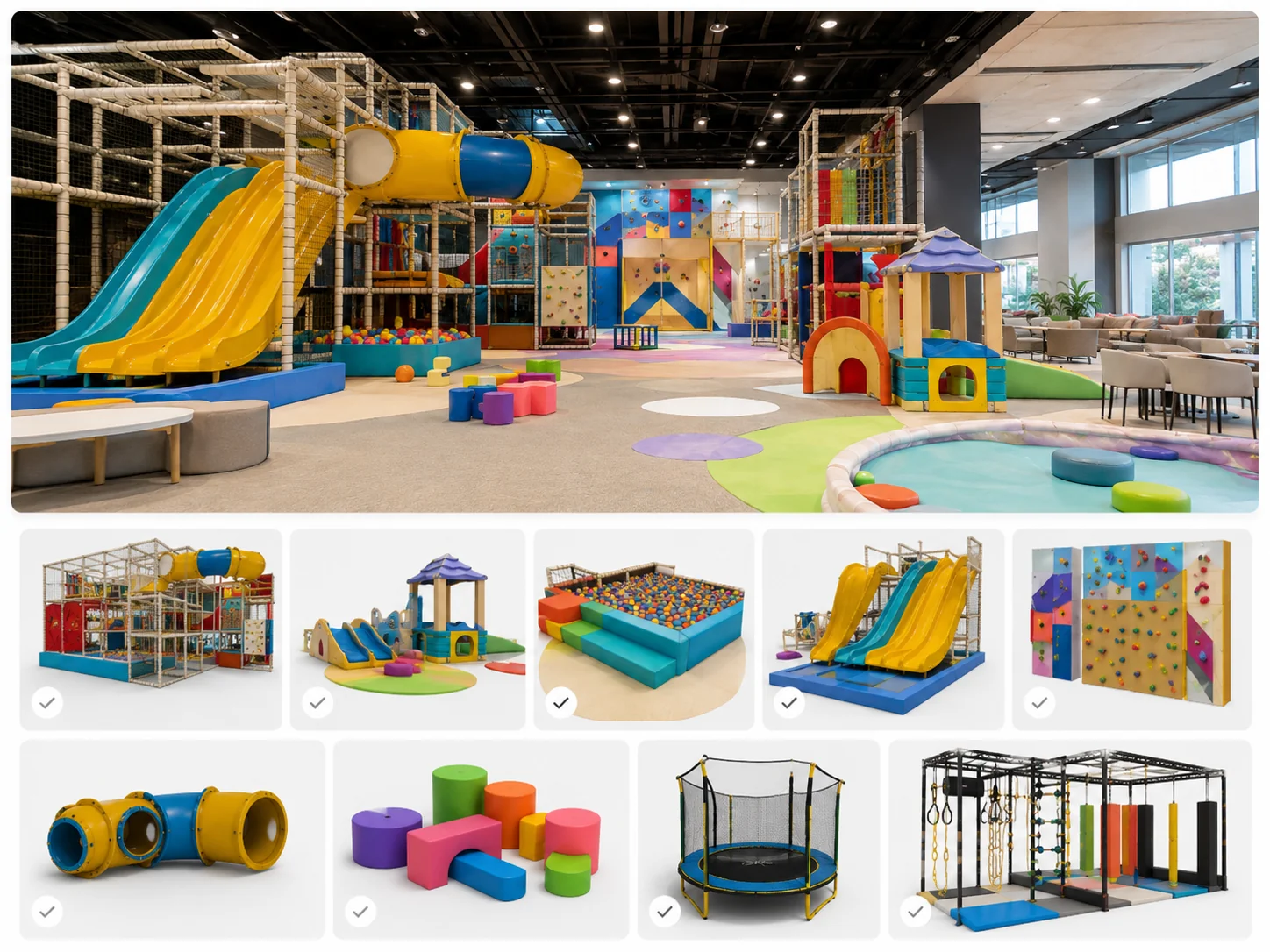
Required Opzionale Excluded Supplier recommendation requested
Core Indoor Play Scope
- Main contained-play structure
- Toddler or preschool zone
- Attrezzature soft play
- Ball area, slides, climbers, tunnels and activity panels
- Entry gates, barriers and internal circulation
- Flooring or protective surfacing if required in the supplier scope
Optional Mixed-Activity Scope
- Commercial trampoline court
- Ninja or obstacle route
- Interactive equipment or powered components
- Role-play, arcade or party-room interfaces
- Custom entrance, decorative facade or branded graphics
A layout conflict often appears when a toddler exit opens into a faster slide, climbing or trampoline circulation route. Identify the intended zone separation and supervision approach in the RFQ so the supplier can address it during the first layout rather than after design approval.
Share Theme, Color and Brand Direction Without Freezing It Too Early
Theme inputs help the supplier estimate custom design work, but the equipment layout and budget structure should be reviewed before the visual concept is frozen. Otherwise, the buyer may spend time approving graphics that later change when the equipment scope or usable area is reduced.
| Input | Cosa inviare | What the supplier should clarify |
|---|---|---|
| Brand palette | Color references, interior finishes or brand guide | Which colors and finishes can be applied to which components |
| Direzione tematica | A short mood board with preferred and avoided styles | Standard design, adapted design or fully custom theme scope |
| Logo or mascot | Approved vector artwork and confirmation of usage rights | Where branded graphics are included and how revisions are handled |
| Visual priority | Entrance impact, photo area, parent-facing elevation or immersive theme | Which surfaces are included in the quotation |
| Revision expectations | Decision-maker and review timetable | Number and type of design revisions included |
On smaller screens, swipe horizontally to review all columns.
Ask Material, Structure and Maintenance Questions That Can Be Answered by Evidence
Instead of asking whether the playground is “high quality,” ask the supplier to identify the material or component, the proposed specification, the available supporting document and whether it applies to the quoted item.
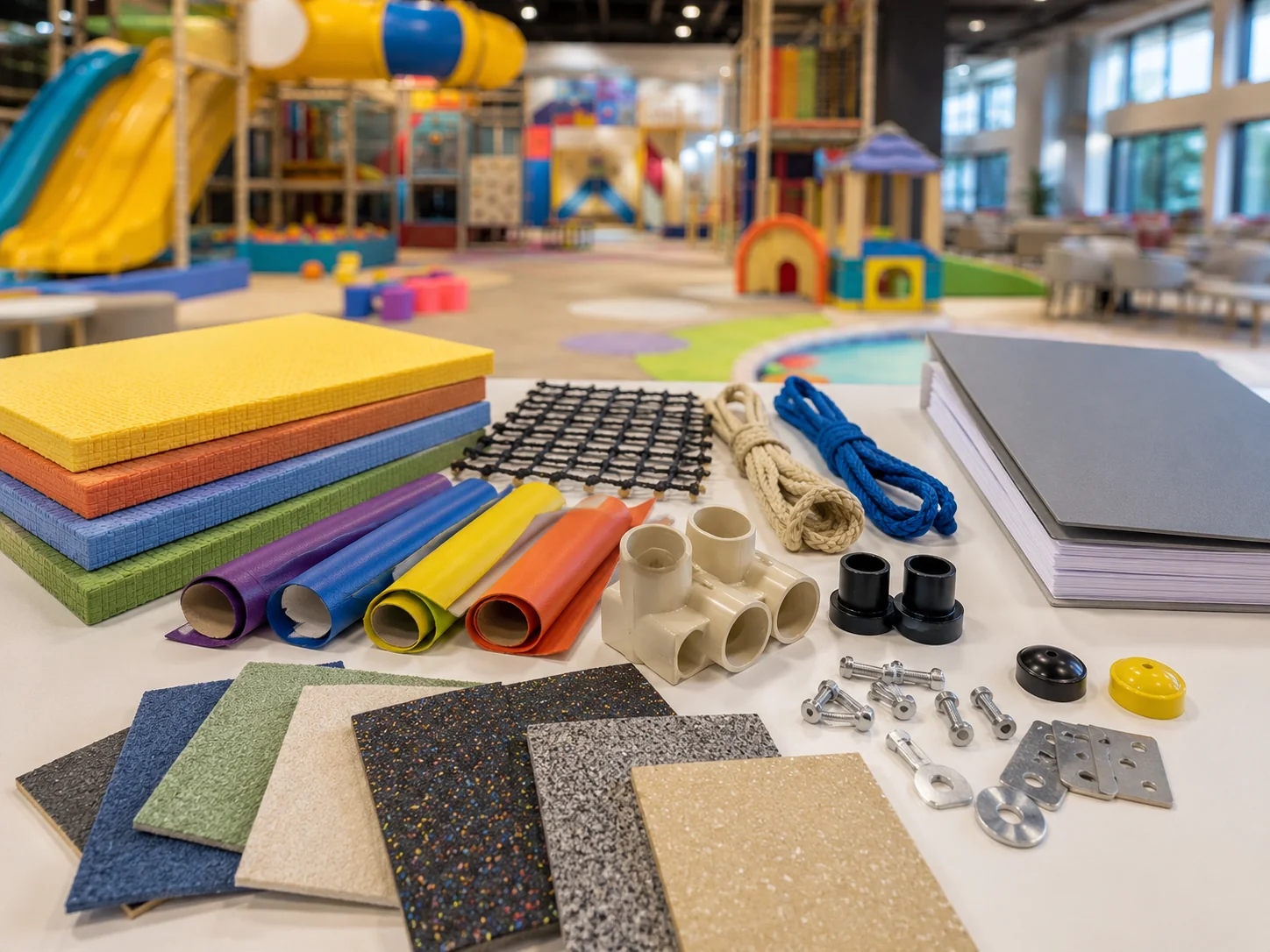
| Area | RFQ question | Evidence or response to request | Why it matters |
|---|---|---|---|
| Frame and platforms | What structural system is proposed for this layout? | Project specification, component description or drawing reference | The answer should relate to the actual structure, not a generic catalog. |
| Padding and covers | What padding and covering system applies to exposed contact areas? | Material description, finish schedule and cleaning guidance | Affects wear, hygiene, replacement and maintenance. |
| Nets, ropes and connectors | Which components are proposed and how are wear parts identified? | Component schedule, maintenance points and replacement process | Supports inspection and future spare-part orders. |
| Plastic and decorative parts | Which molded or decorative parts are included? | Equipment list, finish schedule and exclusions | Prevents theme illustrations from being mistaken for included components. |
| Fasteners and guards | How are accessible fasteners, edges and connections addressed? | Project-specific construction detail or supplier explanation | Helps the buyer and installer understand the proposed assembly. |
| Pavimentazione o rivestimento superficiale | Is flooring included, optional or buyer-supplied? | Area, system, substrate assumptions, installation scope and applicable documents | Flooring is frequently omitted or priced on a different area basis. |
| Cleaning and maintenance | What instructions will be supplied? | Cleaning limitations, inspection points and replacement guidance | Operational suitability cannot be judged from material names alone. |
On smaller screens, swipe horizontally to review all columns.
Map Equipment Zones to Relevant Standards and Local Requirements
An RFQ should not ask whether the entire project is “ASTM certified” or “compliant worldwide.” It should identify the equipment categories in the proposed layout and ask which standards, documents and local reviews may apply to each zone.
| Equipment or review area | Reference that may be relevant | What the buyer should ask | Important limitation |
|---|---|---|---|
| Soft contained indoor play | ASTM F1918-21 | Which quoted structures and documents relate to this scope? | The public scope covers its defined soft contained play equipment and stated 2–12-year user range; it is not a universal project approval. |
| Commercial trampoline court | ASTM F2970-25 | If trampoline zones are included, what design, installation, operation and inspection responsibilities apply? | A trampoline court is not covered simply by treating it as ordinary soft play. |
| Public-use play equipment for ages 2–12 | ASTM F1487-25 | Does any non-contained public-use equipment in the project fall within this scope? | Applicability depends on the equipment type and local adoption. |
| Public-use equipment for 6–23 months | ASTM F2373-24 | What exact products are proposed for very young users and what standard scope applies? | Do not assume a standard for older children or soft contained play automatically covers infant equipment. |
| Accessibility in U.S.-covered projects | U.S. Access Board play-area guide | What accessible routes, entries and components must the local design team review? | Accessibility review is location- and facility-specific and is not replaced by a supplier layout. |
On smaller screens, swipe horizontally to review all columns.
Ask the supplier to state the document title, issuing organization, report or certificate number, date, tested sample, referenced standard and the quoted item to which it applies. General statements without this mapping are difficult to verify.
Checklist Documenti Richiesti per una Richiesta di Offerta (RFQ) per Parco Giochi Indoor
The RFQ should state which files are needed at quotation, approval, production, shipment, installation and handover stages. Not every document will be available at the first inquiry, but the supplier should state what will be provided and when.
| Document or file | Scopo | Requested stage | Control point |
|---|---|---|---|
| Preliminary dimensioned layout | Confirms site fit, zones and major restrictions | Quotation / design review | Drawing number, revision, units and site basis |
| Elenco attrezzature | Identifies zones, components, quantities and options | Quotation and final approval | Must match the quoted layout revision |
| Inclusion / exclusion matrix | Standardizes commercial comparison | Preventivo | Mark included, optional, provisional, excluded or buyer-supplied |
| Material and finish schedule | Links specifications to quoted equipment | Clarification / approval | Avoid generic documents not tied to the order |
| Document register | Lists reports, manuals and files to be delivered | Quotation / contract | State document title, stage and responsible party |
| Packing plan and packing list | Supports freight, receiving and installation preparation | Before shipment | Package ID, dimensions, weight, zone or drawing reference |
| Installation drawings and manuals | Supports the agreed installer | Before installation | Version, language, tools and support limits |
| Maintenance and spare-parts information | Supports operation after handover | Handover | Part identification, inspection guidance and claims process |
On smaller screens, swipe horizontally to review all columns.
Concept layouts, certificates and sample manuals from other projects may be useful references, but the final contract should identify which documents apply to the buyer’s actual order.
Useful Authoritative References for Buyer Review
These sources help buyers understand the context of public playground guidance, soft contained play, trampoline courts and accessibility. They do not certify Playtime or automatically approve a project.
The current CPSC page provides the July 2025 handbook for general public-playground safety guidance. Use it as educational context, not as a soft-play certification.
Reference for soft contained play equipment within its published scope and user range.
Reference for commercial or institutional trampoline courts, including responsibilities beyond manufacture.
Reference for accessible routes and play components where U.S. accessibility requirements apply.
Clarify Quote Scope and Commercial Assumptions
A useful RFQ tells the supplier how the quotation should be structured. Require every line to be identified as included, optional, provisional, excluded or buyer-supplied.
| Quotation area | Ask the supplier to state | Common gap |
|---|---|---|
| Progettazione | Layout deliverables, theme scope, revision allowance and final production documents | A free concept image is mistaken for a complete design package. |
| Attrezzature | Itemized zones, quantities, accessories, gates, barriers and spare items | The quote uses one lump sum with no equipment schedule. |
| Materials and documents | Specifications and documents tied to the quoted scope | Generic claims or unrelated reports are supplied. |
| Pavimentazione | Area basis, system, substrate assumptions, installation and exclusions | Flooring is omitted or calculated on a different area. |
| Imballaggio | Packing method, estimated volume, package dimensions, labeling and included cost | Export packing is assumed but not written. |
| Freight | Incoterm, named place, currency, route assumption and excluded destination charges | The phrase “shipping included” has no delivery basis. |
| Installazione | Drawings, remote support, supervision, labor, tools, travel and site-readiness assumptions | Installation support is interpreted as full installation. |
| Commercial terms | Quote validity, payment terms, lead-time basis, warranty and change-order process | Conditions are discussed verbally but not included in the quotation. |
On smaller screens, swipe horizontally to review all columns.
For broader budget context, use the separate guide to indoor playground equipment cost. The RFQ should state whether the buyer wants equipment price, landed-equipment planning or a broader installed-scope discussion.
What the Supplier Should Return After Receiving the RFQ
A strong RFQ should lead to a structured response, not only a total price. Request the same response package from every shortlisted supplier.
| Supplier return | Minimum content | Buyer review question |
|---|---|---|
| RFQ acknowledgment | List of files received, missing inputs and assumptions | Did the supplier quote from the correct site information? |
| Preliminary layout | Dimensions, zones, major restrictions and revision identifier | Does it fit the marked usable area and clear heights? |
| Elenco attrezzature | Included zones, items, quantities, options and exclusions | Can every price be traced to the layout? |
| Preventivo | Currency, price basis, status of each item, validity and payment terms | Can it be normalized against other quotations? |
| Document register | Files available now and files promised later | Do the documents apply to the quoted equipment? |
| Packing and freight basis | Estimated packing data, Incoterm, named place and destination exclusions | What remains for the buyer or forwarder? |
| Installation statement | Supplier support, local labor, tools, travel, site requirements and acceptance boundary | Who is responsible for each installation task? |
| Clarification log | Open points, alternatives and decisions required | Are unresolved assumptions visible before approval? |
On smaller screens, swipe horizontally to review all columns.
Send Destination, Packing Access and Installation Preference
International logistics and installation assumptions should be included before the supplier finalizes the quote. Indoor playground shipments can contain long structural parts, soft components, panels, nets, hardware and zone-specific packages.
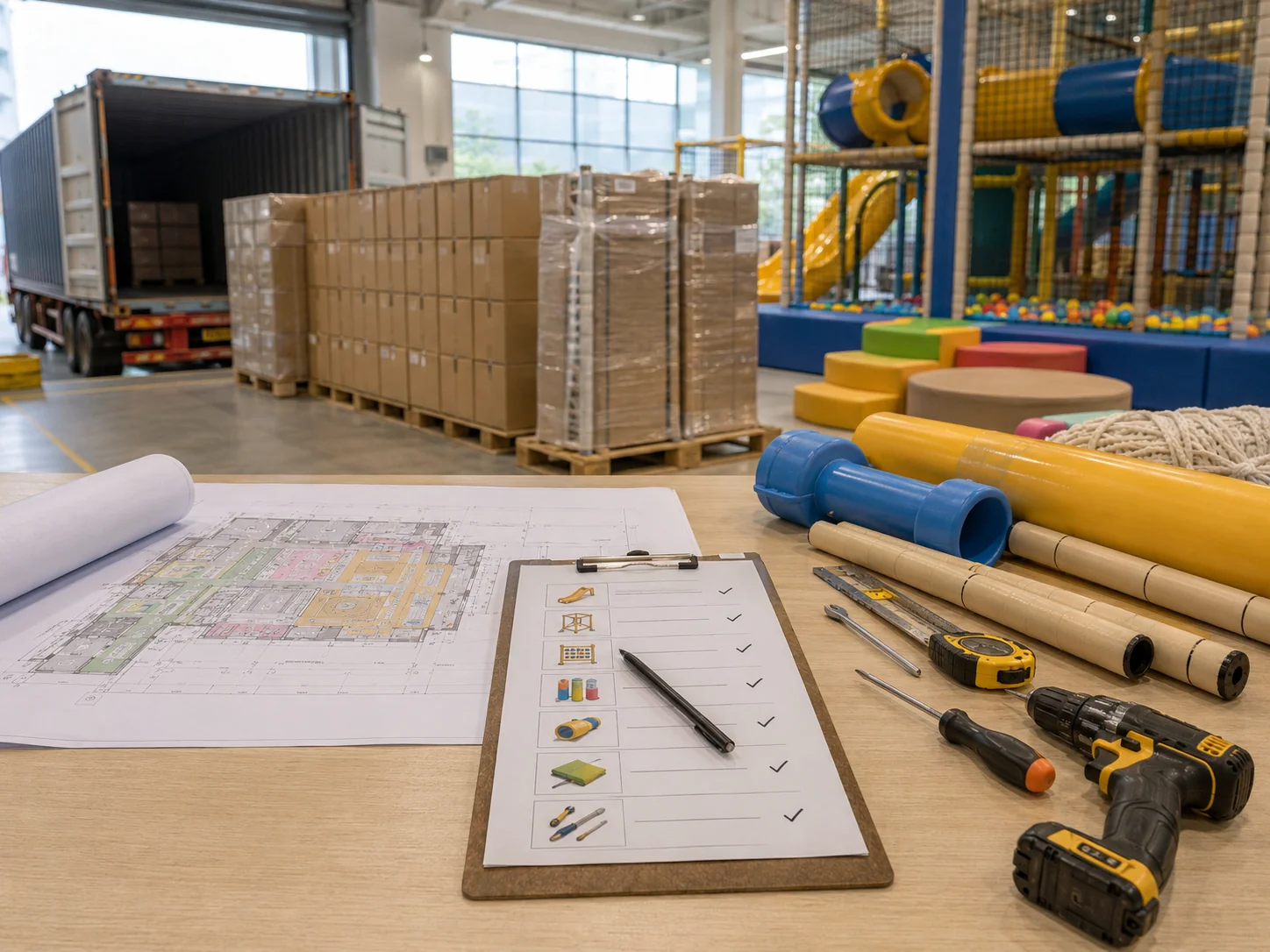
Shipping and Installation Information to Provide
- Destination country, city, preferred port or exact delivery address if known
- Requested Incoterm or request for separate EXW, FOB, CIF or other applicable options
- Import agent or freight-forwarder status
- Delivery access, unloading area, storage conditions and permitted working hours
- Door, corridor, stair and elevator dimensions, including difficult turns
- Whether local labor, tools, scaffolding and lifting equipment are available
- Whether drawings, manuals, remote guidance or on-site supervision are requested
- Who covers visas, travel, accommodation and local transport if personnel travel is considered
- Site-readiness status for floor, walls, lighting, HVAC, fire work and utilities
- Local inspection and final acceptance responsibility
During installation planning, a common problem occurs when the equipment fits the room but the longest package cannot pass through the loading door, elevator or final corridor turn. Share access dimensions before packing is finalized.
Destination-port pricing is not the same as delivery to the venue. Ask the supplier to identify customs, duties, port charges, inland delivery, unloading and storage as included or excluded.
Clarify Buyer, Supplier and Local-Contractor Responsibilities
The RFQ should ask each party to identify its responsibilities. The final matrix will vary by project, but ambiguity should be resolved before order confirmation.
| Work area | Supplier discussion | Buyer / owner discussion | Local professional or contractor discussion |
|---|---|---|---|
| Informazioni sul sito | Reviews the information supplied and identifies missing inputs | Provides accurate dimensions, restrictions and access information | Verifies survey, structure, services and site conditions where required |
| Equipment and layout | Develops proposal based on confirmed inputs | Approves operating concept, zones and revisions | Reviews local interfaces and approvals where applicable |
| Standards and documents | States available documents and the quoted items they cover | Defines tender and local document requirements | Confirms local building, fire, accessibility, licensing and inspection needs |
| Packing and freight | Provides agreed packing data and export scope | Coordinates import, inland delivery, unloading and storage unless included | Supports local handling or logistics where contracted |
| Installazione | Provides agreed drawings, guidance, supervision or labor | Provides site readiness and agreed owner resources | Executes local work, tools, anchoring and inspections as contracted |
| Gestione e manutenzione | Provides agreed manuals, spare-part information and support process | Establishes staff training, daily checks, cleaning and incident procedures | Supports specialist inspection or maintenance where required |
On smaller screens, swipe horizontally to review all columns.
Share the Project Stage and Opening Timeline
The RFQ should state the current project stage so the supplier can distinguish a feasibility inquiry from a procurement-ready request.
| Project stage | What to state | Appropriate supplier response |
|---|---|---|
| Concept / feasibility | Approximate area, venue model, location and budget direction | High-level equipment direction and missing-input list |
| Site selected | Dimensioned plan, clear heights, restrictions and access | Preliminary layout and more structured quote basis |
| Design coordination | Landlord or consultant comments, MEP and egress constraints | Revision-controlled layout and clarification log |
| Procurement | Approved RFQ, required documents, commercial terms and decision date | Comparable formal quotation and equipment schedule |
| Pre-installation | Site-readiness date, logistics, installer and local approval status | Packing, installation and handover coordination |
On smaller screens, swipe horizontally to review all columns.
Include the desired opening date, but do not treat it as guaranteed until design approval, production, shipping, customs, local construction and installation assumptions are confirmed in the final agreement.
Complete Indoor Playground Equipment RFQ Checklist
A complete RFQ does not need to be complicated. It needs to be specific, consistent and honest about unknown information.
Project and Commercial Information
- Buyer, project and venue type
- Paese e città di destinazione
- Current project stage
- Requested quotation layer
- Currency and delivery-basis preference
- Indicazioni sul budget, se disponibili
- Decision date and opening target
Site Information
- Dimensioned CAD, PDF, survey or measured sketch
- Gross area and marked usable equipment area
- Clear height below all overhead restrictions
- Columns, exits, services and restricted zones
- Reception, seating, party and support areas
- Loading path and access dimensions
- Site photos or video
User and Equipment Information
- Exact age groups and separation needs
- Normal and peak attendance direction
- Supervision and entry-control model
- Required, optional and excluded zones
- Theme and brand direction
- Cleaning and maintenance priorities
- Any powered or mixed-activity equipment
Documents and Responsibility Needs
- Layout and equipment schedule requirements
- Material and finish information
- Standard or test-document requests
- Flooring scope
- Packing, freight and Incoterm requirements
- Installation-support preference
- Maintenance, spare-parts and handover needs
- Known local review requirements
After preparing these inputs, buyers can submit the RFQ for project review.
Common RFQ Mistakes Buyers Should Avoid
| Mistake | Why it creates risk | Better approach |
|---|---|---|
| Requesting only a price per square meter | Different equipment, design and service scopes can use the same area | Send the site and request an itemized, scope-based quotation. |
| Using gross venue area as equipment area | Reception, seating, egress and restrictions reduce usable space | Mark the actual equipment boundary on the plan. |
| Providing nominal ceiling height only | Beams, ducts, lights and sprinklers may control the design | Send the lowest relevant clear height by zone. |
| Giving one broad age range | Toddler and older-child equipment may require different zoning and standards | State exact groups, separation and supervision. |
| Listing every attraction as mandatory | The design may exceed area or budget before priorities are understood | Mark zones required, optional or excluded. |
| Requesting universal compliance | Different equipment categories and jurisdictions have different requirements | Map requirements by zone and obtain local review. |
| Assuming freight or installation is included | The quote may stop at factory, port or documentation support | Require Incoterm, named place and an installation responsibility statement. |
| Comparing totals without revision control | Quotes may be based on different layouts and equipment quantities | Match quotation, layout and equipment-schedule revisions. |
On smaller screens, swipe horizontally to review all columns.
How Playtime Supports Indoor Playground RFQ Review
Playtime Playground can review the project inputs supplied by the buyer, discuss suitable equipment categories, develop a project-based layout direction and prepare a quotation around the confirmed scope. Available drawings, specifications, packing information, shipping basis and installation support should be confirmed project by project in the quotation and final agreement.
Buyers can review Playtime’s servizi per progetti di parchi gioco e playground project portfolio as supporting background. These pages do not replace verification of the files, scope and responsibilities for the buyer’s own project.
Playtime’s role is to support equipment and project-scope discussion. Local building, fire, accessibility, insurance, landlord, licensing and inspection responsibilities remain with the relevant project parties.
Send a Scope-Based Indoor Playground RFQ
Send the dimensioned floor plan, marked usable equipment area, clear heights, venue type, user groups, required and optional play zones, destination, installation preference and opening target. Include known document or local-review requirements so the quotation can state its assumptions and exclusions clearly.
Send Floor Plan and RFQ DetailsFAQ
Cosa dovrebbe includere una richiesta di preventivo (RFQ) per attrezzature per parchi giochi indoor?
Includere la sede e il modello operativo, il piano quotato, l'area attrezzature utilizzabile indicata, le altezze libere, le zone ristrette, i gruppi di età, la direzione dell'affluenza, il modello di supervisione, le zone gioco richieste e opzionali, la direzione del tema, le esigenze documentali, la destinazione, la base di consegna, la preferenza e la pianificazione dell'installazione.
È necessaria una planimetria prima di richiedere un preventivo?
Si raccomanda vivamente un piano quotato. Un fornitore può discutere la direzione generale senza di esso, ma un preventivo di progetto comparabile richiede normalmente la forma del sito, le dimensioni, le colonne, le uscite, le aree di supporto e il confine dell'attrezzatura utilizzabile.
Devo inviare l'area totale del locale o l'area utilizzabile per le attrezzature?
Inviare entrambi. Segnare l'area effettivamente disponibile per le attrezzature dopo aver rimosso posti a sedere, sale feste, aree di circolazione, vie di fuga e zone ristrette. I fornitori non devono presumere che l'intera area in affitto sia disponibile per le attrezzature da gioco.
Perché l'altezza libera dovrebbe includere travi e impianti dell'edificio?
L'altezza minima della trave, del condotto, della luce, dell'irrigatore o di altre restrizioni a soffitto può determinare l'altezza della struttura e dello scivolo. Un'altezza architettonica nominale del soffitto può portare a un primo layout inutilizzabile.
Come deve essere indicata la capacità nella richiesta di preventivo?
Fornire indicazioni sulla frequentazione normale e di picco, sulla distribuzione per età, sulla supervisione e sulle ipotesi di controllo degli accessi. Chiedere al fornitore di spiegare la base di capacità utilizzata. Non considerare una formula di utenti per metro quadrato come un limite legale universale.
Di quali standard dovrei chiedere?
Richiedi per zona attrezzatura. Il gioco soft contenuto, le attrezzature per uso pubblico, le attrezzature per bambini molto piccoli e i campi trampolino commerciali possono rientrare in standard diversi. Conferma l'ambito applicabile e i requisiti locali con il team di progetto pertinente.
Come devo confrontare i preventivi dei fornitori?
Richiedere lo stesso formato di risposta RFQ. Corrispondere alle revisioni del layout e della distinta attrezzature, quindi contrassegnare design, attrezzature, materiali, documenti, pavimentazione, imballaggio, trasporto, installazione, garanzia e pezzi di ricambio come inclusi, opzionali, provvisori, esclusi o forniti dall'acquirente.
Cosa dovrebbe restituire il fornitore dopo aver ricevuto la richiesta di offerta (RFQ)?
Ricezione richiesta RFQ, layout preliminare quotato, elenco attrezzature dettagliato, preventivo con base commerciale, registro documenti, ipotesi di imballaggio e trasporto, dichiarazione di installazione e registro chiarimenti.