






Indoor Playground Cost Guide
How Much Does Indoor Playground Equipment Cost?
Indoor playground equipment is quoted project by project, not from one universal retail price list. The figure buyers need to compare is more than the equipment price: it may also include custom design, export packaging, freight, destination charges, local delivery and installation support. Usable play area, ceiling height, equipment mix and destination can change the budget as much as the nominal floor area.
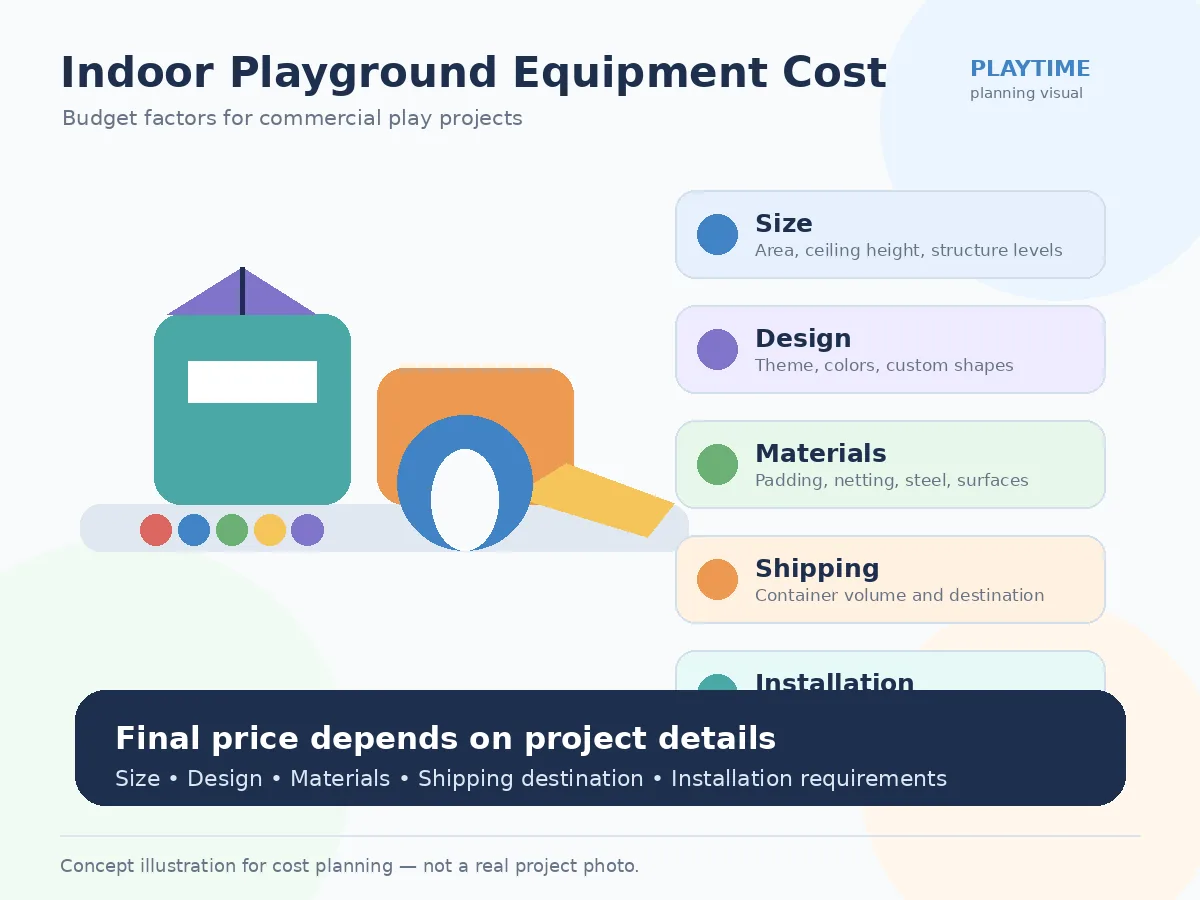
Why Indoor Playground Equipment Cost Is Not a Fixed Price
Commercial indoor playground equipment is normally configured around a real venue rather than sold as one standard package. The layout must respond to usable floor area, clear ceiling height, columns, entrances, required circulation, target age groups, supervision needs and the selected attractions. Those inputs determine how much structure, padding, netting, platform area, slide length, decoration, packaging and installation work the project requires.
The first cost question should therefore be: Which budget are we discussing? Buyers often compare three different numbers as though they were the same.
| Cost Level | Usually Includes | Usually Excludes or Still Needs Confirmation |
|---|---|---|
| Equipment quotation | Confirmed play equipment, structure, selected finishes and the supplier’s stated design scope | International freight, destination charges, local delivery, installation labor, site work and approvals unless specifically listed |
| Landed equipment budget | Equipment plus export packaging, freight and the delivery elements defined by the agreed shipping term | Local site preparation, installation labor, permits, insurance and pre-opening operating costs |
| Full project or opening budget | Equipment, logistics, installation, local fit-out, approvals and owner-side opening costs | Ongoing rent, payroll, utilities, marketing and other operating expenses after opening |
Consider two hypothetical venues with the same nominal floor area. One has a high clear ceiling, few columns and a direct loading route; the other has low beams, several structural columns, a narrow service elevator and larger areas reserved for circulation. The second venue may use less playable structure yet require more layout adjustment, smaller packaging modules and additional local handling. Floor area alone cannot explain that difference.
This is why quotations should be compared by confirmed scope, not only by a single “price per square meter.” A useful quote identifies the equipment list, design basis, material options, packaging, delivery basis, installation responsibility and exclusions.
What Affects Indoor Playground Equipment Cost?
1. Usable Play Area, Floor Shape and Ceiling Height
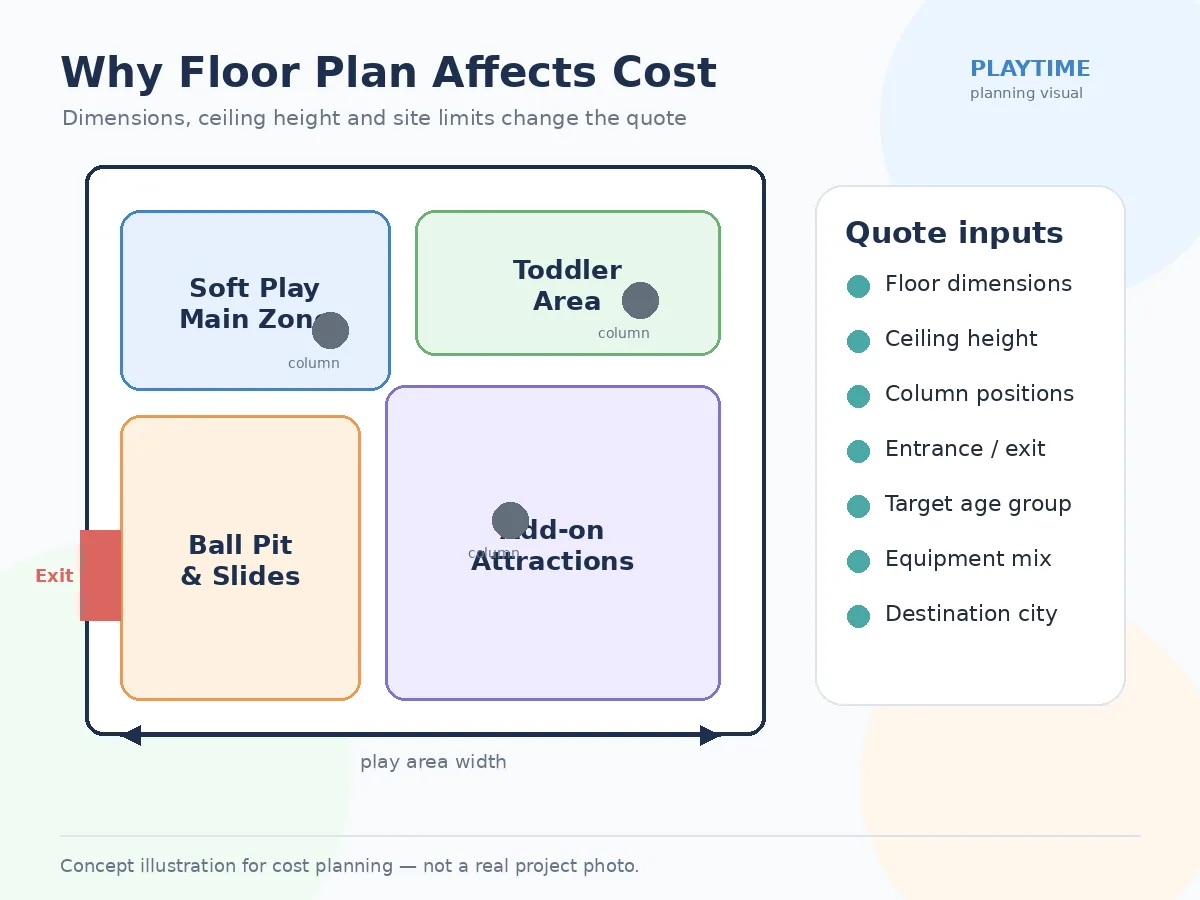
Cost planning should start with usable play area, not the gross lease area. Reception, shoe storage, parent seating, party rooms, toilets, food service, required circulation, structural columns and restricted zones may reduce the space available for equipment. A 300 m² venue does not automatically provide 300 m² of playable equipment area.
Clear height matters as much as floor area. Higher venues may support additional levels, taller slides and more vertical play value, while low beams, ducts or sprinkler zones may force a lower structure and wider footprint. Irregular walls and dense columns can also increase design effort and reduce the efficiency of the equipment layout.
A common planning mistake occurs when a buyer sends only the total area and a few photos. The initial concept may look workable, but the design has to be revised after beam heights, emergency exits or column dimensions are added. Sending a dimensioned floor plan at the beginning produces a more reliable budget.
Prepare the total venue area, usable play area, exact floor dimensions, clear ceiling and beam heights, column positions, entrance and exit locations, restricted areas, site photos, videos and any available CAD drawing.
2. Equipment Mix and Activity Intensity
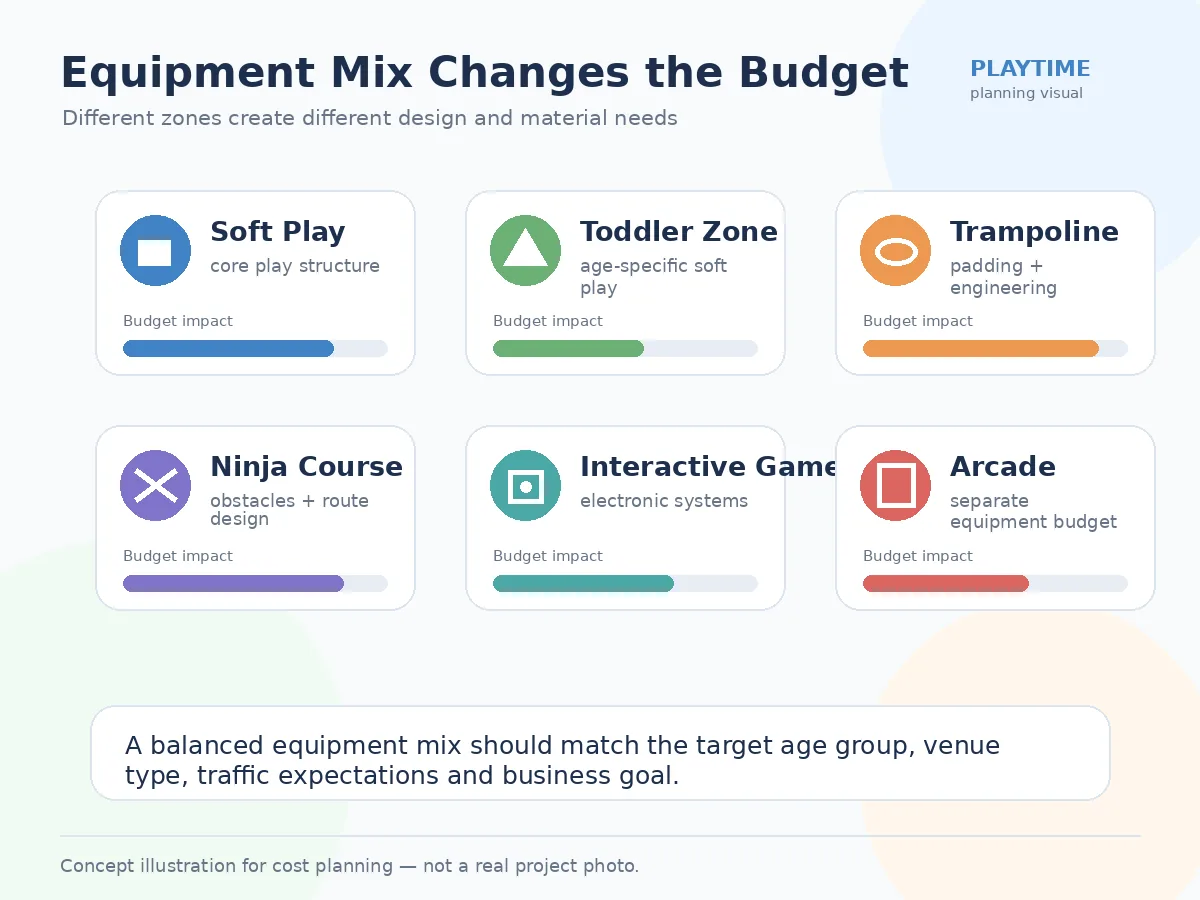
The equipment mix is one of the largest cost variables. A compact soft play area uses a different structure and supervision model from a multi-zone family entertainment center that combines slides, ball pits, trampoline courts, ninja course elements, interactive games and arcade equipment.
Each attraction adds more than a product line. It may change clear-height requirements, circulation, padding, electrical demand, staff supervision, inspection routines and installation sequencing. For that reason, buyers should define the core attraction, secondary attractions and optional future-phase items before comparing quotations.
For a daycare or preschool, the equipment mix may prioritize low-height soft play, clear sightlines and simple cleaning access. For an FEC, the budget is better divided by zone because the soft play structure, trampoline area, challenge course and arcade equipment have different cost and operating profiles.
3. Layout, Theme and Custom Design Complexity
A standard color treatment and practical layout are generally simpler to produce than a fully themed commercial environment. Custom entrance features, venue-specific decorative panels, branded colors, sculpted soft play forms, large visual landmarks and repeated design revisions can increase design and manufacturing work.
Visual spending should support the business goal. A mall-facing project may justify a stronger entrance and photo point because corridor visibility matters. A church, school or community venue may obtain better value from simple decoration, durable finishes and clear supervision. Buyers can often protect play value by simplifying decorative elements before removing core activities.
4. Materials, Documentation and Project Requirements
Indoor playground equipment may include steel frames, platforms, foam padding, surface covers, safety netting, slides, plastic components, hardware and electrical interactive elements. Material selection affects appearance, cleaning, maintenance and service life, but generic claims such as “high quality” do not make quotations comparable.
Ask suppliers to identify the material options and the documents that can be provided for the actual project. Confirm padding and cover materials, netting and barriers, frame and platform construction, slide material, cleaning requirements, fire-related documentation where required, spare-part scope and any destination-specific test or inspection needs. Requirements must be confirmed project by project rather than assumed from a general catalog statement.
5. Export Packaging, Freight and Final Delivery
International logistics can materially change the landed cost. Freight depends on packed volume, destination, market conditions and the agreed delivery basis. Large slides, themed panels and irregular padded components may consume more container space than their visible floor area suggests.
A typical receiving problem occurs when the equipment is packaged correctly for export but the venue’s loading door, elevator or internal route is smaller than the largest package. Repacking, special lifting or local handling can then add cost and delay. Site-access dimensions should be reviewed before the packing plan is finalized.
Confirm whether the quotation includes export packaging, loading preparation, inland transport to the port, ocean freight, destination charges, customs clearance, duties, local delivery, unloading and movement from the building entrance to the installation area. The shipping term and delivery address should be written into the quote instead of left as an assumption.
6. Installation Scope and Site Readiness
Installation cost depends on equipment complexity, clear height, local labor, working hours, access, site readiness and the support model. Some projects can be installed by a qualified local team using drawings, labels, manuals, videos and remote guidance. Complex multi-level, trampoline or challenge-course projects may require a different support plan.
The quotation should state who supplies installation labor, tools, lifting equipment, travel, accommodation, local supervision and final inspection support. It should also state what the buyer must complete before installation, including flooring, walls, electrical work, HVAC coordination, lighting, fire-related work, unloading and secure storage.
One frequent cost increase happens when equipment arrives before the site is ready. Installers may have to stop work, remobilize or protect components while other contractors finish the venue. A written site-readiness checklist reduces that risk.
What an Early-Stage Cost Estimate Can—and Cannot—Tell You
A universal price list can provide product-level references, but it cannot produce a reliable commercial project budget before the site and scope are known. Buyers should treat cost information in three stages.
Uses venue type, approximate usable area, target age group and preferred attractions. It is suitable for early feasibility discussions, not final purchasing.
Uses a dimensioned floor plan, clear height, zoning and an initial equipment list. It is suitable for comparing design directions and budget priorities.
Uses the approved equipment scope, material options, delivery basis, installation responsibility and documented exclusions.
The same floor area could be configured as a simple toddler zone, a themed multi-level soft play system, a trampoline-and-ninja venue or a mixed FEC. Each option changes the structure, materials, packed volume, electrical scope, supervision needs and installation plan. A number issued before those decisions should be labeled as a preliminary estimate.
Buyers comparing space-based options can use the indoor playground cost-by-size guide as an early planning reference, then request a layout-based quotation for the actual venue.
Indoor Playground Budget Formula: Equipment Price vs Total Project Cost
A practical planning formula is:
Not every supplier quotation covers every term in this formula. The buyer’s job is to identify which costs sit inside the quote and which remain with the owner, landlord, local contractor or logistics provider.
| Budget Layer | What to Confirm | Buyer Decision Value |
|---|---|---|
| Equipment scope | Main play structure, slides, toddler zone, trampoline, ninja course, interactive games and listed accessories | Confirms whether different quotations deliver the same activity mix and quantity |
| Design scope | Floor-plan review, 2D layout, 3D concept, theme direction, revision rounds and production drawings | Shows whether the quote covers only equipment or also project design work |
| Material and document scope | Specified materials, finish options, project documents, labeling, manuals and spare parts | Allows a like-for-like review instead of relying on generic quality claims |
| Export and freight scope | Packaging, loading, shipping term, freight assumption, destination charges, local delivery and unloading | Separates factory price from landed equipment cost |
| Installation scope | Manuals, drawings, remote guidance, local labor, tools, lifting, travel and project-based on-site support | Clarifies who carries labor, coordination and site-readiness responsibility |
| Owner-side project costs | Flooring, electrical work, fire and HVAC modifications, permits, inspection, insurance, staffing and opening preparation | Prevents an equipment quote from being mistaken for the complete opening budget |
Indoor Playground Equipment Cost Breakdown
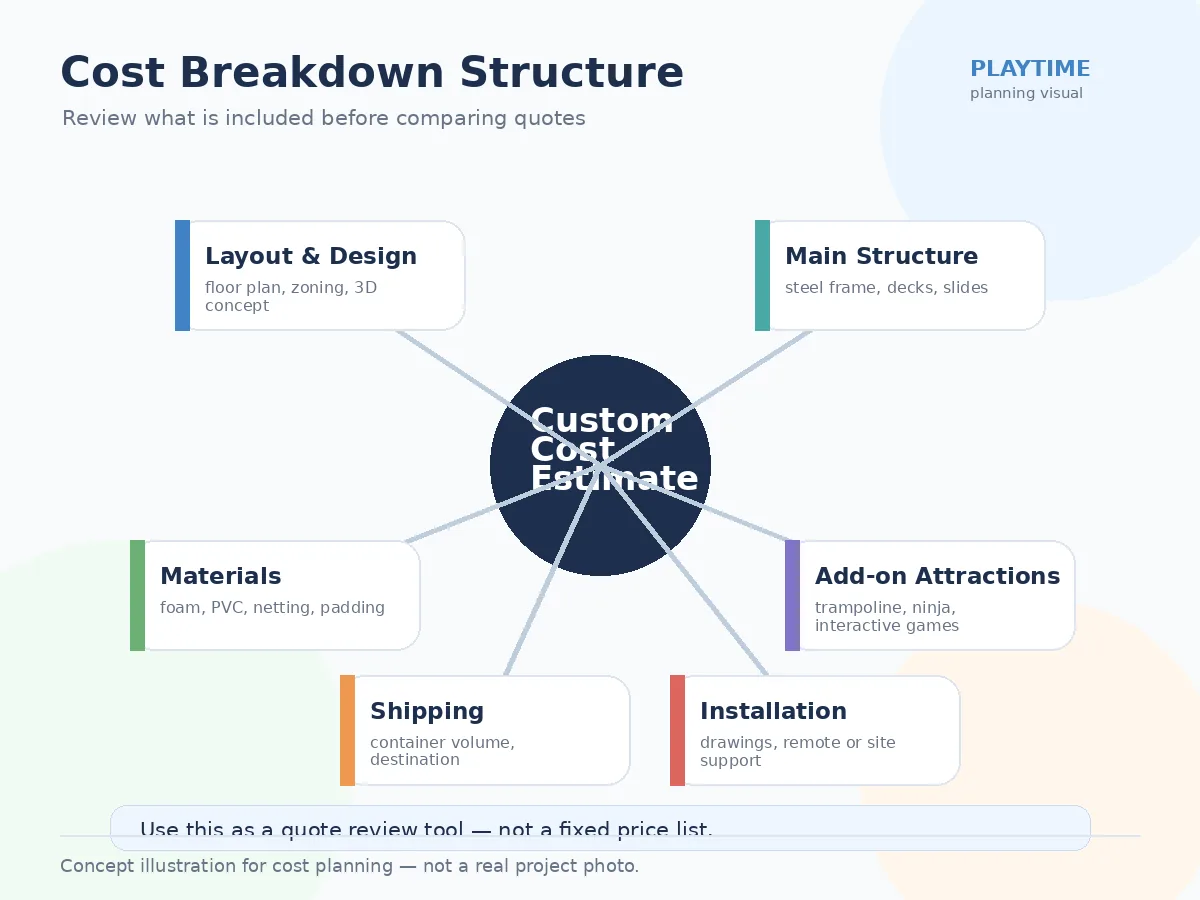
The table below is a scope-review tool rather than a fixed price list. Mark each line as included, excluded, provisional or owner-supplied when comparing quotations.
| Cost Area | What It May Include | Why It Changes the Budget |
|---|---|---|
| Layout and design | Site review, zoning, 2D layout, 3D concept, theme direction and revisions | Irregular sites, more zones and customized themes require more design coordination |
| Main play structure | Frame, platforms, decks, tunnels, bridges, barriers and slides | Height, platform area, route complexity and component quantity affect material and production scope |
| Soft play and toddler zone | Soft obstacles, mini slides, ball play, role-play and sensory elements | Age-specific zoning, padding and sightline requirements affect the layout |
| Add-on attractions | Trampoline courts, ninja obstacles, interactive games and arcade options | Different attractions introduce separate structures, systems, padding, electrical and operating requirements |
| Materials and documents | Surface covers, foam, netting, frame, platforms, hardware, manuals, labels and requested project documents | Confirmed specifications and destination requirements change the supply scope |
| Export packaging | Protection, package labeling, packing list preparation and loading coordination | Large or irregular components require more volume and handling protection |
| Freight and destination logistics | Origin transport, ocean freight, port charges, customs, local delivery and unloading as stated | Cost changes with packed volume, delivery basis, destination and market conditions |
| Installation support | Drawings, manuals, videos, remote guidance, local labor or project-based on-site support | Complexity, access, clear height and site readiness affect labor and coordination |
| Local site work | Flooring, walls, electrical work, lighting, HVAC, fire-related modifications and builder’s work | These items are commonly outside the equipment supplier’s price |
| Approval and opening costs | Permits, inspection, accessibility review, insurance, staff training, software, marketing and opening stock | These owner-side costs determine the full project budget, not just equipment cost |
How Venue Type Changes the Cost Structure
Shopping Mall Indoor Playground
A mall project often places more weight on corridor visibility, entrance design, durable finishes, age zoning, parent waiting and landlord coordination. The equipment budget must be reviewed together with the tenant fit-out and circulation plan. Use the mall indoor playground layout checklist before approving a concept.
Family Entertainment Center
An FEC may combine soft play, trampoline, ninja, interactive games, party rooms and arcade equipment. Budgeting by zone is more useful than applying one average rate to the whole venue because each attraction has different structure, installation, staffing and maintenance requirements.
Daycare or Preschool Play Area
These projects usually prioritize younger children, low-height activities, clear supervision, simple circulation and cleaning access. The decorative budget may be lower than a mall attraction, but age zoning and practical material choices remain important.
Restaurant, Cafe, Church or Community Venue
Compact projects need careful separation between play, seating, food service and circulation. A smaller area is not automatically inexpensive if the venue requires custom fit, strong sightlines, acoustic control or difficult installation access.
How Equipment Mix Changes the Budget
Different equipment types create different cost, space, installation and operating requirements. Buyers should define the core attraction, supporting activities and optional future-phase items according to target users, venue type and business goal.
| Equipment Type | Best For | Budget Impact |
|---|---|---|
| Soft play structure | Core indoor playground zone | Usually one of the main cost drivers |
| Toddler playground | Daycare, preschool and younger children’s areas | Adds age-specific soft play design |
| Slides and climbing items | Active play and circulation | Cost depends on height, shape and structure |
| Ball pit | Young children and family venues | Adds space and maintenance planning |
| Trampoline zone | FECs and active play venues | Adds engineering, padding and safety planning |
| Ninja warrior course | Older children and challenge zones | Adds obstacles, padding and route design |
| Interactive games | Engagement and repeat visits | Adds electronic or game system cost |
| Arcade machines | FEC revenue mix | Usually planned as a separate equipment budget |
| Themed decoration | Mall and branded venues | Can increase design and production cost |
How to Control Budget Without Removing Core Play Value
Budget control does not always mean removing the most valuable play activities. A better sequence is to protect the core age group and circulation first, then simplify non-essential decoration, reduce one-off custom shapes, standardize selected finishes or move optional attractions into a later phase.
For example, a buyer may retain the main soft play route, toddler zone and signature slide while reducing decorative panels or delaying selected interactive games. Cutting circulation, padding, required barriers or age separation to meet a budget is not an equivalent cost-saving strategy.
What Information Should You Send for an Accurate Quote?
A useful quotation starts with a usable site brief. “How much per square meter?” can support an early conversation, but it cannot confirm the equipment list, packed volume, delivery responsibility or installation scope.
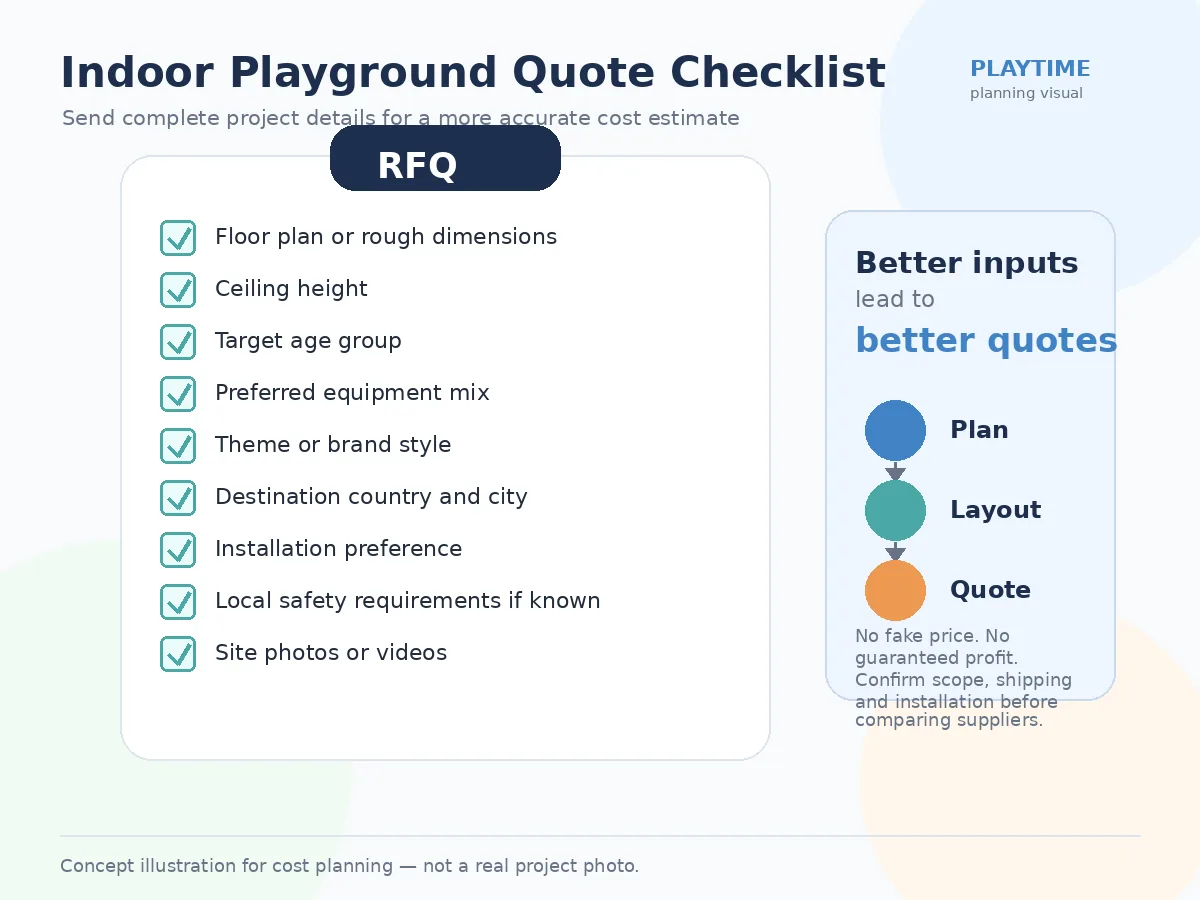
Indoor Playground Quote Checklist
- Dimensioned floor plan or clear hand sketch
- Total venue area and usable play area after non-play zones are deducted
- Clear ceiling height, beam height and overhead restrictions
- Column, wall, window and fixed-service positions
- Entrance, exit, emergency-exit and circulation requirements
- Target age groups and desired age zoning
- Expected operating capacity or peak attendance assumptions for local review
- Core equipment, optional attractions and future-phase items
- Theme, brand colors or visual direction
- Destination country, city, port or full delivery address as applicable
- Loading door, elevator and internal access dimensions
- Preferred installation model and available local labor
- Target opening date and site-readiness schedule
- Known local safety, fire, accessibility, insurance or inspection requirements
- Site photos and walk-through video
- Budget direction and the cost level it represents
A floor plan is especially important because it reveals the actual site shape and the areas that cannot be filled with equipment. Buyers can review Playtime’s playground planning tools and the layout ideas by square meter before preparing an RFQ.
Quote Scope Comparison Checklist
Indoor playground quotations should be normalized before the totals are compared. Use the same floor plan, equipment brief, currency, delivery basis and installation assumption for each supplier. The indoor playground supplier selection guide provides a broader due-diligence checklist.
| Question | Why It Matters | Recommended Buyer Action |
|---|---|---|
| Does the quote use the same approved layout and equipment list? | Different quantities, platform areas, slides, obstacles or attraction zones can change the total substantially. | Request an itemized scope linked to a dated layout or equipment schedule. |
| Does the quote include the same design scope? | Some totals cover equipment only; others include floor-plan review, 3D design, theme work and revisions. | Confirm the deliverables, number of revision rounds and point at which changes become chargeable. |
| Are materials and documents clearly identified? | Generic quality descriptions do not allow a like-for-like comparison. | Ask for project-specific material options, document scope, manuals, labels and spare parts. |
| Is export packaging included? | Packaging affects damage risk, container volume, component identification and installation efficiency. | Confirm packing method, packing list, labels and loading responsibility. |
| Are freight and destination costs based on the same delivery term? | An equipment-only or port-based quote cannot be compared directly with a delivered-to-site estimate. | Confirm the shipping term, destination, quote validity, included charges and excluded duties or taxes. |
| What installation support is included? | Drawings, manuals, remote support, local labor and on-site support create different cost and responsibility boundaries. | Confirm installer qualifications, labor, tools, lifting, travel and final handover responsibilities. |
| Are warranty, spare parts and after-sales procedures stated? | A low initial price may omit replacement parts, response procedures or documentation needed after opening. | Request written warranty scope, exclusions, spare-part recommendations and claim process. |
| Have local approval requirements been identified? | Late fire, accessibility, insurance or inspection changes can trigger redesign or site rework. | Confirm local requirements before final design approval and production release. |
Common Quote Comparison Mistakes
Using Price per Square Meter as the Final Decision
A square-meter figure does not show structure height, platform area, equipment quantity, theme complexity, packed volume or installation scope. Use it only for early screening, then compare layout-based quotations.
Comparing Different Equipment Mixes
One supplier may quote a basic soft play structure while another includes a toddler zone, larger slides, trampoline courts, ninja elements, interactive games and theme work. Place the equipment schedules side by side before comparing totals.
Comparing Different Delivery Bases
A common purchasing error occurs when an equipment-only or port quotation is compared with a price that includes freight or local delivery. The lower number may simply stop earlier in the logistics chain. Confirm the shipping term, destination and excluded charges.
Ignoring Venue Access and Site Readiness
A quotation may assume normal unloading and an installation-ready venue. Narrow doors, limited elevator capacity, restricted working hours or unfinished flooring and electrical work can add local handling, waiting and remobilization costs. Send access dimensions and a site schedule before shipment.
Approving the Design Before Local Review
Another avoidable problem is freezing the layout before fire exits, accessible routes, landlord conditions, insurer requirements or inspection responsibilities are reviewed. If those requirements change the equipment footprint after production begins, redesign and rework can be expensive.
Safety, Materials and Compliance Notes for Buyers
Safety and compliance requirements can affect the layout, materials, documentation, surfacing, access routes and installation scope. They should be identified before the design is frozen, not treated as optional extras after the quotation is accepted.
Standards must be matched to the actual equipment type and destination. ASTM F1918 addresses soft contained play equipment; it is not a blanket standard for trampoline courts, public playground equipment or accessibility. Commercial trampoline courts are addressed separately by ASTM F2970. Public-playground guidance and accessibility rules may also influence parts of a project, but their legal application depends on the venue and jurisdiction.
Questions to Confirm Before Finalizing a Supplier
- Which equipment categories are included in the project, and which standards or local rules may apply to each?
- What materials and project documents are included in the quotation?
- Who confirms fire, building, accessibility, insurance and inspection requirements?
- Are installation drawings, manuals, labels and maintenance information included?
- Has the target age range been matched to the equipment and operating rules?
- Are surfacing, padding, barriers, access and emergency procedures included in the design review?
- Can warranty terms, lead time, spare parts and installation support be confirmed in writing?
Useful External References
- ASTM F1918-21 for soft contained play equipment — scope and safety-performance context for soft contained play systems.
- ASTM F2970-25 for commercial or institutional trampoline courts — separate design, installation, operation, maintenance and inspection context for trampoline court projects.
- CPSC Public Playground Safety Handbook — U.S. public-playground guidance that may support broader buyer review where relevant.
- U.S. Access Board guide for play areas — guidance on accessible routes and accessible play components in covered U.S. projects.
How to Structure an Indoor Playground Cost Review
A useful project cost review starts with site information and a layout-based equipment scope rather than one generic package. The objective is to align the attraction mix, design level and quote boundary with the actual site and buyer priorities.
Provide the floor plan, usable area, clear height, access dimensions, target ages, destination and preferred attractions.
Identify columns, exits, restricted zones, circulation, supervision and local requirements that affect the equipment footprint.
Separate core play value from optional decoration and future-phase attractions according to the budget direction.
Confirm equipment, design, materials, packaging, delivery assumptions, installation support and exclusions.
Use the project review to define the layout, equipment scope, design requirements, packaging, delivery basis and installation responsibilities that must be confirmed in the quotation and order documents.
Before requesting a final price, review Playtime’s project services, playground project portfolio and supplier comparison checklist. These pages help separate design capability and project support from a simple catalog price.
How to Prepare a Reliable Indoor Playground Cost Estimate
Start by defining the cost level you need: equipment quotation, landed equipment budget or full opening budget. Then provide the usable play area, clear height, floor plan, target age groups, core attractions, destination and installation model.
Request an itemized, layout-based quote that states the equipment schedule, material and document scope, packaging, delivery basis, installation responsibility, validity period and exclusions. This approach will not create one universal price, but it will produce a figure that can be compared, financed and managed with fewer hidden assumptions.
Request a Layout-Based Indoor Playground Project Review
Send your dimensioned floor plan, usable play area, clear height, target age groups, preferred equipment mix, destination and installation preference. Use the review to define the equipment, logistics and support scope that should appear in a project quotation.
Request a Project Cost ReviewIndoor Playground Equipment Cost FAQ
How much does commercial indoor playground equipment cost?
There is no single reliable price without a defined site and equipment scope. Cost depends on usable play area, clear height, equipment mix, design complexity, materials, packed volume, destination and installation responsibility. Request a layout-based quotation and confirm whether it represents equipment price, landed equipment cost or the full project budget.
Is indoor playground equipment priced by square meter?
A square-meter figure can be used for early screening, but it is not a final pricing method. Two equal-size venues can require different structure heights, equipment quantities, themes, packaging and installation plans. Final pricing should be tied to an approved layout and equipment schedule.
What is the difference between equipment price and total project cost?
Equipment price normally covers the listed play equipment and stated supplier scope. Total project cost may also include design customization, packaging, freight, destination charges, local delivery, installation, flooring, electrical work, approvals, insurance and pre-opening expenses. Each quotation should identify its exclusions.
Why can two playgrounds with the same floor area cost different amounts?
Floor shape, ceiling height, columns, usable play area, age zoning, attraction mix, theme complexity, delivery access and installation conditions can all differ. The same gross area may therefore produce a different equipment footprint, material quantity and logistics plan.
Are shipping and installation included in the equipment quotation?
Not automatically. The quote should state the shipping term, destination, included logistics charges and installation-support model. Local delivery, unloading, labor, tools, lifting equipment, travel and site preparation may remain outside the supplier’s price.
What should I send to receive a more accurate quote?
Send a dimensioned floor plan, usable play area, clear ceiling and beam heights, columns, entrances, exits, access dimensions, target age groups, preferred attractions, theme direction, destination, installation preference, site photos and known local requirements.
How can I reduce cost without removing the core play value?
Protect circulation, age separation and the main attraction first. Then simplify non-essential decoration, standardize selected finishes, reduce one-off custom shapes or phase optional interactive and arcade items. Do not treat required padding, barriers, access or local compliance work as optional cost savings.