






Indoor Playground Supplier Guide
How to Choose an Indoor Playground Equipment Supplier: A Buyer’s Checklist
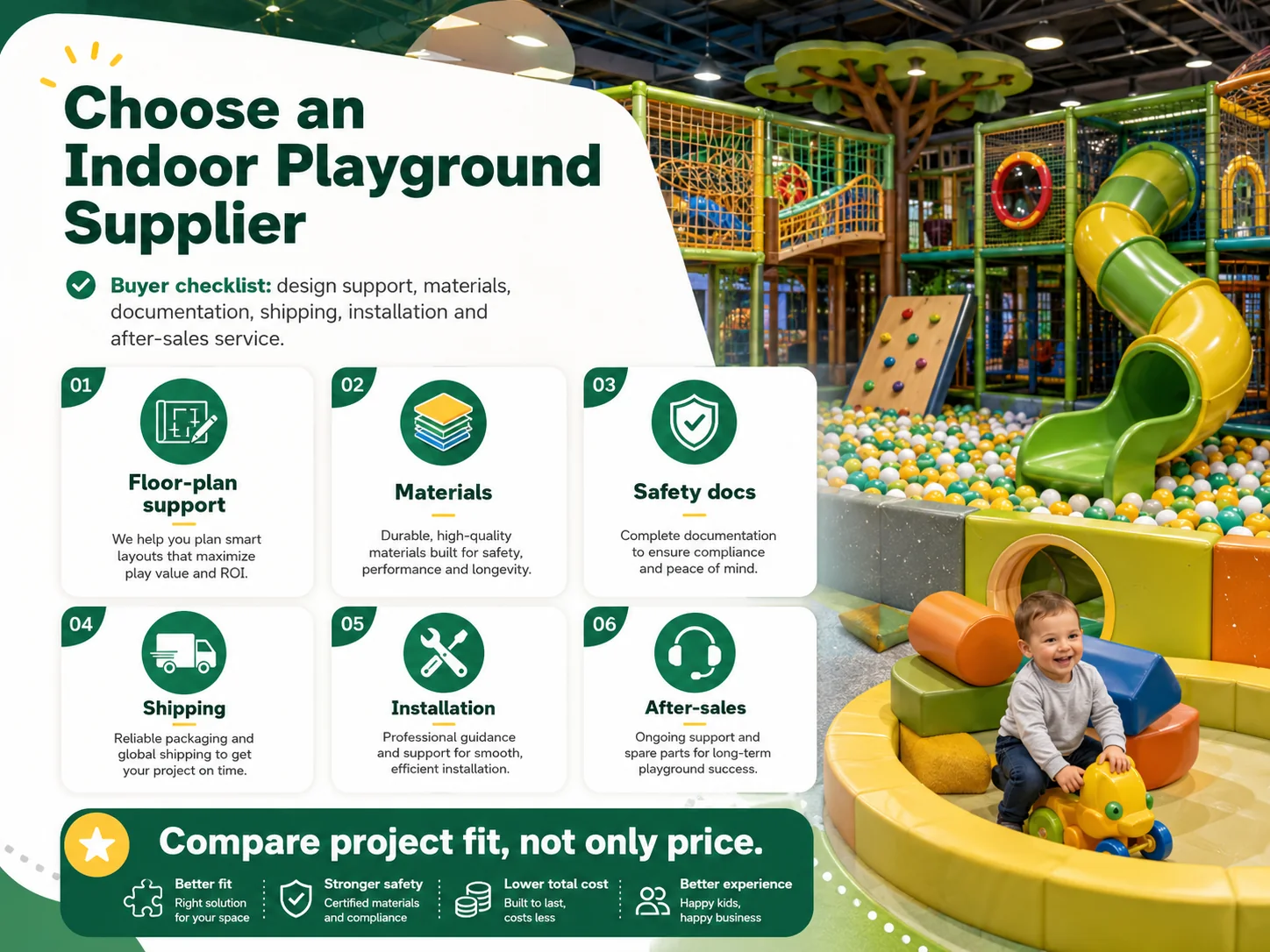
Choose an indoor playground equipment supplier by verifying five things: the supplier can translate your site brief into a workable layout; return an itemized equipment and document scope; explain materials without unsupported claims; define packing, freight and installation responsibilities; and provide a clear handover and after-sales process. The lowest quotation is not necessarily the lowest project cost when design, flooring, logistics, local labor or replacement support are excluded.
What an Indoor Playground Equipment Supplier Should Actually Provide
A commercial supplier should provide more than a catalog and a total price. At minimum, the supplier should be able to convert the buyer’s site information into a reviewable project scope: a layout or dimensioned planning drawing, an itemized equipment schedule, material and document notes tied to the quoted equipment, a defined packing and shipping basis, an installation-support scope, and an after-sales contact process.
These deliverables do not all need to be final at the first inquiry. However, the supplier should explain what will be returned at each stage—initial discussion, quotation, design confirmation, production approval, shipment and handover. Buyers can begin by reviewing the supplier’s commercial indoor playground equipment range, then test whether the supplier can adapt it to the actual venue rather than forcing a standard package into the space.
Start With Project Fit, Not Only Product Price
The lowest equipment price does not automatically produce the lowest installed project cost. A quotation may omit layout revisions, safety flooring, custom theme work, export packaging, freight, destination charges, local delivery, installation labor, travel, tools or spare parts. Compare the quoted responsibility, not only the final number.
Project Details a Serious Supplier Should Request
- Dimensioned floor plan, usable play boundary and clear ceiling height
- Columns, beams, entrances, exits, restricted areas and delivery access
- Venue type, operating model, target age groups and supervision approach
- Required play zones, optional attractions and theme direction
- Destination country, delivery basis and installation preference
- Known landlord, fire, accessibility, insurance or inspection requirements
- Budget direction, project stage and target opening timeline
A common quotation mistake occurs when one supplier prices the main soft-play structure only, while another includes flooring, packaging, installation documents and optional attractions. The first total may appear lower even though the two offers are not comparable. Use the indoor playground equipment cost framework to separate equipment price, landed equipment cost and owner-side project costs.
Venue-Fit Supplier Evaluation: Different Buyers Need Different Support
The right indoor playground equipment supplier is not the same for every project. A daycare buyer, shopping mall operator, family entertainment center owner and distributor may all need indoor playground equipment, but the supplier evaluation criteria can be different.
| Buyer / Venue Type | Main Project Concern | Supplier Support to Confirm | Risk if Ignored |
|---|---|---|---|
| Family entertainment center | High user capacity, repeat visits, activity mix and commercial flow | Layout planning, equipment mix, age zoning, party-room flow and operational access | The playground may look attractive but fail to support daily operation. |
| Shopping mall | Space efficiency, brand image, landlord rules and visitor circulation | Floor-plan review, entrance planning, parent viewing, safety documentation and installation schedule discussion | The project may conflict with mall operation, landlord requirements or site limitations. |
| Daycare / preschool | Age-appropriate play, supervision, low-height play and local review | Toddler-zone design, soft play details, material documents and local compliance reminders | Equipment may not match young children’s use or supervision needs. |
| Restaurant / cafe / hotel | Family attraction, compact footprint, visual theme and easy cleaning | Compact layout, theme customization, cleaning guidance and maintenance support discussion | The play area may not support the venue’s customer experience or maintenance routine. |
| Contractor / distributor | Scope clarity, packing, shipping, installation documents and after-sales coordination | Detailed equipment list, packing list, freight assumptions, installation manuals and document handover | Local execution may suffer because responsibilities and components are unclear. |
This is why supplier evaluation should start with the venue, not only the catalog. A good supplier should ask what kind of business, site and user group the equipment needs to support.
A typical mall-project conflict appears when a supplier reviews only the equipment footprint but not the controlled entrance, parent waiting area, landlord access window or emergency route. The proposed structure may technically fit the floor area while still failing the operating or installation brief. Venue-fit questions should therefore be answered before theme details are frozen.
A Practical Supplier Evaluation Process
Buyers can reduce confusion by following a simple process before confirming a supplier. The goal is to move from rough interest to a clear project scope.
Send site size, floor plan, ceiling height, venue type, age group and destination.
Check how the proposed indoor playground fits circulation, zoning and supervision.
Review play zones, soft play structure, toddler area, slides, ball pit and optional add-ons.
Check whether drawings, material notes, reports, project photos and factory evidence are current and match the quoted scope.
Mark supplier, buyer, freight provider and local-contractor duties before payment, production and shipment.
Use the indoor playground equipment RFQ checklist to send every shortlisted supplier the same project brief and request the same return documents.
Check the Supplier’s Design and Floor-Plan Support
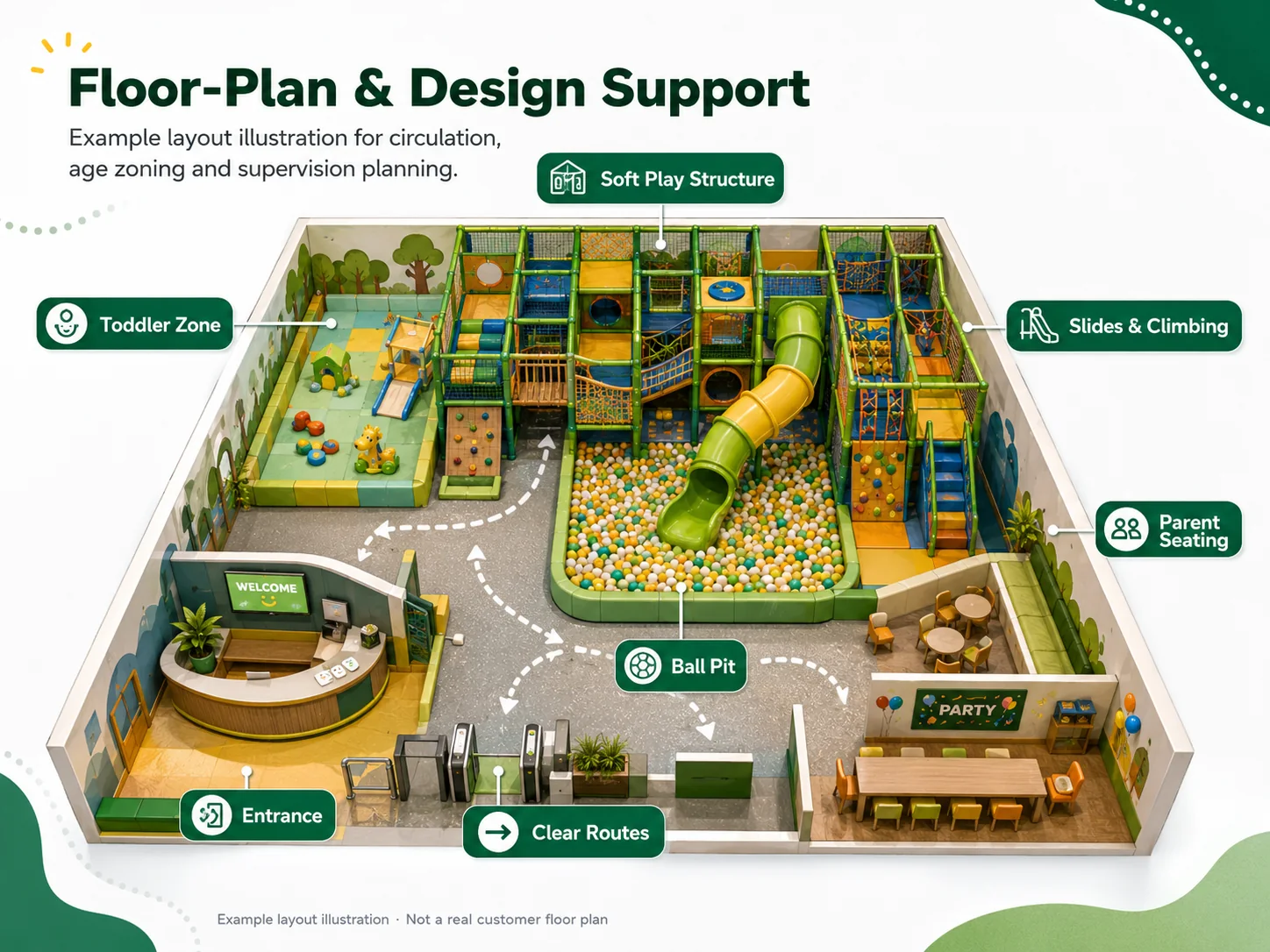
Floor-plan support is one of the most important parts of choosing an indoor playground equipment supplier. A good design discussion should consider how children, parents, staff and maintenance teams will move through the space.
Site Review
Ask whether the supplier requests a floor plan, site dimensions and ceiling height before preparing the final quote.
Age Zoning
Check whether the design separates toddler areas from older-child activity areas and considers supervision visibility.
Commercial Flow
Ask how entrances, reception, party rooms, seating, cafe areas or restrooms are considered in the layout discussion.
Access and Operation
Confirm whether emergency access, staff circulation, maintenance access and local project requirements are discussed.
A common planning issue occurs when the supplier receives only the room length and width. After the concept is prepared, low beams, HVAC ducts, columns, sprinkler zones or delivery-door limits force the equipment to be reduced or redesigned. Ask the supplier to identify which dimensions and restrictions were used, and require the final quote to reference the same drawing revision.
For venue-specific checks, review the mall indoor playground layout checklist or the layout guide by square meter.
Compare Product Range and Customization Ability
An indoor playground project may include more than one product type. A supplier should be able to explain which equipment types fit the site, the age group and the business model.
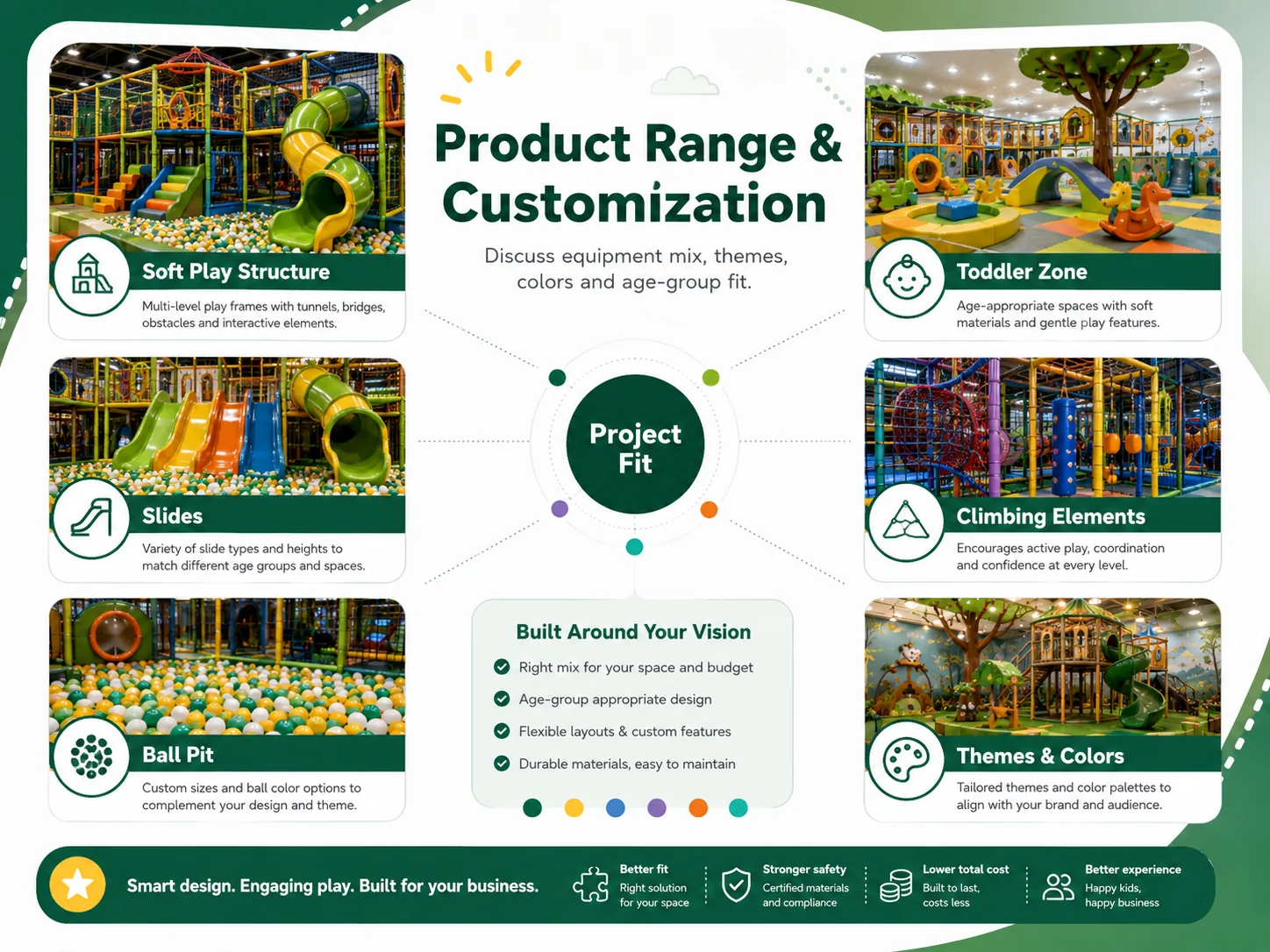
Common indoor playground components may include main soft play equipment, toddler play zones, slides, climbing obstacles, ball pits, crawl tubes, role-play panels, rope or obstacle routes, interactive games, and themed decorative elements if included in the scope.
Customization should be discussed carefully. Buyers may want specific colors, themes, brand elements or a layout that fits an unusual floor plan. However, customization should be confirmed according to the final design scope, material availability, production requirements and safety review.
Ask the supplier to separate core equipment, optional add-ons and future-phase items. This prevents a visually impressive concept from hiding the cost and operating impact of attractions that are not essential to the first opening phase. For custom visual direction, compare the theme against the layout and operating model using Playtime’s commercial indoor playground theme guide.
Review Materials, Structure and Soft Play Details
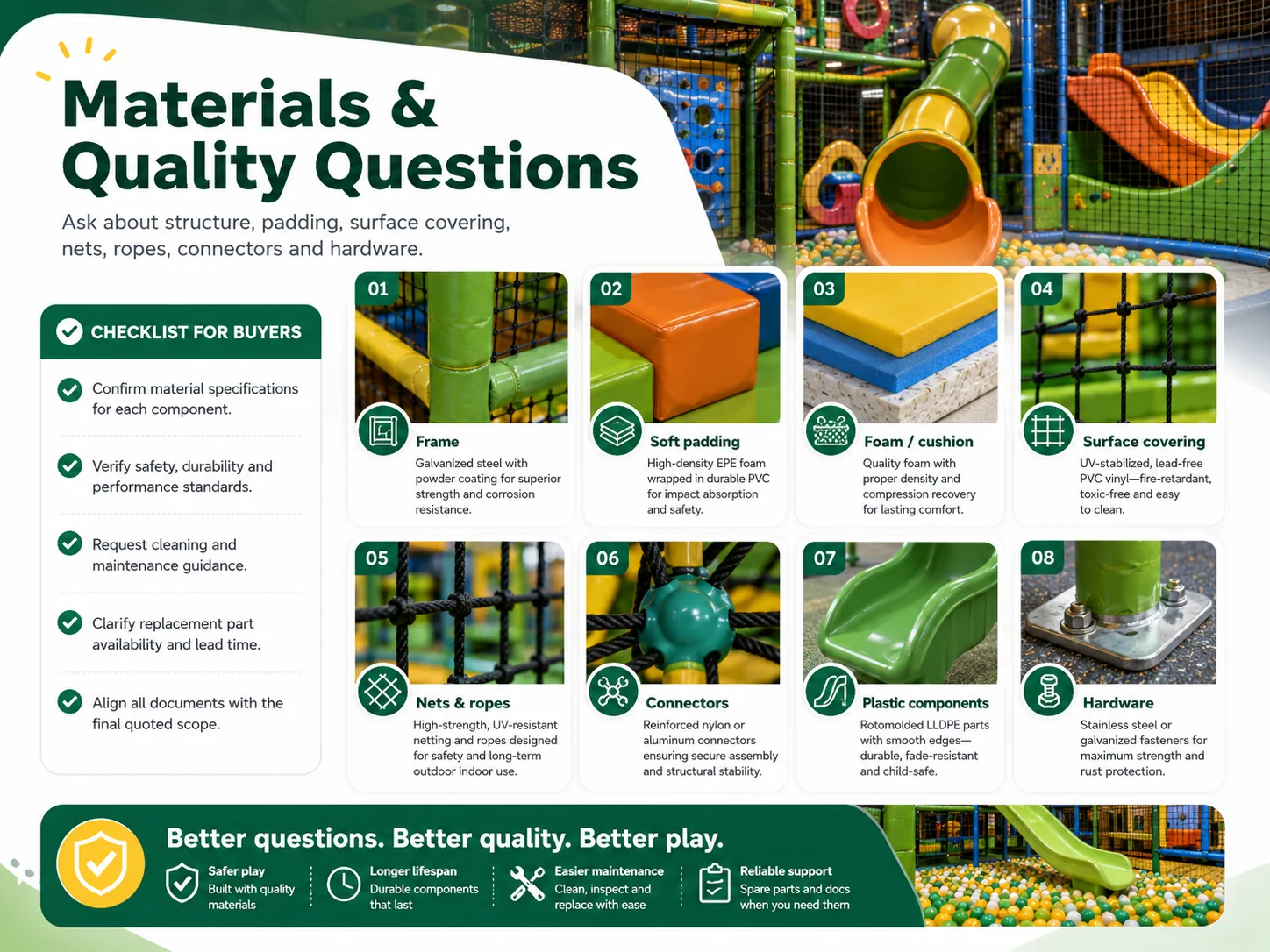
Material evaluation should be tied to the exact equipment schedule, not to generic statements such as “commercial grade,” “safe material” or “high quality.” Ask which structural, padding, covering, netting, rope, plastic, hardware and flooring information applies to the quoted design, and whether the evidence is current and traceable to the proposed product or material.
| Claim or Component | Evidence to Request | What to Match | Common Gap |
|---|---|---|---|
| Main structure | Quoted specification, drawing notes or supplier technical description | Final layout, component type and order revision | A generic specification that is not linked to the quoted structure |
| Padding and surface covering | Material notes, available test documents, cleaning and repair guidance | Exact cover, foam or pad used in the order | One material report is presented as proof for every padded component |
| Nets, ropes, connectors and hardware | Component descriptions, inspection points and replacement process | Quoted component family and installation location | No wear-part or replacement information |
| Flooring or surfacing | Scope, area, system description and local-review responsibility | Equipment use area and project requirement | Flooring is assumed but not priced or assigned |
| Cleaning and maintenance | Product-specific instructions and approved cleaning limits | Final surface materials and operating environment | Only a broad “easy to clean” statement |
One evidence problem occurs when a supplier sends a valid report for a material category but cannot show that the final order uses the same material, formulation or component. The buyer should request a document index that identifies which evidence applies to which part of the quoted playground.
Document Pack to Confirm Before Production
- Approved layout and final equipment schedule
- Material and component notes applicable to the final scope
- Available safety or test documents with scope and dates
- Installation drawing, manual or support description if included
- Packing-list format and component-labeling method
- Cleaning, inspection and maintenance guidance
- Warranty, spare-parts and after-sales terms
For company-level background, buyers can review Playtime’s company information, but supplier selection should still be based on project-specific evidence and contract scope.
Ask About Safety Standards, Local Compliance and Documentation
Safety should be evaluated through scope, evidence and responsibility—not through a universal “certified” claim. The applicable requirements depend on the equipment type, user age, venue, country, local authority, landlord, insurer and inspection pathway. A soft-contained play structure, trampoline court and public-use playground are not automatically reviewed under the same standard.
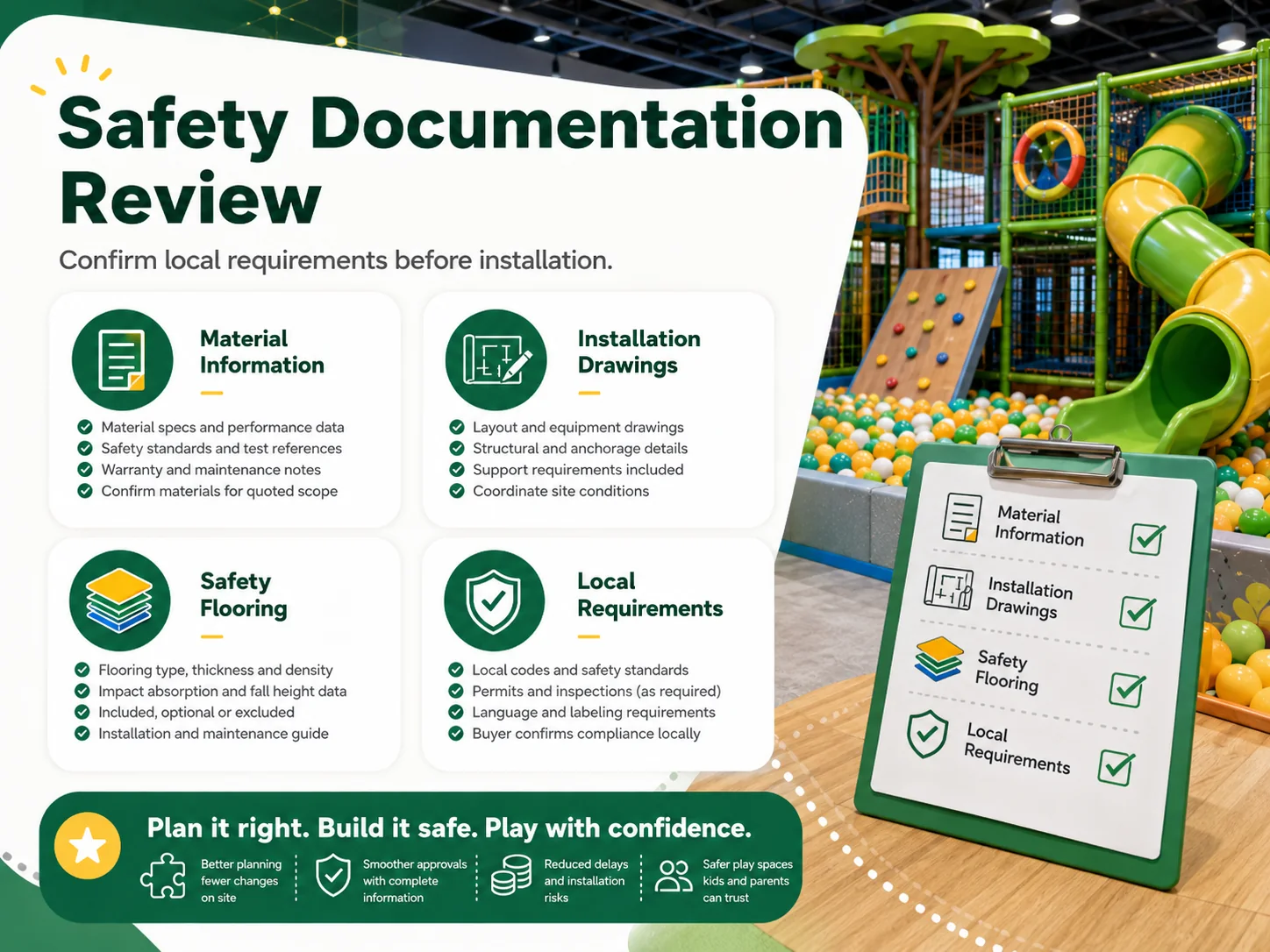
| Verification Question | Why It Matters | What to Record |
|---|---|---|
| Which standard or requirement is relevant to each equipment category? | Different attractions can have different scopes and responsibilities. | Equipment category, standard edition and local-review owner |
| Does the document apply to the final quoted product or material? | A real report can still be irrelevant to the proposed order. | Model, material, sample, report number, date and issuing body |
| What installation documents are included? | Assembly quality and local execution affect the completed project. | Drawing revision, manual, support method and installer responsibility |
| Who confirms building, fire, accessibility, insurance and venue requirements? | Supplier documents do not replace local project approval. | Buyer, landlord, consultant, inspector or authority responsibility |
| What is not covered by the supplier’s document package? | Explicit exclusions prevent false assumptions before ordering. | Excluded equipment, local work, inspection and owner-side documents |
External References for Standards and Accessibility Review
Use external references to understand scope and ask better questions—not as automatic proof that a supplier or project is approved. The following sources are relevant only when their stated scope matches the equipment and project location.
Useful Buyer References
- ASTM F1918-21 — Soft Contained Play Equipment: ASTM identifies this as the active soft-contained-play specification for users within its stated 2–12-year range. Its public scope excludes public playground equipment, amusement rides and several other equipment categories, and it does not replace general accessibility review.
- U.S. CPSC Public Playground Safety Handbook: the current CPSC page provides the 2025 handbook for general public-playground guidance. It is not a supplier certificate and should not be used as proof that a soft-contained system is automatically compliant.
- U.S. Access Board Play Areas Guide: useful when accessible routes and play components are relevant to an ADA-covered U.S. project. Accessibility review remains project- and jurisdiction-specific.
Check Factory, Quality Control and Production Evidence
Factory evaluation should focus on traceable evidence for the order rather than polished marketing images. Buyers may review the supplier remotely or on site, but the most useful evidence shows how the approved design becomes a labeled, checked and packable shipment.
| Evidence Area | Useful Evidence | What Buyers Should Verify | Risk Signal |
|---|---|---|---|
| Company and factory identity | Current business details, facility information and dated factory evidence | Entity name, address and relationship between seller and producer | Unclear factory ownership or reused third-party images |
| Design control | Approved drawing revision, equipment schedule and change record | The production file matches the buyer-approved scope | Production starts from an outdated rendering or unapproved layout |
| Incoming and in-process checks | Checklists, component identification or dated inspection evidence where available | Which checks apply to the actual order and who records them | Only broad “strict QC” claims |
| Pre-packing verification | Component count, labeling examples, zone-based packing list and packing photos | Parts can be traced to the layout and installation sequence | Shipment is treated as one undefined bulk package |
| Nonconformance handling | Process for missing, damaged or incorrect parts | Reporting channel, evidence required and resolution terms | No written process or responsible contact |
During installation planning, a common delay occurs when packages are not labeled by zone or drawing reference. Local installers may spend time identifying similar tubes, panels, nets and hardware before assembly can begin. Ask to see the planned labeling logic and packing-list format before shipment.
Project photos can support trust only when the supplier can explain the project context and has permission to use them. Do not rely on unverifiable case photos, cropped certificates or documents with hidden issuing details. Review Playtime’s playground project portfolio as background, then request evidence relevant to the proposed order.
Supplier Evaluation Checklist
Use the checklist below to classify each item as Verified, Clarify Before Selection, or Unacceptable. A supplier does not need to provide every final document at the first inquiry, but it should explain when each deliverable becomes available and what evidence will apply to the final order.
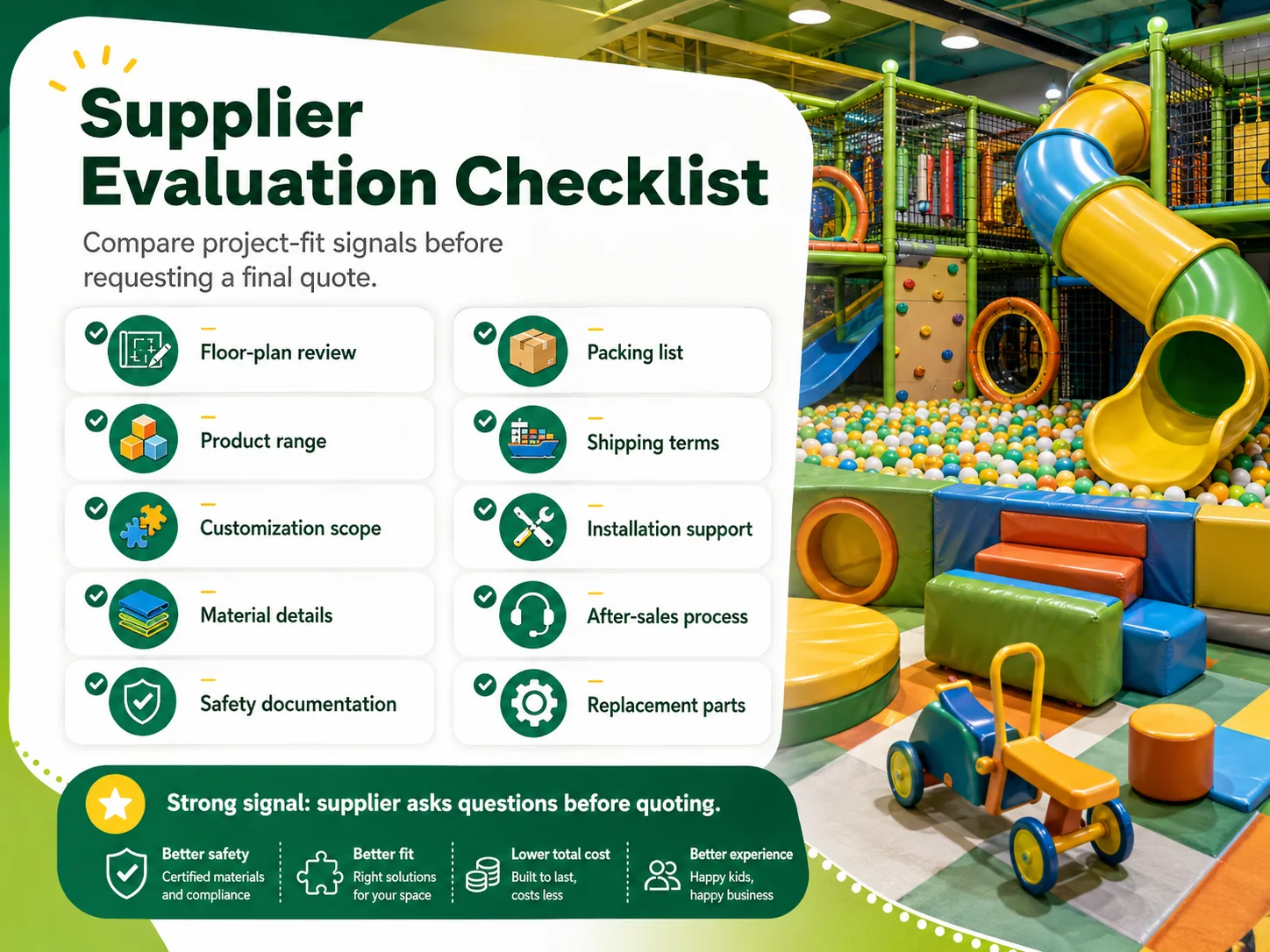
| Evaluation Area | What to Ask | Strong Signal | Risk Signal |
|---|---|---|---|
| Floor-plan review | Does the supplier request site dimensions, floor plan and ceiling height? | The supplier reviews layout before final quote. | The supplier quotes without understanding the site. |
| Product range | Can the supplier explain suitable play zones and equipment options? | Equipment is matched to age group and venue type. | The supplier only sends a generic catalog. |
| Customization | Can theme, color or layout be adjusted? | Customization scope is clearly explained. | The supplier promises anything without design review. |
| Materials | Are structure, padding, covering, ropes, nets and hardware discussed? | Material details are available upon request. | The supplier uses vague material claims only. |
| Safety documentation | What project documents are available? | Documentation is tied to the quoted scope. | The supplier claims universal approval. |
| Packing and shipping | Are packing list, freight terms and destination assumptions clear? | Packing and shipping assumptions are explained. | Shipping is unclear or excluded without explanation. |
| Installation support | Are drawings, manuals or remote support included? | Installation responsibilities are clear. | No installation document discussion. |
| After-sales support | How are questions, missing parts or replacement parts handled? | Communication process is explained. | No after-sales contact process is provided. |
Compare Quote Scope Line by Line
Request a normalized comparison sheet rather than placing two supplier PDFs side by side. Mark every line as Included, Optional, Provisional, Excluded or Buyer-Supplied, and require assumptions to be written beside the price.
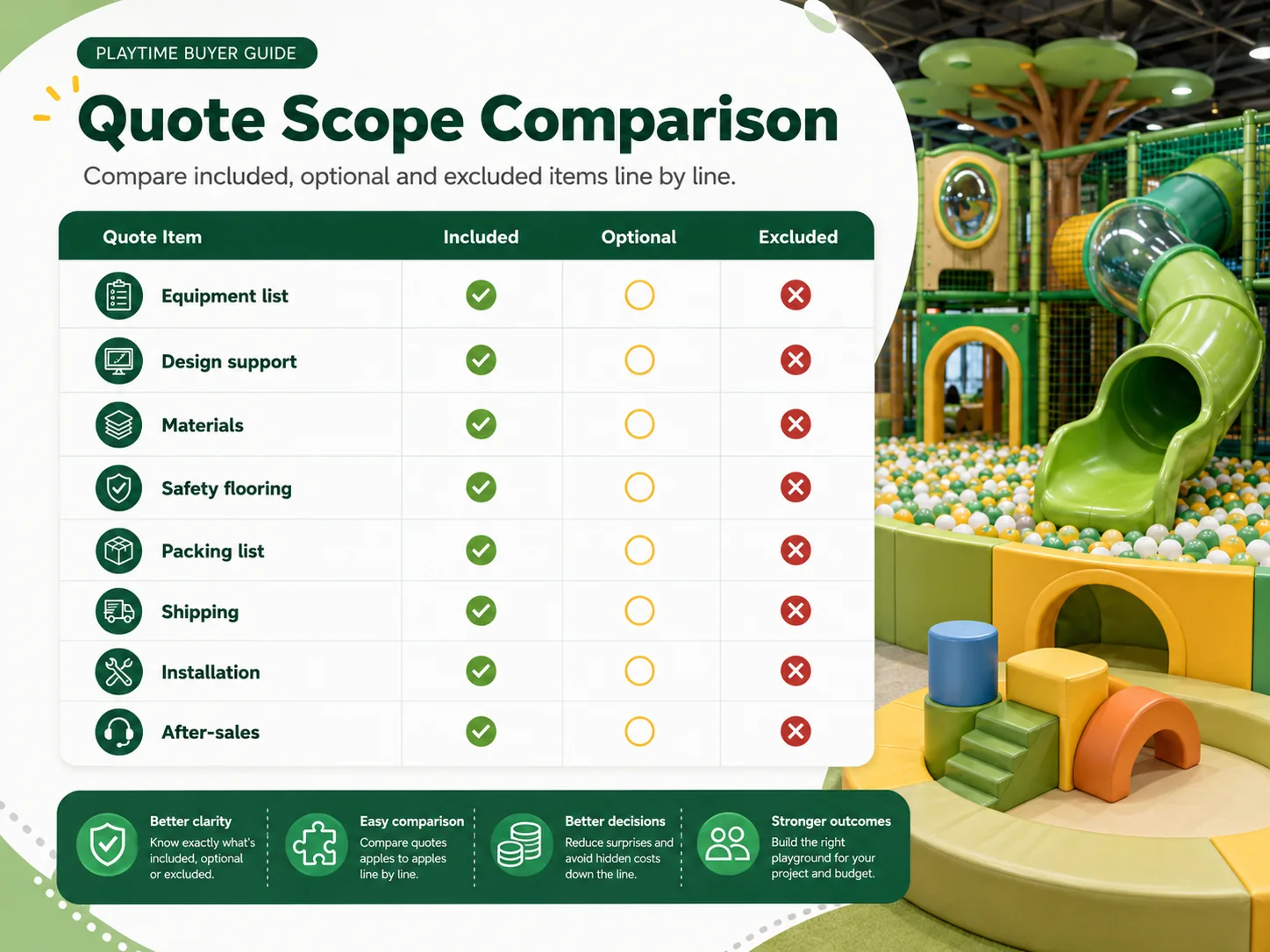
| Quote Item | What to Check | Why It Matters |
|---|---|---|
| Equipment list | Exact structures, play zones and components | Prevents missing or unclear scope |
| Design support | Floor plan, zoning and layout review | Reduces mismatch between design and site |
| Materials | Surface, padding, frame, hardware, nets and ropes | Affects durability, maintenance and cleaning |
| Safety documentation | Available documents for the quoted scope | Supports local review and project discussion |
| Shipping and packing | Terms, volume, destination and packing list | Affects landed cost and installation coordination |
| Installation support | Drawings, manual or remote support | Affects local execution |
| After-sales communication | Support process after delivery | Affects long-term operation |
One quotation mistake happens when freight is described as “included” without a delivery term, destination charge boundary or inland-delivery responsibility. Another occurs when “installation included” means drawings only rather than labor and supervision. The commercial playground buyer checklist can be used as a second-stage order review after supplier shortlisting.
Project Responsibility Matrix: Supplier vs Buyer vs Local Contractor
One of the most common supplier-selection mistakes is assuming that everything is included. A clearer responsibility matrix helps buyers avoid missing scope before confirming an order.
| Project Area | Usually Discussed With Supplier | Often Handled by Buyer / Local Team | Confirm Before Order |
|---|---|---|---|
| Floor plan and layout | Equipment layout, age zoning and play-zone planning support | Final site measurement, landlord or local approval, local consultant review | Which drawing version is used for the final quote? |
| Equipment supply | Soft play structure, slides, ball pit, panels, nets, ropes, hardware and quoted components | Items outside the supplier’s quoted scope | Is the equipment list complete and itemized? |
| Safety flooring | May be included, optional or excluded depending on quote | Local flooring contractor, site base, local inspection if applicable | Is flooring included, optional or excluded? |
| Shipping and import | Export packing, packing volume and freight discussion if included | Import duties, customs service, inland delivery or unloading unless agreed | What shipping terms and destination assumptions are used? |
| Installation | Installation drawings, manual or remote support if included | Local labor, tools, site readiness, anchoring conditions and local inspection | Who installs, who supervises and what documents are provided? |
| Operation and maintenance | Cleaning and maintenance guidance available for the quoted equipment | Daily inspection, staff training, operation rules and local maintenance routine | What maintenance guidance is provided after delivery? |
Attach the responsibility matrix to the quotation or contract package. Confirm it again before production, before shipment and before installation, because the responsible party can change when freight terms, local contractors or site conditions change.
Shipping, Packing and Installation Support
International delivery is part of supplier evaluation because indoor playground shipments can contain many structural tubes, panels, padded parts, nets, slides, fasteners, hardware and decorative components. The supplier should explain how the shipment will be identified, protected, counted and handed over to the local team.
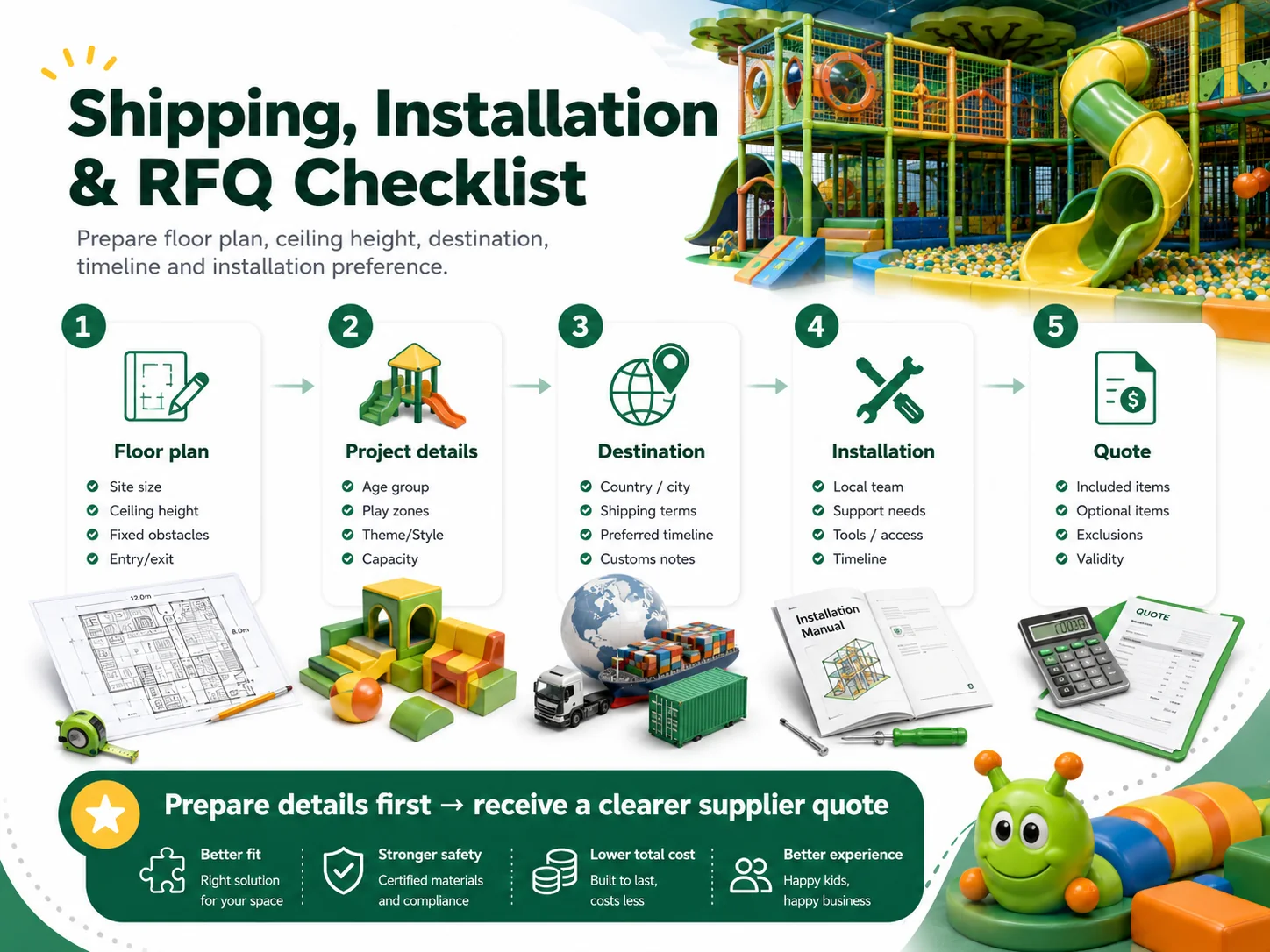
Shipping and Installation Questions
- What Incoterm, destination and freight assumptions are used?
- What is the estimated packed volume and maximum package dimension?
- How are boxes and components labeled by zone, drawing or installation sequence?
- Who handles destination charges, customs, inland delivery, unloading and storage?
- Can the largest packages pass through the loading door, corridor, stairs or elevator?
- Are installation drawings, manuals, videos or remote support included?
- Who supplies local labor, tools, lifting equipment, scaffolding and consumables?
- What site conditions must be complete before the installation team begins?
- Who performs final inspection, punch-list closure and handover?
During installation planning, a common access problem appears when the buyer provides the room dimensions but not the loading route. A large slide or bundled structural section may fit the finished venue but not the elevator or doorway. Confirm access dimensions and package strategy before packing is finalized.
For broader coordination options, review Playtime’s playground project services.
After-Sales Support and Replacement Parts
After-sales support should be defined before shipment, not after a problem appears. Ask who receives installation questions, what evidence is required for a missing or damaged part claim, how replacement components are identified, and which costs or time limits are covered by the final warranty terms.
| Support Area | What to Confirm | Evidence or Record |
|---|---|---|
| Installation questions | Contact person, communication channel, support hours and drawing reference | Named support process in the order file |
| Missing or damaged parts | Reporting deadline, photos, package labels and resolution responsibility | Claim procedure and packing-list reference |
| Replacement parts | Part identification, availability, pricing, freight and compatibility | Component code or drawing reference |
| Warranty | Covered components, exclusions, start date, remedy and buyer maintenance duties | Final contract or warranty document |
| Maintenance support | Inspection points, cleaning limits and wear-part replacement guidance | Product-specific maintenance file |
“Available upon request” can be acceptable for some details, but the supplier should still define when the information becomes available and whether it is included, chargeable or subject to the final project scope.
Handover and Maintenance Checklist
Handover should create a controlled record of what was supplied, installed and transferred to the operator. The buyer should not rely only on chat messages or an unversioned folder.
Handover Items to Confirm
- Approved layout and final equipment schedule with revision numbers
- Packing list, component list and package-label reference
- Installation drawings or manuals included in the agreed scope
- Site punch list and record of closed items where applicable
- Cleaning, inspection and maintenance guidance
- Replacement-part identification and request process
- Warranty and service terms from the final quotation or contract
- Supplier contact route for installation and after-sales questions
- Buyer’s local inspection, staff-training and operating responsibilities
Red Flags When Choosing an Indoor Playground Supplier
Red flags are most serious when they affect identity, evidence, scope control or execution responsibility. Be cautious when a supplier:
- Quotes without requesting a floor plan, usable area, clear height or destination
- Provides one total price without an equipment schedule and exclusions
- Cannot identify which drawing revision controls production
- Uses broad material or safety claims without project-matching evidence
- Provides certificates with hidden report numbers, issuing bodies, dates or tested products
- Claims one design is approved for every country or venue
- Uses project photos or factory images that cannot be verified
- Does not explain packing, component labeling or missing-part checks
- Uses “shipping included” without a delivery term and destination boundary
- Uses “installation included” without defining labor, tools, travel and supervision
- Cannot explain warranty exclusions, spare-parts identification or after-sales communication
- Pressures the buyer to pay before scope, drawings and responsibilities are clear
A single unresolved critical red flag may outweigh several positive marketing claims. Record clarification requests in writing and require the final answer to appear in the quotation, technical attachment or contract—not only in informal messages.
What Buyers Should Send Before Asking for a Quote
Send the same structured RFQ to every shortlisted supplier. This improves quote comparability and reveals which suppliers ask useful technical and commercial questions before pricing.
Indoor Playground Supplier RFQ Checklist
- Venue type, business use and current project stage
- Dimensioned floor plan and marked usable play area
- Clear ceiling height, beams, columns, entrances, exits and restricted zones
- Delivery-route dimensions, unloading conditions and installation access
- Target age groups, supervision model and expected capacity direction
- Required, optional and future-phase play zones
- Theme, color and brand direction
- Material, document and local-review requirements
- Destination country, city, delivery basis and import arrangement
- Installation preference and local-contractor capability
- Budget direction and target opening timeline
- Requested supplier return package: layout, itemized scope, assumptions, documents, packing, shipping, installation and exclusions
The full indoor playground equipment RFQ guide provides a more detailed buyer input and supplier-return checklist.
How Playtime Supports Indoor Playground Equipment Buyers
Playtime Playground uses confirmed project information to discuss equipment selection, layout direction, age zoning, customization, quotation scope, packing, shipping and installation-support options. The exact deliverables, documents, specifications, lead time, warranty and support level should be confirmed project by project in the final quotation and technical attachments.
Buyers can review Playtime’s indoor playground equipment, project portfolio, project services and company information before submitting a formal RFQ.
Playtime’s role is to support equipment and project-scope discussion. The buyer and local project team remain responsible for confirming site measurements, landlord requirements, local building and fire review, accessibility, insurance, inspection, installation conditions and operating responsibilities.
Request an Indoor Playground Supplier-Scope Review
Send your dimensioned floor plan, usable play area, clear height, age groups, required play zones, destination, delivery access and installation preference. Playtime can review the project inputs and prepare a quotation that identifies equipment scope, assumptions, logistics and support responsibilities.
Planning an indoor playground for a family entertainment center, shopping mall, daycare center, preschool, restaurant, church, hotel, contractor project or distributor order? Send your floor plan, ceiling height, site size, target age group, preferred play zones, destination country, installation preference, opening timeline and local safety requirements if known.
Send Project Details for ReviewIndoor Playground Supplier FAQ
How do I choose an indoor playground equipment supplier?
Compare the supplier’s ability to review your site, produce a usable layout, return an itemized equipment scope, explain project-matching materials and documents, define packing and installation responsibilities, and provide a written handover and after-sales process. Do not choose from price or catalog images alone.
What should a serious supplier return after receiving my RFQ?
The response should identify the drawing or planning basis, included equipment and options, material and document notes, quote assumptions, exclusions, packing and freight basis, installation-support scope, lead-time conditions, warranty terms and the next approval stage.
Should I choose the lowest-price indoor playground supplier?
Not automatically. A lower quotation may exclude design revisions, flooring, theme work, packaging, freight, destination charges, installation labor, tools, spare parts or after-sales support. Normalize the scope before comparing totals.
How can I verify a supplier’s certificates and material claims?
Check the issuing body, report or certificate number, date, tested sample, model or material, applicable standard and test scope. Then confirm that the proposed order uses the same product or material. A real document can still be irrelevant to the quoted equipment.
Which standard applies to indoor soft-contained play equipment?
ASTM F1918-21 is an active reference for soft-contained play equipment within its stated scope and user range. Other attraction types may require different standards, and supplier documents do not replace local building, fire, accessibility, insurance or inspection review.
How should I compare shipping and installation support?
Confirm the Incoterm, destination, packed volume, package dimensions, labeling, destination charges, inland delivery, unloading, storage, drawings, local labor, tools, travel, supervision, site readiness and final inspection responsibilities. “Installation support” should be defined precisely.
What are the most serious supplier red flags?
Critical red flags include unverifiable company or factory identity, fake or irrelevant evidence, no itemized equipment scope, no drawing-revision control, unclear shipping or installation responsibility, and pressure to pay before the project scope is defined.
What should I send Playtime for a supplier-scope review?
Send the dimensioned floor plan, marked usable play area, clear height, columns and access constraints, venue type, target ages, required play zones, destination, delivery access, installation preference, project stage and known local requirements.