






Commercial Playground Pre-Purchase Guide
What to Confirm Before Buying Commercial Playground Equipment: A Buyer’s Checklist
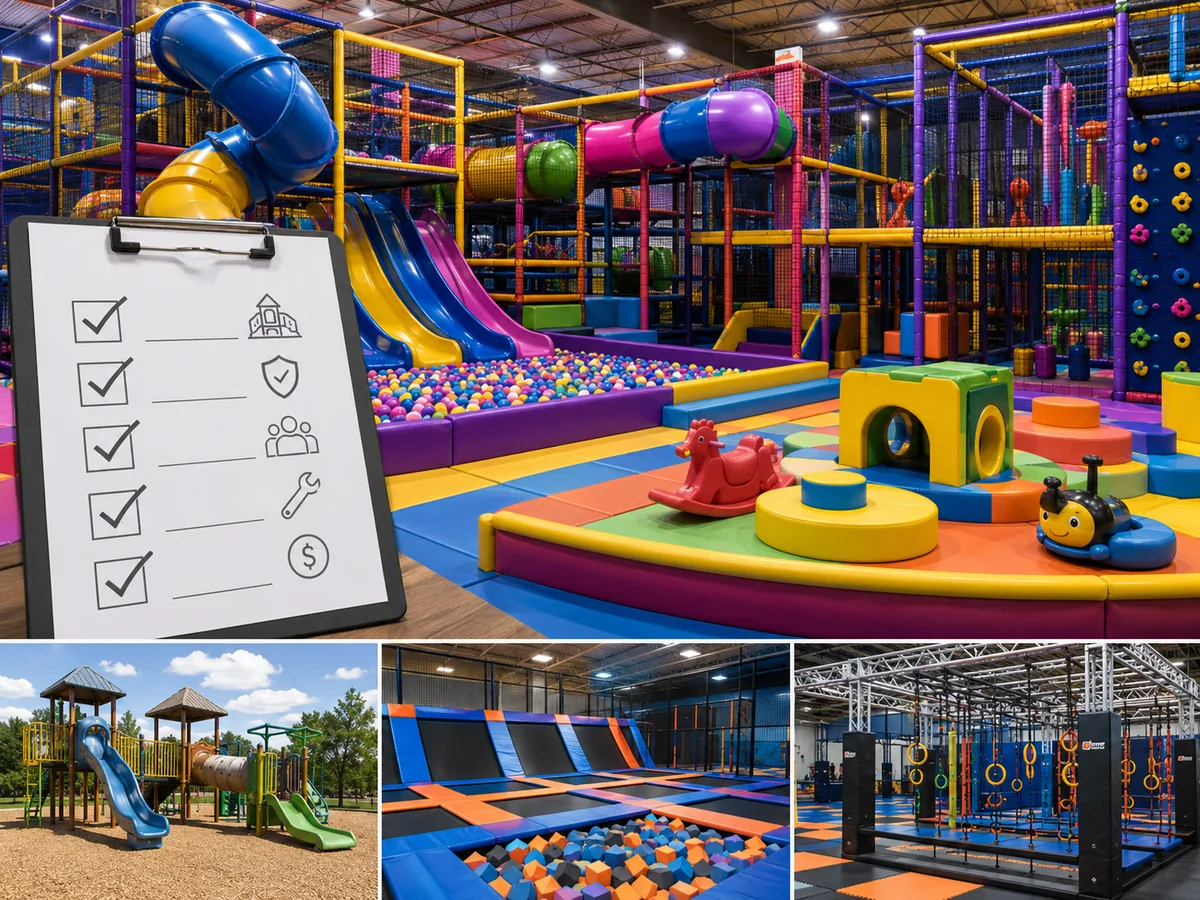
Before buying commercial playground equipment, freeze the project basis—not only the product price. The buyer should confirm the approved drawing version, usable play area, age groups, exact equipment schedule, material and document scope, quote inclusions, freight basis, installation responsibility, handover documents and local approval path. Indoor soft play, outdoor public-use equipment, trampoline courts and toddler equipment can fall under different standards and operating requirements, so one generic “playground package” is not enough for a reliable purchase order.
Why Commercial Playground Equipment Requires Pre-Purchase Confirmation
Commercial playground equipment is a project package rather than a simple retail item. The final order must fit a real building or outdoor site, serve defined users, work with the operator’s supervision model and connect to local construction, accessibility, inspection and insurance requirements where applicable.
The buyer therefore needs a controlled purchase package. At minimum, the purchase order or contract should reference an approved layout, an itemized equipment schedule, the agreed material and document scope, the commercial delivery basis and a responsibility matrix for installation and handover. Without those controls, two parties may sign the same total price while understanding the project very differently.
| Control Item | What It Should Identify | Risk if Missing |
|---|---|---|
| Approved layout | Drawing number, revision, site basis, dimensions and approved play zones | Production may follow an outdated concept or the wrong site dimensions. |
| Equipment schedule | Structures, quantities, accessories, flooring, optional items and exclusions | The buyer cannot prove which components were included in the price. |
| Specification and document register | Materials, finishes, available reports, manuals and document status | General marketing claims may be mistaken for order-specific evidence. |
| Commercial scope | Price basis, Incoterm, freight assumptions, payment terms and validity | The landed cost may be materially higher than the supplier total. |
| Responsibility and handover plan | Who measures, approves, unloads, installs, inspects, trains and maintains | Critical work can remain unassigned until equipment arrives. |
A common purchasing mistake occurs when a buyer approves a 3D rendering but never approves a dimensioned production layout. The rendering communicates appearance, not necessarily final dimensions, component quantities, exit clearances or installation interfaces. The prevention is straightforward: reference the approved-for-production drawing and equipment schedule in the order documents.
A Practical Commercial Playground Purchase-Control Process
A reliable buying process moves from project definition to controlled approval. Asking for a price before the scope is defined usually produces estimates that are difficult to compare and risky to convert directly into an order.
Confirm venue, users, operating model, site data, equipment categories, destination and target opening sequence.
Mark usable equipment boundaries, clear heights, restricted areas, routes, supervision points and installation access.
Require the same equipment, document, freight and installation categories from every bidder.
Check whether drawings, reports, project images and company documents are current and relevant to the quoted scope.
Reference approved revisions, responsibilities, terms, handover items and change-control rules before payment.
Use a formal commercial playground RFQ checklist so shortlisted suppliers respond to the same project basis. Supplier selection can then focus on scope, evidence and execution rather than inconsistent totals.
Confirm the Venue Type and Operating Use
The same equipment category can require different purchase controls in a mall, daycare, school, resort or family entertainment center. The buyer should describe how the venue will operate, who supervises it, how users enter and how the equipment connects to other revenue or service areas.
| Venue Type | Primary Operating Concern | Pre-Purchase Confirmation | Typical Scope Risk |
|---|---|---|---|
| Family entertainment center | Mixed attractions, repeat visits, party traffic and peak capacity | Zone interfaces, access control, staff routes, party adjacency and maintenance access | Attractions are selected independently and create operational cross-traffic. |
| Shopping mall | Landlord restrictions, visitor circulation and installation windows | Lease boundary, exits, ceiling services, delivery route, work hours and review documents | The layout or installation plan conflicts with mall rules. |
| Daycare or preschool | Young users, direct supervision, hygiene and licensing | Exact age range, local category, visibility, cleanability and low-height equipment suitability | A general 2–12 layout is applied to younger users without separate review. |
| School or public-use site | Age zoning, accessibility, surfacing, inspection and daily use | Public-use standard pathway, use zones, accessible routes, surfacing and maintenance records | The equipment price excludes foundations, surfacing or inspection. |
| Resort, hotel, restaurant or play cafe | Guest experience, parent visibility, compact footprint and cleaning | Relationship to seating, food service, pools, landscape, shade and staff responsibility | The play area disrupts guest flow or cannot be supervised from the intended area. |
| Contractor or distributor | Document control, logistics and local execution | Revision register, packing sequence, responsibilities, installation package and claims process | The local team receives components without usable identification or installation information. |
Confirm Indoor, Outdoor or Mixed Equipment Scope
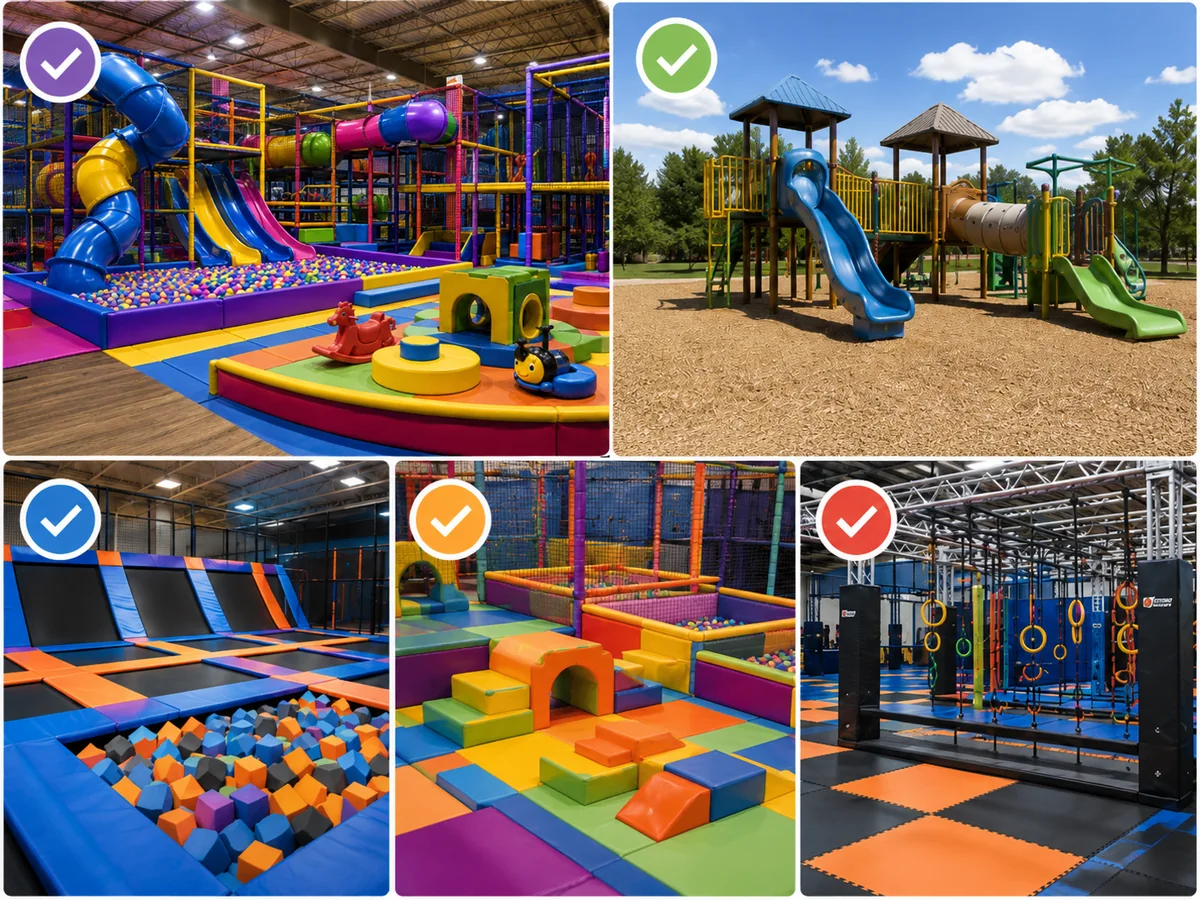
“Commercial playground equipment” can describe several technically different product groups. The order should identify each category separately because the applicable design inputs, documents, installation conditions and operating responsibilities can change.
| Equipment Category | Core Site Inputs | Purchase-Control Focus |
|---|---|---|
| Indoor playground equipment | Usable floor area, clear height, columns, ceiling services, exits and access | Approved layout, age zones, padding, barriers, cleaning access and installation sequence |
| Soft play equipment | Exact age, room use, supervision, flooring, walls and cleaning routine | Dimensions, surface materials, seams, modular or fixed status and replacement covers or parts |
| Outdoor playground equipment | Survey, slope, drainage, climate, use zones, foundations and delivery access | Public-use scope, surfacing, coatings, hardware, foundations, accessibility and inspection |
| Trampoline park equipment | Usable court area, clear height, beams, activity zones and operator model | Court system, pad coverage, decks, gates, operating documents, inspection and maintenance |
| Ninja or obstacle attractions | User profile, route difficulty, clear height, fall area and supervision | Obstacle schedule, landing system, route control, replaceable wear parts and operator rules |
A mixed FEC order should not hide all zones under one line item. Ask for zone-level prices, drawings, component lists and responsibility notes so a change to one attraction does not create uncertainty across the entire package.
Confirm Target Age Groups, Capacity Direction and Supervision
Age affects access dimensions, activity difficulty, movement speed, separation, surfacing and supervision. Capacity should not be approved from a universal “children per square meter” formula. It can depend on the installed layout, equipment manufacturer information, intended activities, operating rules, local fire or licensing limits, insurance requirements and the operator’s staffing model.
Age, Capacity and Supervision Questions
- What is the exact minimum and maximum user age for each zone?
- Are there height, skill or operating restrictions in addition to age?
- How are toddlers separated from faster or higher-intensity activities?
- What normal and peak attendance does the operator expect?
- What capacity information can the supplier provide for the final layout?
- What fire, licensing, insurance or venue limits must the owner confirm locally?
- Where will staff stand, and can they see entrances, exits and higher-risk interfaces?
- Are parents inside the play zone, outside it or admitted only in specific areas?
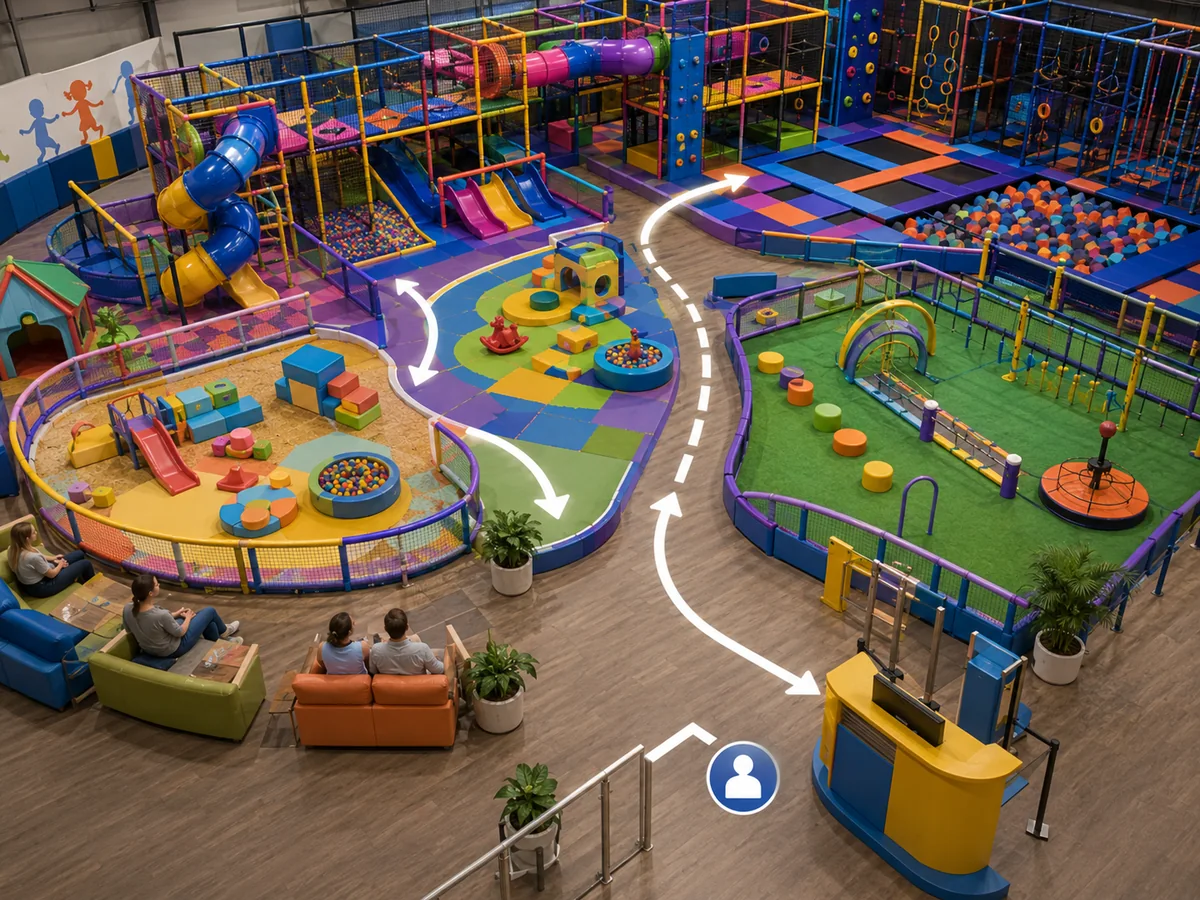
A layout conflict often appears when a toddler-zone exit meets the landing or circulation path of an older-child attraction. The risk is created by different movement speeds, not only by equipment height. Separate the paths before approving the final layout.
Confirm Site Data, Usable Area and Installation Access
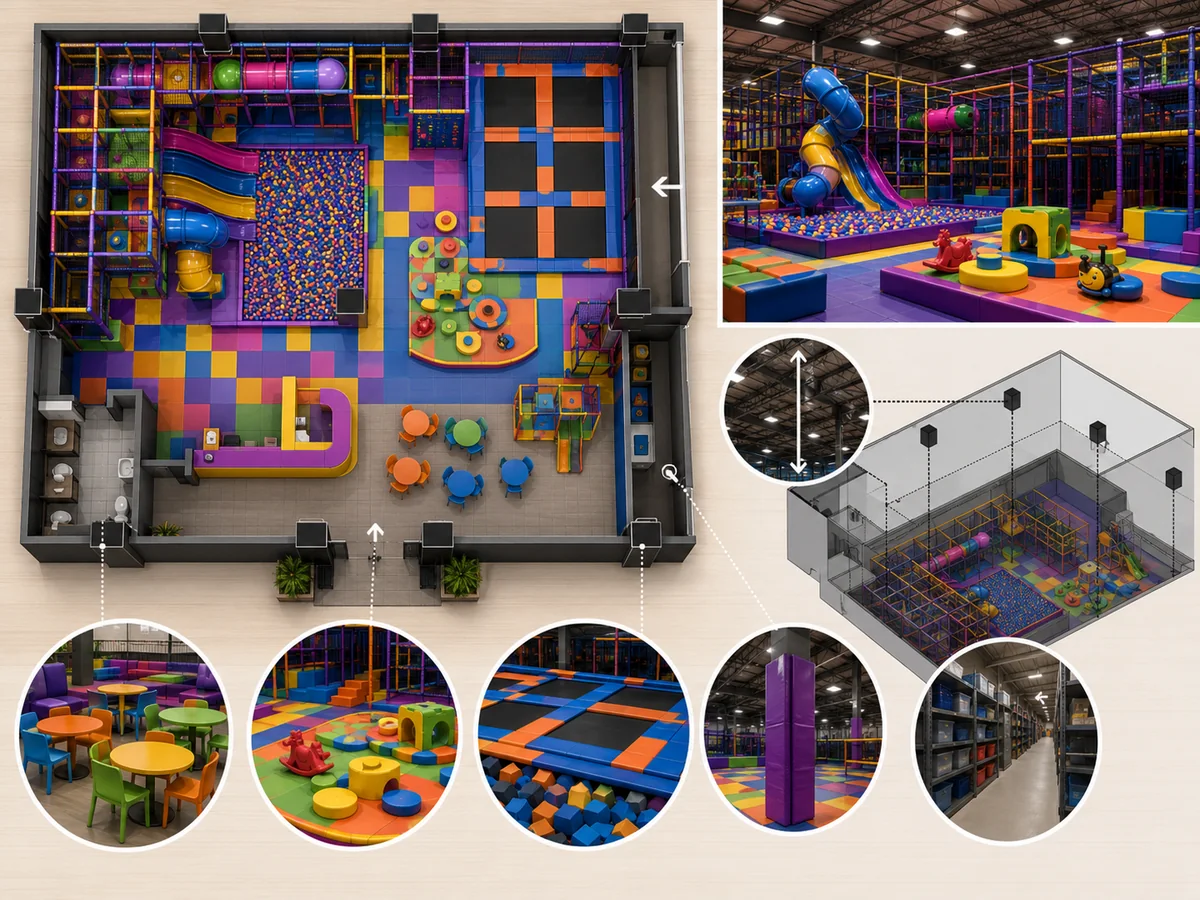
The total leased or fenced area is not automatically the equipment area. Reception, shoe storage, seating, party rooms, service routes, structural columns, doors, exits, landscaping, use zones, accessible routes and other restricted areas can reduce the usable footprint.
Indoor Site Inputs
- Dimensioned floor plan and site measurement responsibility
- Finished-floor level and clear height below beams, ducts and sprinklers
- Columns, walls, glazing, doors, exits and restricted zones
- Reception, seating, party rooms, storage and maintenance routes
- Loading bay, door, corridor, stair and elevator dimensions
- Power or data points for interactive equipment where applicable
Outdoor Site Inputs
- Survey or dimensioned site plan, slope and finished levels
- Drainage, underground utilities and ground condition
- Trees, fences, roads, pools, buildings and landscape restrictions
- Equipment use zones, accessible routes and surfacing boundaries
- Climate, UV, rain, coastal exposure, freeze-thaw or shade needs
- Truck, unloading, storage and lifting access
During installation planning, a common failure occurs when the largest packed component is wider or longer than the receiving door, corridor or elevator route. Confirm the maximum package dimensions and access path before production—not after shipment.
Buyers can use Playtime’s playground planning resources to organize floor plans and early project inputs before requesting a final layout.
Confirm Equipment Categories and Play-Zone Interfaces
The order should identify the purpose of each zone, the users, access points, interfaces and owner-side operational controls. A product list without a zone plan does not show how the venue will function.
| Zone | Confirm in the Layout | Confirm in the Quote |
|---|---|---|
| Toddler or early-years zone | Separation, direct sightlines, controlled entry, low-intensity circulation and cleaning access | Soft pieces, flooring, wall padding, gates, modular or fixed components and age basis |
| Main indoor play structure | Clear heights, access, slide exits, dead ends, staff reach and maintenance openings | Frame, decks, padding, nets, panels, slides, fasteners and listed accessories |
| Trampoline or active challenge zone | Clearance, entry control, court or route separation, attendant positions and landing interfaces | Complete system, pad coverage, gates, decks, landing systems, operational and inspection documents |
| Outdoor public-use zone | Use zones, routes, slope, drainage, shade, fencing and adjacent hazards | Equipment, foundations, surfacing, installation, inspection and maintenance scope |
| Parent, party or cafe interface | Viewing, queues, food separation, stroller movement and emergency paths | Confirm which furniture, barriers, finishes or owner-side works are excluded. |
Confirm Materials, Structure and Surface Specifications
Material review should produce an order-specific specification schedule, not a collection of general catalog statements. The supplier should identify the material or construction information that applies to the actual quoted components and clearly state which details remain subject to final approval.
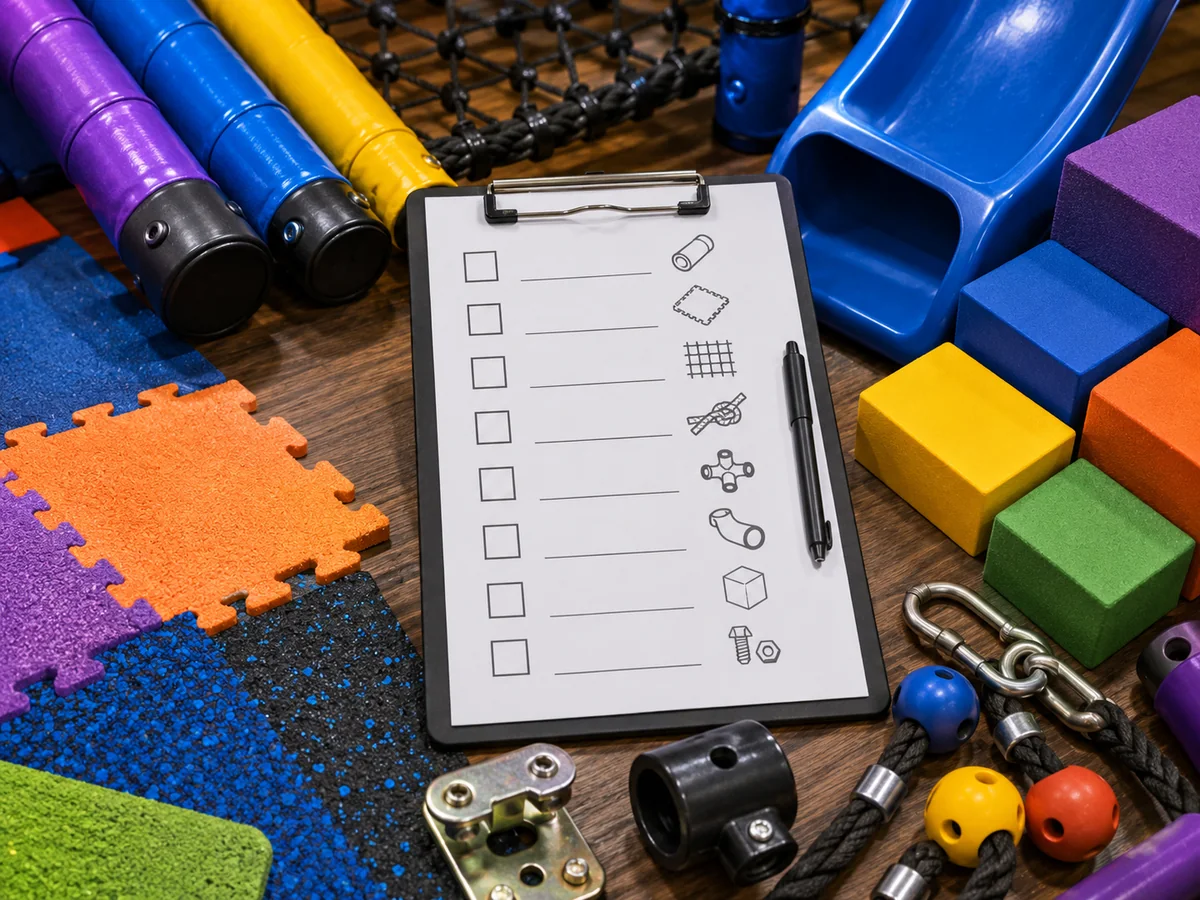
| Component Area | Buyer Should Confirm | Supporting Evidence or Control |
|---|---|---|
| Main structure and platforms | Construction type, finish, interfaces, corrosion or indoor-use assumptions and replaceable parts | Order specification, drawings and component schedule |
| Padding, foam and covers | Location, dimensions, surface material, seams, fastening, access and replacement method | Material notes, samples where agreed, cleaning and maintenance instructions |
| Nets, ropes and barriers | Function, opening or mesh details, attachment, wear points and inspection access | Drawing references, component identification and replacement information |
| Slides, plastics and panels | Exact included parts, finish, connection details, graphics and maintenance restrictions | Approved equipment schedule and artwork or color approval where applicable |
| Hardware and fasteners | Included sets, protective covers, installation sequence and spare quantities if agreed | Packing list, installation manual and box or component labels |
| Flooring or outdoor surfacing | System, covered area, substrate assumptions, transitions, installation and inspection responsibility | Separate surfacing scope and local review where required |
Do not accept “commercial grade,” “safe,” “non-toxic,” “fireproof” or “maintenance-free” as complete specifications. Ask what the claim means, which component it covers, what evidence is available and whether the evidence corresponds to the current order.
Confirm the Document Pack and Revision Status Before Production
Document control is essential when the buyer, supplier, landlord, architect, installer and operator are different parties. Each document should have a title, revision or date, purpose and status. A concept, approval drawing, production drawing and handover drawing are not interchangeable.
| Document | Minimum Content | Status to Record | Buyer Check |
|---|---|---|---|
| Project basis or RFQ | Site, users, equipment categories, destination, responsibilities and known local requirements | Issued for quotation | Did every supplier receive the same revision? |
| Layout drawing | Dimensions, zones, heights, restrictions, interfaces and drawing basis | For approval / Approved | Which revision controls the quotation and production? |
| Equipment schedule | Component descriptions, quantities, options, exclusions and zone references | Approved for order | Does it reconcile with the layout and price? |
| Material and evidence register | Applicable materials, finishes, reports, samples and limitations | Submitted / Accepted | Does each item apply to the quoted component? |
| Packing and logistics package | Packing list, volume, weight, labels, largest package and shipment basis | Before shipment | Can the site receive, store and identify the shipment? |
| Installation and handover package | Drawings, manuals, checklists, maintenance, spare parts and contacts | For installation / Handover | Is the package complete before the local team starts work? |
One quotation mistake happens when the price references a newer equipment list but the attached layout is an older revision. Before order confirmation, reconcile the quote, layout and equipment schedule line by line.
Map Standards to the Actual Equipment and Project
Different equipment types can fall under different standards. A standard title should never be used as a universal marketing badge for an entire mixed venue. Buyers should identify which standard, guideline, code or local requirement applies to each zone and who is responsible for final review.
| Equipment or Review Area | Relevant Reference Context | Important Boundary |
|---|---|---|
| Soft contained play equipment | ASTM F1918-21 | The public scope covers soft contained play equipment for the specified 2–12-year user range; it is not a universal standard for every indoor attraction. |
| Public-use playground equipment | ASTM F1487-25 | Public-use outdoor or indoor equipment within its scope should be distinguished from soft contained play, trampoline courts and other attractions. |
| Public-use equipment for 6–23 months | ASTM F2373-24 | Very-young-child equipment requires separate age-specific review; the standard’s scope does not turn every infant room into soft contained play. |
| Commercial or institutional trampoline courts | ASTM F2970-25 | The practice addresses design through operation, maintenance and inspection; manufacturer documents alone do not replace operator responsibilities. |
| Public playground guidance | CPSC 2025 Public Playground Safety Handbook | The handbook describes guidance, not a universal certification, and local jurisdictions or insurers may impose additional requirements. |
| U.S. accessibility | ADA Standards and U.S. Access Board play-area guidance where applicable | Accessibility review depends on the covered facility and complete site design, not only the purchased play component. |
When a supplier presents a certificate or report, verify the issuing body, report number, date, tested sample, product or material identification, referenced standard and scope. A genuine report can still be irrelevant if it covers a different material, model or earlier product configuration.
Confirm Accessibility, Supervision and Traffic Flow
Equipment can fit geometrically and still fail operationally. The buyer should review movement and visibility before approving the layout, particularly where different ages, attraction intensities or parent areas meet.
| Area | Confirm | Reason |
|---|---|---|
| Entry, check-in and exit | Controlled gates, queues, shoe storage, re-entry and emergency release | Prevents congestion and supports visitor management. |
| Staff supervision | Positions, sightlines, blind spots, response access and zone responsibility | Equipment arrangement should support the operator’s supervision plan. |
| Age-zone interfaces | Separate entrances, crossing points, landing paths and speed differences | Reduces conflict between young users and high-activity zones. |
| Parent and party circulation | Viewing, stroller movement, food separation, seating and party transitions | Avoids obstructing play exits and staff routes. |
| Accessible routes | Site arrival, play-area entrance, relevant components and surface transitions | Accessibility is a site and route issue, not just an equipment feature. |
| Maintenance access | Cleaning, inspection, replacement, electrical isolation and component removal | Reduces downtime and prevents hidden areas from becoming inaccessible. |
Confirm Quote Scope, Exclusions and Commercial Terms
Every line in a comparable quotation should have a status. Use included, optional, provisional, excluded or buyer-supplied. A blank cell should not be interpreted as included.

| Quote Category | Required Confirmation | Typical Hidden Difference |
|---|---|---|
| Equipment and quantities | Itemized structures, components, accessories, zones and spare items | One quote includes gates, pads or accessories that another omits. |
| Design and revisions | Included drawings, number or basis of revisions and production approval process | A low quote covers only a standard product, not site-specific design. |
| Materials and documents | Order-specific specification, available reports, manuals and limitations | General certificates are provided but do not match the purchased scope. |
| Flooring, surfacing and owner works | Area, system, substrate, transitions, installation and inspection | Equipment is quoted without the required floor or ground system. |
| Packaging and freight | Export packing, volume, weight, Incoterm, destination, validity and exclusions | “Freight included” covers only a port and excludes destination charges. |
| Installation | Manuals, remote support, supervision, labor, tools, travel and local work | “Installation included” excludes local labor or site preparation. |
| Warranty and after-sales | Start date, duration, covered items, exclusions, claim process and freight | Replacement components are offered but shipping and labor are excluded. |
| Commercial terms | Currency, taxes, payment milestones, lead-time basis, validity and change rules | Lead time begins only after drawing approval, but the quotation does not state it. |
For cost-layer clarification, use the indoor playground equipment cost guide to distinguish equipment price, landed cost and the wider owner-side project budget.
Project Responsibility Matrix: Supplier, Buyer and Local Specialists
Responsibility should be assigned to named parties rather than described as “by others.” The exact allocation varies by project, but the matrix should cover measurement, design approval, authority review, logistics, installation, commissioning and operation.
| Project Area | Supplier Scope to Confirm | Buyer / Local-Team Scope to Confirm | Control Question |
|---|---|---|---|
| Site measurement | Required input format and review assumptions | Who measures and certifies final dimensions and levels | Who owns errors in the site information? |
| Equipment layout | Drawing production, revisions, equipment interfaces and approval status | Landlord, architect, operator and authority review | Which drawing revision is approved for production? |
| Local compliance | Available product and project documents | Code, fire, accessibility, licensing, insurance and permit pathway | Who confirms final local requirements and by what date? |
| Site preparation | Equipment interface and stated substrate or foundation assumptions | Floor, foundations, drainage, power, walls, ceilings and protection | What must be complete before delivery or installer mobilization? |
| Freight and receiving | Export packing, documents and agreed delivery basis | Import, destination charges, delivery, unloading, storage and security | Where does supplier risk and cost responsibility end? |
| Installation | Manual, remote guidance, supervisor or labor if agreed | Local crew, tools, lifting, utilities, access and permits | Who performs, supervises and accepts the installation? |
| Opening and operation | Handover documents and equipment guidance in the agreed scope | Inspection, staff training, operating rules, daily checks and maintenance | What must be closed before public use begins? |
Confirm Packing, Freight, Receiving and Installation
International supply introduces interfaces that are not visible in the equipment drawing. The buyer should review packing dimensions, shipment basis, receiving access, storage, installation sequence and site readiness before the supplier releases production or shipment.
Packing and Freight Questions
- What is the agreed Incoterm, named place and quotation validity?
- What are the estimated packing volume, gross weight and largest package dimensions?
- Are boxes and loose components labeled by drawing, zone or installation sequence?
- Are export packing, container loading, freight, insurance and shipping documents included?
- Which port, terminal, customs, duty, inland-delivery and unloading costs are excluded?
- Who provides a forklift, crane, dock, labor and secure storage?
- How are shortages or transit damage recorded at receiving?
Installation and Site-Readiness Questions
- Are installation drawings, manuals and revision-controlled component lists included?
- Is support remote, supervisory or full labor, and what exactly is excluded?
- Who supplies local labor, tools, scaffolding, lifting equipment and consumables?
- Who covers travel, visas, accommodation, local transport and working permits where applicable?
- What floor, foundation, wall, power, lighting, HVAC, fire-protection or drainage work must be complete?
- What happens if the site is not ready when the equipment or installation team arrives?
- Who performs the completion inspection, punch list and final acceptance?
A common execution problem occurs when an installer mobilizes while flooring, foundations, ceiling services or fire work are still incomplete. The result can be stoppage, remobilization cost and damage by later trades. Use a signed site-readiness checklist before shipment and again before installation starts.
Confirm Maintenance, Spare Parts and After-Sales Processes
A commercial playground requires inspection, cleaning, maintenance and part replacement after opening. The purchase package should state what the supplier provides and what remains the operator’s responsibility.
| After-Sales Area | Confirm in Writing |
|---|---|
| Installation questions | Contact method, working hours or response process, required photos and component identification |
| Shortage or damage claims | Inspection window, evidence, packing references, remedies and freight responsibility |
| Spare and wear parts | Part numbers, recommended initial spares, availability, compatibility and ordering method |
| Warranty | Start date, duration, covered components, exclusions, labor and transport responsibility |
| Cleaning and maintenance | Surface-specific instructions, inspection frequency guidance, adjustment and replacement criteria |
| Change or expansion | Whether future parts must match the original drawing, system and current conditions |
Do not assume a fixed warranty period, response time, spare-part price or delivery time unless it is written into the project documents.
Handover and Opening-Readiness Checklist
Shipment arrival is not the end of the purchase. Before public use, the buyer should confirm that the installed scope, documents, outstanding defects, operator responsibilities and local approvals are complete.
Handover Items to Close
- Final approved layout and equipment schedule
- Final packing list and resolved receiving discrepancies
- Installation drawings, manuals and component identification
- Installed-equipment completion check and documented punch list
- Required local inspection, authority, landlord or insurer sign-off
- Cleaning, inspection and preventive-maintenance instructions
- Recommended spares, replacement-part process and after-sales contacts
- Warranty terms, exclusions and claim evidence requirements
- Operator rules, capacity controls, age or height rules and emergency procedures
- Staff training and responsibility for daily pre-opening inspection
Red Flags Before Buying Commercial Playground Equipment
Pause the purchase if a material risk cannot be closed. A low score in a critical area should not be averaged away by attractive design or a lower price.
- The quotation does not reference a floor plan, drawing number or revision.
- The supplier prices only from total square meters without defining the equipment boundary.
- There is one total amount but no equipment schedule, quantities or zone breakdown.
- Material claims are vague, absolute or unsupported by order-specific information.
- Certificates or project photos cannot be linked to the supplier, product, material or date.
- The supplier claims universal ASTM, CPSC, ADA or worldwide compliance.
- Indoor soft play, outdoor public-use equipment and trampoline areas are treated as if they use one identical standard.
- “Shipping included” has no Incoterm, named destination, volume or excluded destination charges.
- “Installation included” has no labor, tools, travel, site-work or acceptance definition.
- No one can explain box labels, receiving checks, missing-part claims or replacement-part identification.
- The supplier pressures the buyer to pay before revisions, responsibilities and exclusions are frozen.
RFQ Checklist: What Buyers Should Send Before Requesting a Quote
A complete RFQ creates more comparable quotations and exposes missing information early. Send the same package to every shortlisted supplier.
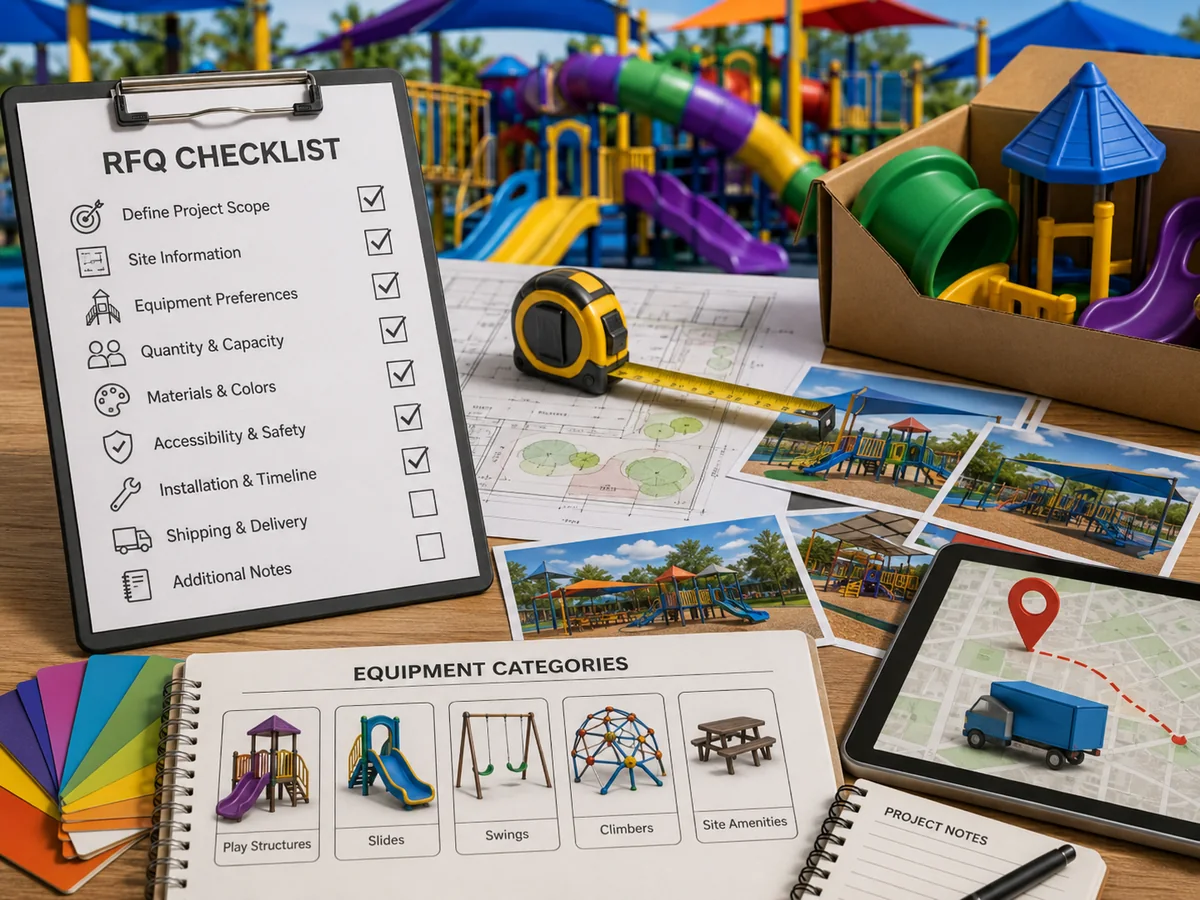
Information to Prepare
- Buyer, project and venue type
- Indoor, outdoor or mixed equipment categories
- Dimensioned plan, CAD file, survey and site photos where available
- Marked usable equipment area and all restricted zones
- Indoor clear heights or outdoor slope, drainage and ground information
- Exact age groups, expected attendance and supervision model
- Required play zones, must-have equipment and optional attractions
- Theme, color or brand requirements and artwork responsibility
- Known standards, authority, landlord, insurance or inspection requirements
- Required drawings, reports, manuals, samples and handover documents
- Destination country, city, named delivery point and preferred Incoterm
- Door, corridor, elevator, gate, truck, unloading and storage conditions
- Installation preference and local-contractor capability
- Target site-readiness, shipment and opening sequence
- Budget direction and required quote currency where available
For supplier qualification before issuing the RFQ, use the separate guide on how to choose an indoor playground equipment supplier. This page focuses on purchase confirmation after the project and bidders have been narrowed.
How Playtime Supports Commercial Playground Equipment Buyers
Playtime Playground can review project inputs, discuss suitable equipment categories, develop a project-based layout direction and prepare a quotation around the confirmed scope. The available drawings, specifications, packing information, shipping basis and installation support should be confirmed project by project in the quotation and final agreement.
Buyers can review Playtime’s playground projects, project services and product categories before preparing the RFQ. Project images and website content should be treated as capability references; the final order remains controlled by the approved project documents.
Request a Scope-Based Commercial Playground Quote
Send the dimensioned plan or site survey, marked usable area, age groups, equipment categories, destination, access conditions, installation preference and known local requirements. Playtime can review the project basis and discuss a quotation tied to the actual equipment and support scope.
Send Project Details for ReviewFAQ
What must be confirmed before buying commercial playground equipment?
Confirm the approved drawing revision, usable equipment area, age groups, equipment schedule, material and document scope, quotation inclusions, delivery basis, installation responsibility, handover package and local approval path. These items should be written into or referenced by the purchase order or contract.
Is a 3D playground design enough to place an order?
No. A 3D concept can communicate appearance, but the order should reference a dimensioned approved-for-production layout and an itemized equipment schedule. Confirm the drawing number, revision, dimensions, zones, quantities and exclusions before production.
Can all commercial playground equipment use the same safety standard?
No. Soft contained play, public-use playground equipment, equipment for very young children and commercial trampoline courts can fall under different standards and operational responsibilities. The applicable requirements should be mapped by equipment zone and confirmed with the local project team.
How should commercial playground quotations be compared?
Normalize each quote using the same categories: equipment, design, materials, documents, flooring or surfacing, packing, freight, installation, warranty, spare parts and commercial terms. Mark every item as included, optional, provisional, excluded or buyer-supplied.
What documents should be approved before production?
Approve the controlling layout revision, final equipment schedule, relevant material or finish schedule and commercial scope. Also agree which reports, manuals, packing documents, installation information and handover documents will be provided and when.
Is freight or installation automatically included in the equipment price?
No. Confirm the Incoterm, named place, packing volume, destination charges, inland delivery, unloading and storage. For installation, confirm drawings, remote support, supervision, labor, tools, travel, local works, site readiness and final acceptance separately.
What are the most serious pre-purchase red flags?
Major red flags include no drawing revision, no itemized equipment schedule, irrelevant certificates, universal compliance claims, unclear freight or installation responsibilities, no receiving or spare-parts process, and pressure to pay before scope and exclusions are frozen.
What should I send for a commercial playground RFQ?
Send the venue type, equipment categories, dimensioned plan or survey, marked usable area, clear heights or outdoor site conditions, age groups, expected attendance, play zones, destination, access conditions, required documents, installation preference, schedule and known local requirements.