






Leitfaden zu den Kosten für Outdoor-Spielplätze
Kosten für Outdoor-Spielplatzgeräte für Schulen und Resorts: Was Käufer vergleichen sollten
Gewerbliche Outdoor-Spielplatzgeräte werden projektbezogen kalkuliert und nicht anhand einer universellen Preisliste. Schulen und Resorts sollten drei verschiedene Zahlen separat vergleichen: das Angebot für die Geräteausstattung, die Anschaffungskosten der Geräte und das Budget für das komplette installierte Projekt. Die Geländegestaltung, Altersgruppe, Geräteauswahl, Fallschutzoberfläche mit kritischer Fallhöhe, Beschattung, Klimaeinwirkung, Fracht, Fundamente und die Installationsverantwortung können die Endkosten verändern, selbst wenn zwei Projekte eine ähnliche Spielstruktur verwenden.
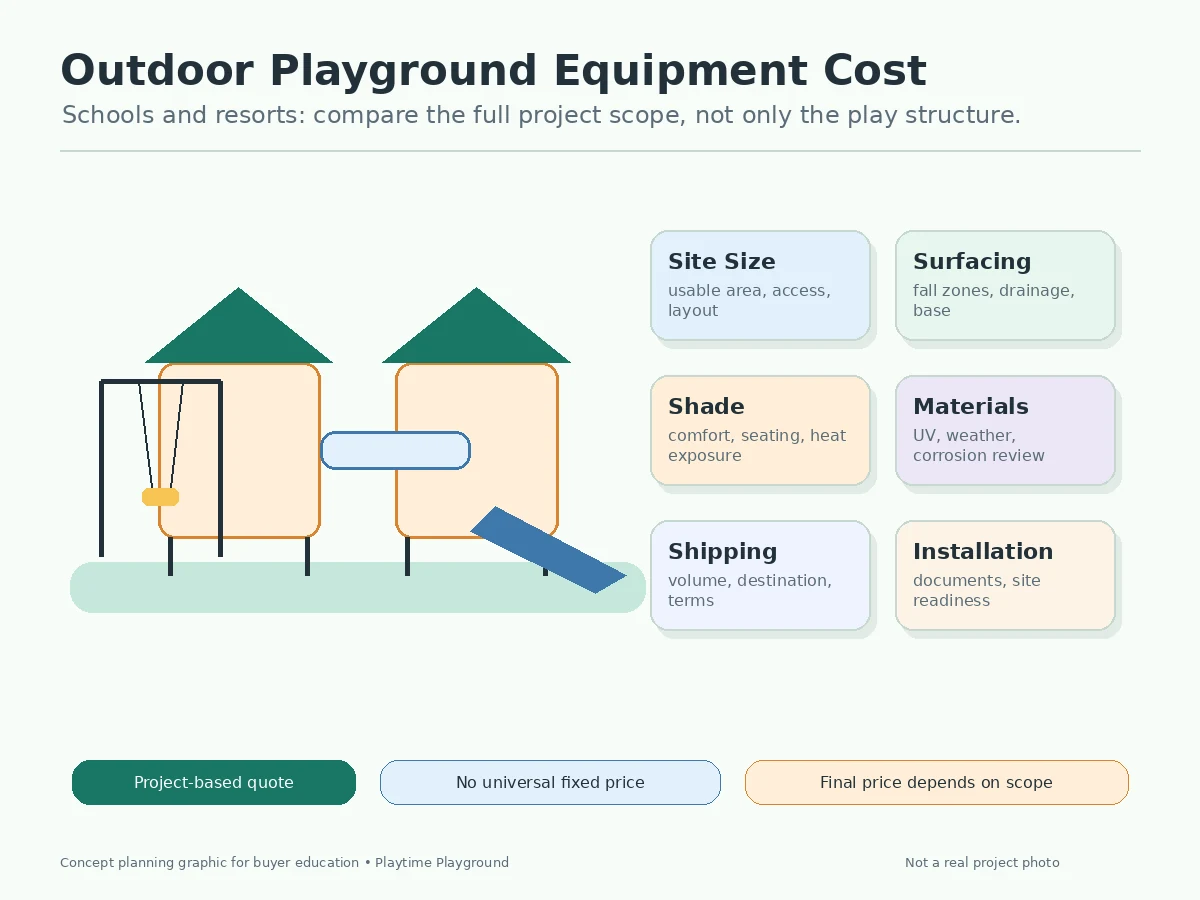
Kosten für Outdoor-Spielplatzgeräte vs. Gesamtkosten des Projekts
Die erste Kostenfrage sollte lauten: welches Budgetniveau wird verglichen? Ein Angebot für die Geräteausstattung kann Spieltürme, Rutschen, Klettergeräte, Schaukeln, Seilelemente, Verkleidungen, aufgeführte Hardware, Planungsunterlagen und Exportverpackung umfassen. Es beinhaltet nicht automatisch Fracht, Zielgebühren, Fundamente, Sicherheitsböden, Beschattung, lokale Arbeitskräfte, Inspektion oder bauseitige Arbeiten des Eigentümers.
Ein komplettes Budget für Schul- oder Resort-Spielplätze ist umfassender. Es kann Tiefbauarbeiten, Entwässerung, barrierefreie Zugangswege, stoßdämpfende Oberflächen, Zäune, Fundamente für Beschattung, Elektro- oder Beleuchtungsarbeiten, Landschaftsgestaltung, lokale Genehmigungen, unabhängige Inspektion, Versicherungsanforderungen und Vorbereitungen für die laufende Wartung beinhalten. Zwei Lieferanten können daher ähnliche Geräte anbieten, dem Käufer aber sehr unterschiedliche Restkosten hinterlassen.
| Budgetebene | Normalerweise enthalten | Erfordert noch Bestätigung | Nutzung durch den Käufer |
|---|---|---|---|
| Angebot für Spielgeräte | Bestätigte Spielgeräte, aufgeführte Hardware, angegebener Designumfang, Dokumente und Exportverpackung | Fracht, Oberflächen, Fundamente, lokale Arbeitskräfte, Beschattung, Inspektion und Arbeiten auf Eigentümerseite, sofern nicht ausdrücklich enthalten | Vergleicht den Umfang der hergestellten Ausrüstung |
| Angebotene Ausrüstung vor Ort | Ausrüstung zuzüglich der vereinbarten Frachtbasis und aller ausdrücklich aufgeführten Zielartikel | Zoll, Abgaben, Binnenlieferung, Entladung, Lagerung und Zugang zum Standort können außerhalb des Angebots bleiben | Schätzt, was für die Anlieferung der Ausrüstung zum Projektstandort erforderlich ist |
| Budget für installierte Spielplatzprojekte | Ausrüstung, Logistik, Fundamente, Installation, Fallschutz, Zugang, Beschattung und andere enthaltene Projektarbeiten | Genehmigungen, lokale professionelle Überprüfung, Inspektion, Landschaftsgestaltung, Versicherung und Betriebsvorbereitung können auf Eigentümerseite verbleiben | Unterstützt die Kapitalplanung und Genehmigung |
Für Käufer, die Angebote prüfen Gewerbliche Outdoor-Spielplatzgeräte, der aussagekräftige Vergleich ist nicht die niedrigste Schlagzeilennummer. Es ist das Angebot, das jede Einbeziehung, Option, Zulage, Annahme und jeden Ausschluss identifiziert.
Schul- vs. Resort-Spielplatzkosten: Warum der Umfang unterschiedlich ist
Schulen und Resorts können ähnliche Spielkomponenten kaufen, aber sie priorisieren normalerweise unterschiedliche Projektergebnisse. Eine Schule legt im Allgemeinen mehr Wert auf tägliche Nutzung, Alterszonierung, Aufsicht durch das Personal, zugängliche Zirkulation, Haltbarkeit, Inspektion und Wartungsplanung. Ein Resort oder Hotel bewertet auch das Gästeerlebnis, die visuelle Integration, die Elternaufsicht, die Beschattung, die Sitzgelegenheiten, die Koordination mit der Landschaftsgestaltung und wie der Spielplatz mit Pools, Restaurants oder Unterkünften zusammenhängt.
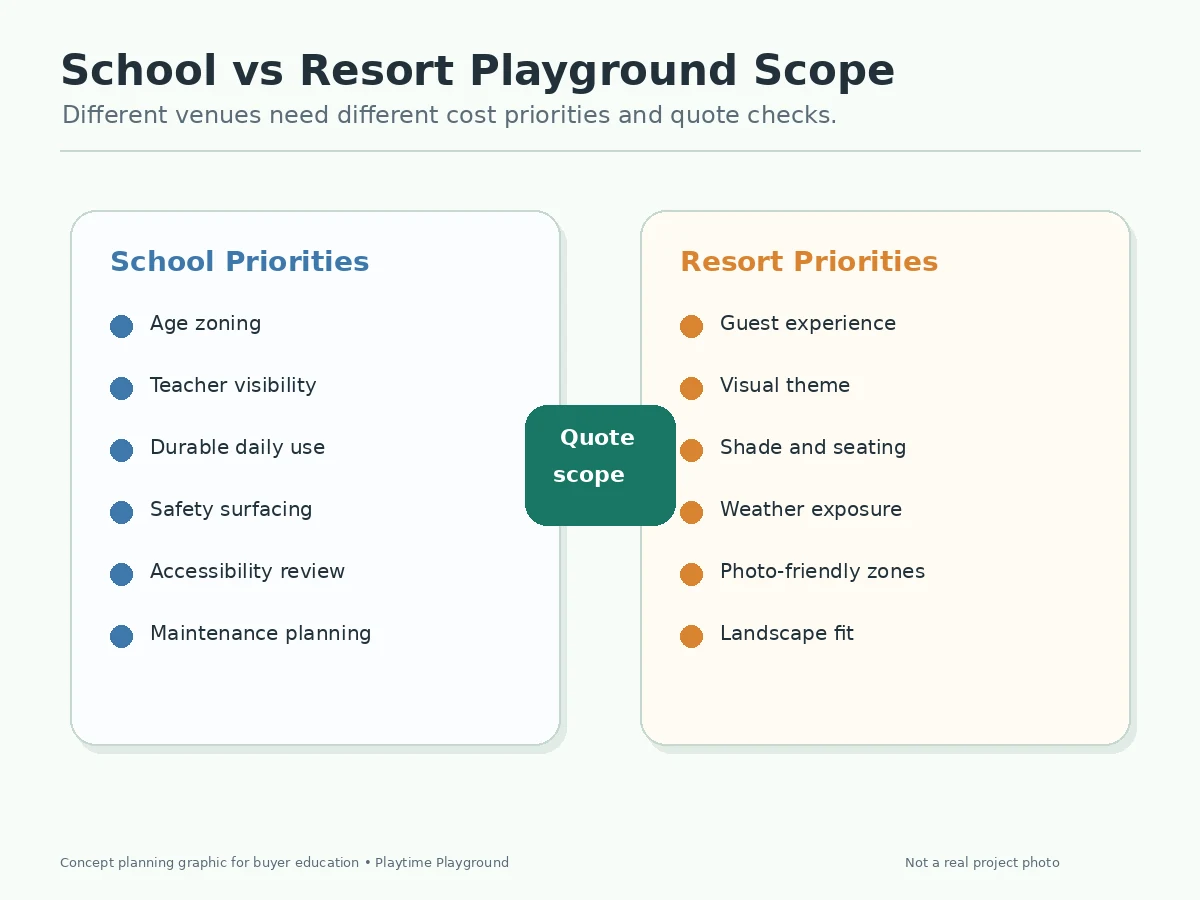
| Käufertyp | Primäres Projektziel | Umfang, der oft die Kosten beeinflusst | Wichtige Genehmigungsfrage |
|---|---|---|---|
| Schule | Tägliche Nutzung durch Schüler unter klarer Aufsicht und altersgerechter Aktivität | Alterszonen, Kapazitätsvorgaben, barrierefreie Wege, Oberflächen, Einzäunung, Inspektions- und Wartungsdokumente | Entspricht das Design den Anforderungen des Schulbezirks, der lokalen Behörden und des Risikomanagements? |
| Resort oder Hotel | Familiengast-Erlebnis integriert in die Immobilie | Thema, Beschattung, Sitzgelegenheiten, Schnittstelle zur Landschaftsgestaltung, Materialien für Küsten- oder Hoch-UV-Bereiche und Sichtbarkeit für Eltern | Passt der Spielplatz in den Gästebereich, ohne Konflikte mit Pools, Straßen oder Servicebereichen zu verursachen? |
| Öffentliche oder gemeinschaftliche Anlage | Breiter öffentlicher Zugang und inklusive Nutzung | Zugängliche Wege, altersübergreifende Geräte, Fallschutz, Beschilderung, Inspektions- und Wartungsplanung | Welche Standards für öffentliche Nutzung und Beschaffungsanforderungen gelten? |
| Auftragnehmer oder Händler | Lieferung eines definierten technischen und kommerziellen Umfangs | Zeichnungen, Stückliste, Verpackung, Incoterm, Fundamente, Installationsdokumente und Garantieabgrenzungen | Kann jeder angebotene Artikel mit der Ausschreibung oder der Spezifikation des Eigentümers abgeglichen werden? |
Ein typischer Fehler auf Schulgeländen ist die Auswahl von Geräten aus einem Katalog, bevor die Sichtlinien der Aufsichtspersonen und nutzbare Fallschutzbereiche bestätigt wurden. Das Ergebnis kann eine geometrisch passende Anordnung sein, die jedoch die Sichtbarkeit des Personals blockiert oder nicht ausreichend Fallschutz bietet. Ein typischer Fehler auf Resortgeländen ist die Genehmigung des visuellen Themas, bevor Sonneneinstrahlung, Sitzgelegenheiten für Eltern und Wartungszugang geprüft wurden. Beide Probleme sind leichter vor der Designfreigabe zu verhindern als nach der Produktion.
Hauptkostenfaktoren für Outdoor-Spielplatzgeräte
Die Kosten für einen Outdoor-Spielplatz werden durch den genehmigten Projektumfang bestimmt, nicht allein durch die sichtbare Spielstruktur. Dieselbe Gerätefamilie kann unterschiedliche Angebote ergeben, wenn sich Standort, Fallschutz, Fundament, Klima, Lieferung und Installationsannahmen ändern.
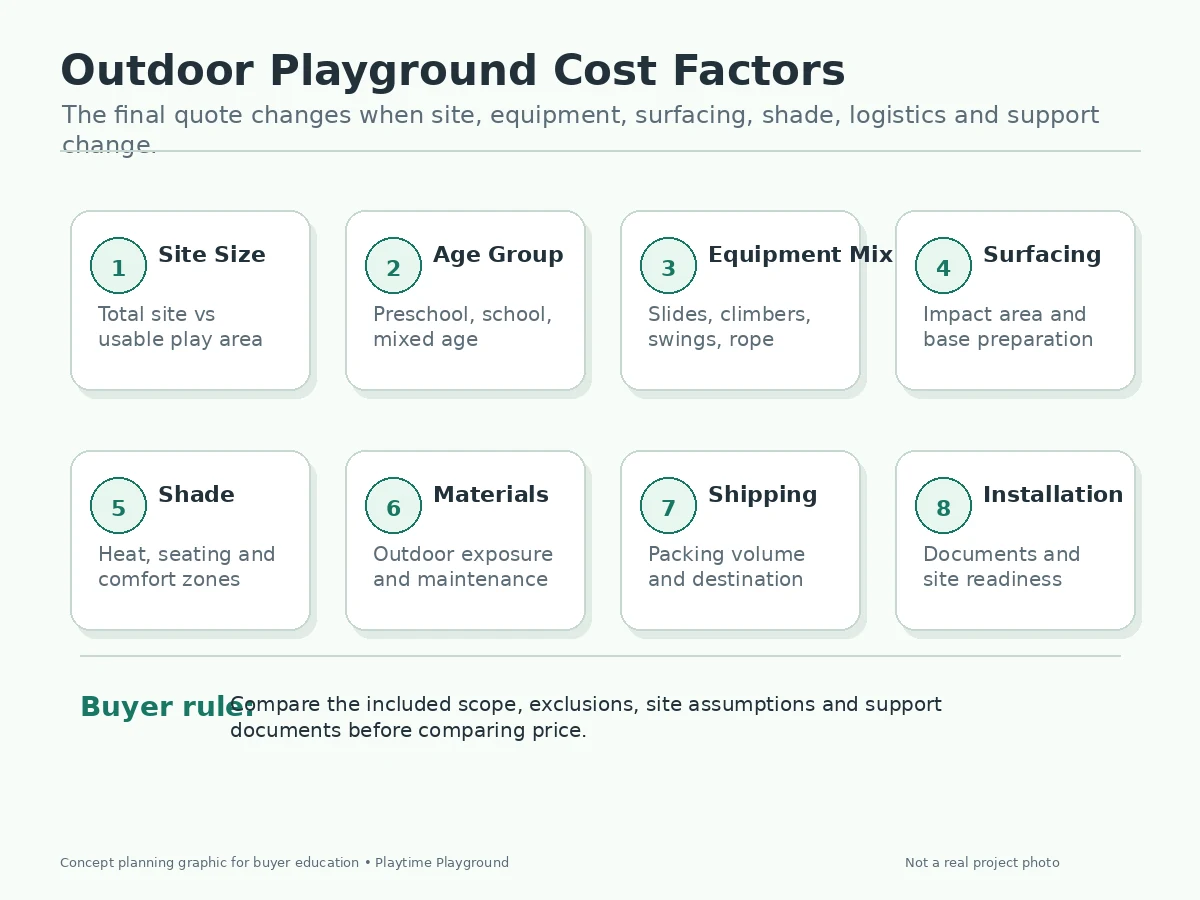
| Kostenfaktor | Warum es das Angebot beeinflusst | Was der Käufer bereitstellen sollte |
|---|---|---|
| Nutzbarer Standort und Grundriss | Use zones, access routes, trees, slopes, utilities, drainage and boundaries reduce the area available for equipment | Dimensioned plan, survey or marked site sketch with photos |
| Age range and use model | Different users require different access, platform heights, activity intensity, separation and supervision | Exact age groups, school grades or guest profile and operating model |
| Ausstattungsliste | Towers, swings, rope play, inclusive components and freestanding items have different space, foundation and surfacing needs | Core items, optional items and future-phase items |
| Protective surfacing | Area, critical fall height, surface system, accessible route, base, drainage and installation affect project cost | Local requirements, proposed surface type and responsibility matrix |
| Shade and site furniture | Independent shade, seating, fencing and signage may need separate structure, foundations or local review | Comfort requirements, wind exposure and whether these items are supplier- or owner-supplied |
| Outdoor environment | UV, heat, rain, humidity, freeze-thaw cycles and coastal exposure influence finish and maintenance discussions | Climate, coastal distance, exposure and maintenance expectations |
| Logistics | Packed volume, long components, port, Incoterm, inland delivery, unloading and storage affect landed cost | Destination, access route, unloading plan and requested delivery basis |
| Foundations and installation | Anchor design, concrete work, site tolerances, local labor, tools and inspection responsibilities vary by project | Ground condition, local contractor plan, site-readiness date and installation preference |
The most useful quotation is the one that connects each cost to a stated drawing, equipment list, material or finish note, surfacing assumption, logistics basis and installation responsibility.
Standortgröße, Layout und nutzbare Spielfläche
Total land area is not the same as usable playground area. The design must reserve equipment use zones, circulation, accessible routes, entrances, supervision positions, drainage paths, landscape setbacks, fencing, shaded rest areas and installation access. Existing trees, retaining walls, slopes, utilities and nearby roads, pools or buildings may further reduce the usable footprint.
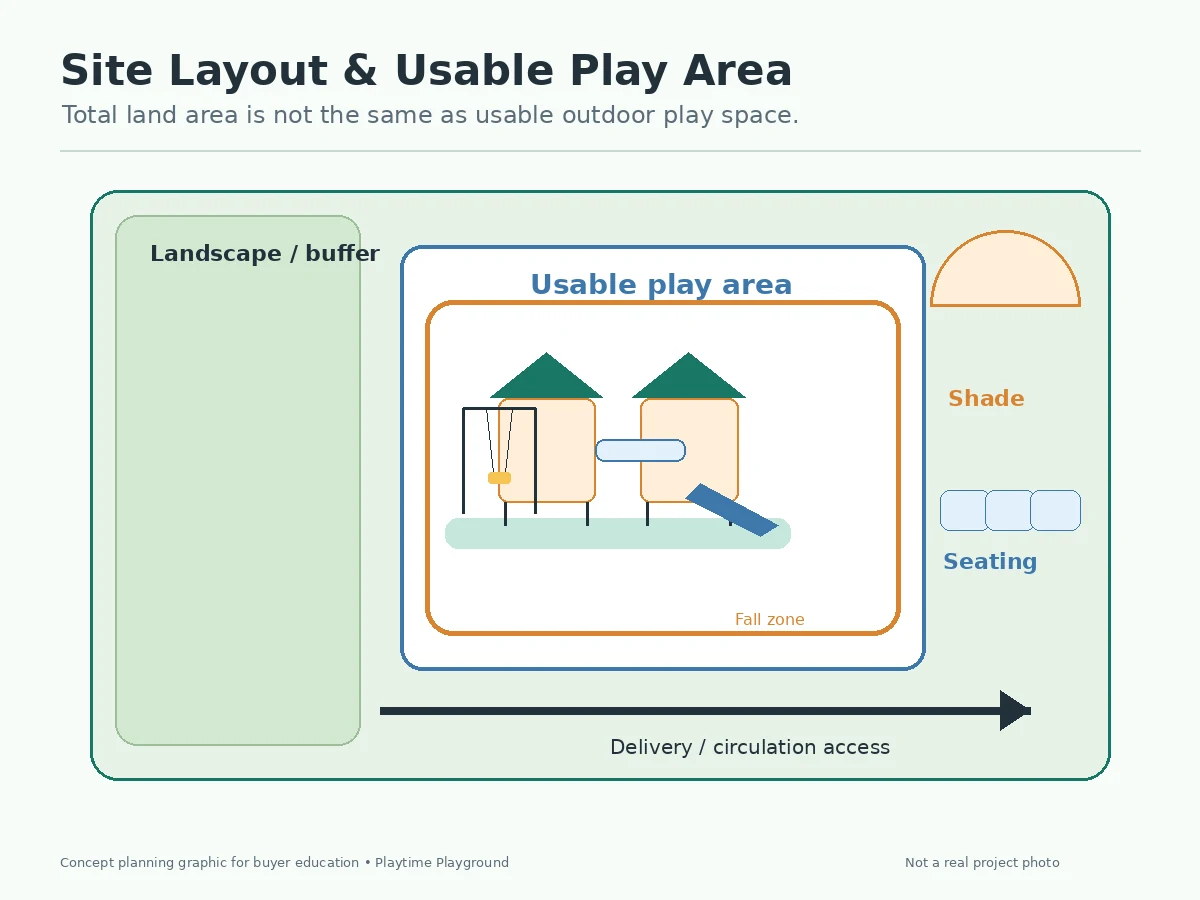
A common planning issue occurs when a buyer reports a large site area but the survey later shows a drainage swale, protected trees, underground services and a narrow delivery gate. The equipment concept then has to be reduced or relocated. Marking these constraints before layout development prevents redesign and makes supplier quotations more comparable.
Informationen zur Standortvorbereitung
- Dimensioned site plan, survey, CAD file or clearly marked sketch
- Site photos from several directions
- Property boundaries, fences, roads, buildings and adjacent hazards
- Slopes, drainage paths, retaining walls and known underground services
- Existing trees, landscape features and areas that must remain clear
- Proposed entrances, accessible route and supervision positions
- Delivery gate, unloading area and installation access
- Target age groups and planned operating capacity direction
Playtime’s Ressourcen für die Spielplatzplanung can help organize early site information before a formal RFQ is issued.
Checkliste für die Bereitschaft von Outdoor-Spielplatzprojekten
A buyer does not need every engineering detail before the first supplier discussion, but the project team should identify who owns the site, surfacing, foundation, accessibility, logistics and inspection decisions. A quotation based on undefined owner-side work is not yet a complete project budget.
| Bereitschaftsbereich | Warum es wichtig ist | Was zu bestätigen ist |
|---|---|---|
| Zugang zum Standort | Long or bulky components may need a truck route, unloading space or lifting plan | Gate width, road condition, delivery restrictions and unloading responsibility |
| Ground and drainage | Subgrade, slope and water management affect foundations and surfacing | Who designs and completes excavation, drainage, base and concrete work |
| Utilities and obstructions | Unknown services can conflict with excavation and anchors | Utility locating, exclusion zones and local permit responsibility |
| Climate exposure | High UV, coastal air, heat, heavy rain or freeze-thaw conditions influence finish and maintenance planning | Environmental conditions and requested material or finish documentation |
| Approval pathway | Schools, resorts and public sites may require different professional reviews and inspections | Local authority, school district, resort operator, insurer and independent inspector requirements |
| Site-readiness date | Installation delays occur when foundations, access or surfacing work are incomplete | Handover conditions and who verifies readiness before installers arrive |
For early coordination, buyers can review Playtime’s Spielplatzprojekt-Dienstleistungen and define which work remains with the owner, local consultant or contractor.
Age Group, User Capacity and Supervision
Age range affects equipment dimensions, access, activity intensity, separation, surfacing and supervision. Capacity should not be calculated from one universal person-per-square-meter rule. It depends on the equipment schedule, use zones, age mix, operating procedures, local requirements, manufacturer information and the owner’s supervision model.
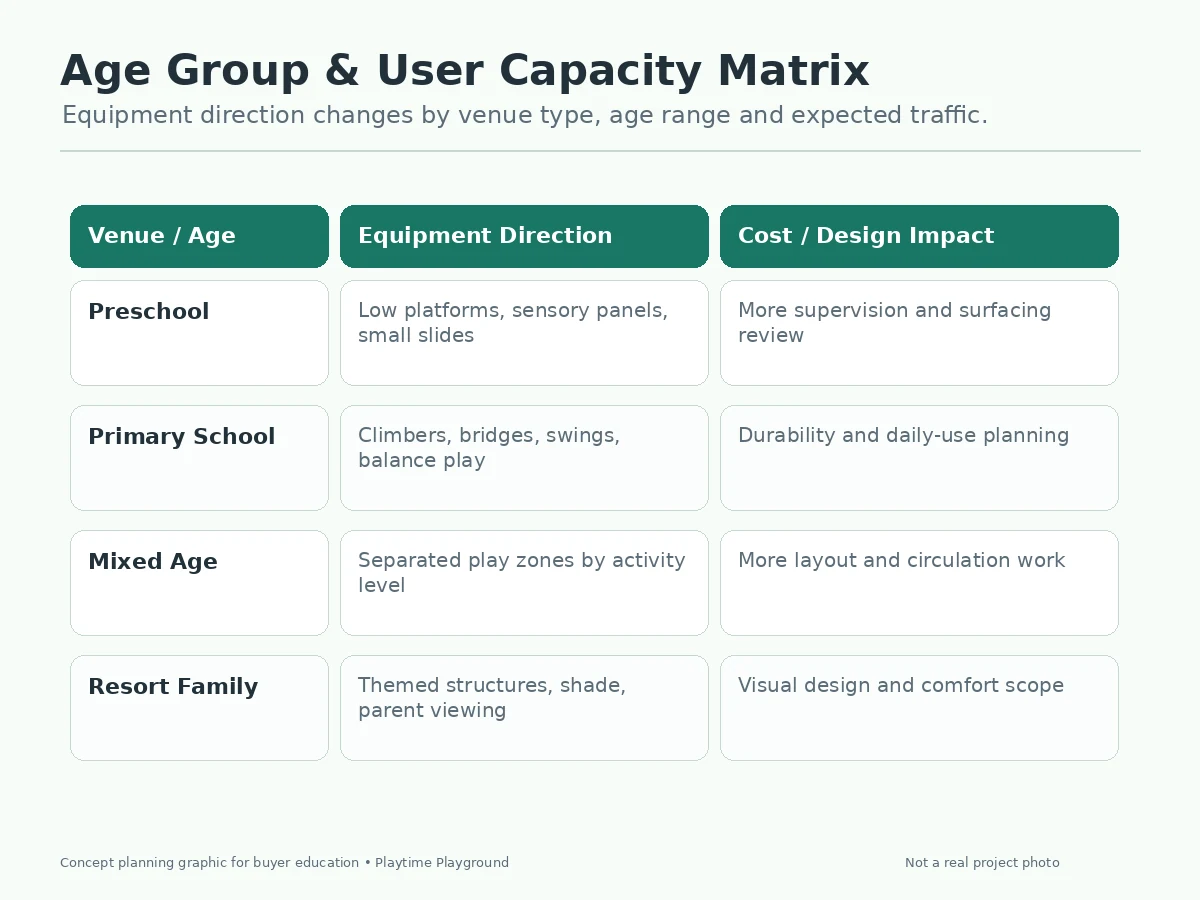
| Benutzergruppe | Typical Direction | Cost and Layout Effect | Buyer Check |
|---|---|---|---|
| Children 6–23 months | Public-use equipment specifically intended for this age range, low access and direct supervision | Separate product suitability, surfacing and local childcare or early-learning review may be required | Do not assume equipment intended for ages 2–12 automatically applies |
| Preschool and early primary | Lower platforms, smaller slides, panels, bridges and lower-intensity climbing | More emphasis on supervision visibility, age separation and accessible ground-level activity | Confirm the exact intended age range and local rules |
| Grundschule | Broader climbing, sliding, balancing and social-play options | More varied equipment, use zones, surfacing and circulation | Confirm grade groups, recess patterns and staff supervision |
| Mixed-age school or resort | Clearly separated zones or equipment selected for distinct user groups | More layout coordination, signage, circulation and supervision planning | Prevent high-speed routes from crossing younger-child areas |
For U.S. public-use projects, ASTM F1487-25 covers public playground equipment for users from the 5th-percentile two-year-old through the 95th-percentile twelve-year-old range, while public-use equipment for children 6–23 months is addressed separately. The applicable standard and local requirements must be confirmed for the actual product and project.
Equipment Mix: What Schools and Resorts Should Compare
Equipment mix changes more than the product price. Each item can affect use-zone area, foundations, surfacing, accessible routes, supervision, inspection and maintenance. Buyers should separate the core play system from freestanding items, inclusive components, shade and future-phase options.
Composite Towers and Slides
Confirm platform levels, access methods, slide exits, use zones, age designation, foundations and all listed panels or roofs.
Swings and Dynamic Equipment
These items can require substantial clearance and dedicated surfacing. Confirm bay count, seat types, separation and whether the layout includes the full use zone.
Climbers, Ropes and Balance Play
Review intended ages, challenge level, fall height, surfacing extent, tensioned components and inspection requirements.
Inclusive and Ground-Level Play
Do not treat one accessible component as a complete accessibility strategy. Review accessible routes, transfer or ramp access, clear ground spaces and the overall play experience.
A school may protect the core age zones and supervision lines first, then add optional freestanding items later. A resort may prioritize one visually distinctive composite structure but should still reserve budget for shade, seating, access and maintenance. Buyers can review Playtime’s outdoor playground equipment range before issuing a layout-based request.
Sicherheitsböden und Bodenvorbereitung
Protective surfacing can be a major cost layer because the required system is tied to the equipment layout, use zones and critical fall height—not simply the total site area. The quotation should state the proposed surface system, area, tested performance basis, thickness or installation specification where applicable, base preparation, edging, drainage, accessible-route treatment and maintenance responsibility.
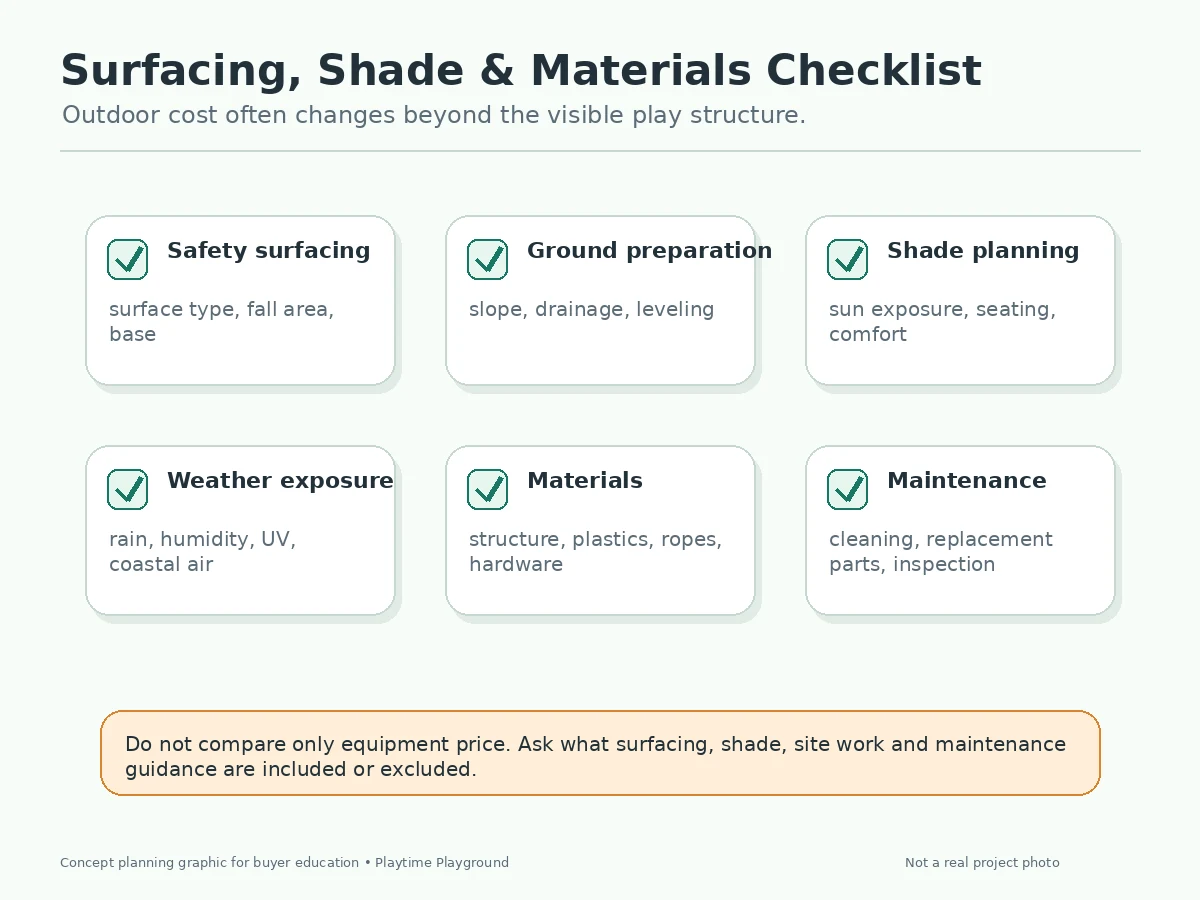
Unitary surfaces, engineered wood fiber and other loose-fill systems have different installation, accessibility, drainage and maintenance characteristics. Artificial turf is not automatically impact attenuating; its complete underlayment system and tested performance must be specified. Likewise, a laboratory-rated product does not eliminate the need to consider installed condition, aging, moisture, compaction, UV exposure and maintenance.
Fragen zur Bodenbelagsauswahl
- Which equipment fall heights and use zones are the surface specification based on?
- Is the surface system included, optional, provisional or owner-supplied?
- Who designs and builds the sub-base, drainage, edging and accessible route?
- Which test reports or product documents apply to the quoted system?
- Who installs and inspects the surface?
- What routine inspection, top-up, repair or replacement is required?
One quotation mistake happens when the equipment price is compared with a second supplier’s equipment-plus-surfacing price. The lower number appears attractive until the buyer adds excavation, base work, drainage and the required surfacing area. Marking surfacing as a separate line item prevents this mismatch.
Safety, Surfacing and Accessibility References for Buyer Review
The references below support buyer due diligence for U.S.-oriented public-use projects. They do not certify Playtime Playground, replace the purchased standards, or substitute for local professional and authority review. International projects should identify the standards and inspection pathway required in the destination country.
General U.S. guidance on layout, hazards, equipment and protective surfacing for public playgrounds.
Review the CPSC handbookCurrent public-use playground equipment safety-performance standard for the covered 2–12-year-old user range. Independent shade and site furniture outside the use zone are not playground equipment under its scope.
Review ASTM F1487-25Impact-attenuation performance requirements for playground surfacing within equipment use zones.
Review ASTM F1292-22Quantitative evaluation of surface firmness and stability for accessible routes and clear ground spaces in playgrounds.
Review ASTM F1951-21Planning guidance for accessible routes, ground-level and elevated play components in ADA-covered play areas.
Review the Access Board guideMaterialien, Witterungseinflüsse und Wartung
Outdoor equipment is exposed to sunlight, rain, humidity, airborne salt, temperature changes, cleaning and repeated use. Buyers should request project-specific information about structural materials, plastic parts, ropes, hardware, connectors, coatings or finishes, drainage details, color and UV considerations, inspection access and replacement components.
Broad statements such as “weatherproof,” “rustproof” or “maintenance-free” are not enough. The quotation or technical schedule should state what material or finish is actually supplied and what environmental assumptions were used. Coastal resorts, high-altitude sites, desert climates and freeze-thaw regions may need different discussions.
A common coastal-project issue occurs when the buyer approves a standard material schedule without identifying salt-air exposure. Fasteners, cut edges, joints and coating damage then require more maintenance than expected. The prevention is not an unsupported “marine grade” claim; it is a documented project review covering the exposure, supplied finish, compatible hardware, inspection interval and repair method.
| Item | Was zu bestätigen ist | Warum es wichtig ist |
|---|---|---|
| Structural components | Material, finish, connection details and inspection access available for the quoted system | Supports durability and repair planning |
| Plastic and panel components | Product description, color/UV considerations and replacement availability | Outdoor exposure can affect appearance and service life |
| Ropes, nets and connectors | Material, termination details, wear points and inspection guidance | High-contact components need routine review |
| Hardware and fasteners | Specified type, protective finish, tamper protection where applicable and spare parts | Connections influence maintenance and after-sales support |
| Maintenance documents | Daily/weekly visual checks, scheduled inspection, cleaning and component replacement guidance | Equipment safety depends on continued inspection and maintenance after installation |
Shade Structures, Seating and Outdoor Comfort
Shade can affect both capital cost and how the playground is used. Schools may need shade for recess, waiting and supervision; resorts may need it for guest comfort and parent viewing. The design should consider sun path, surface temperature, drainage, sightlines and the relationship to nearby buildings, pools and food-service areas.
Independent shade structures and benches should not be assumed to fall within the same product or standard scope as the playground equipment. In U.S. public-use context, ASTM F1487-25 identifies independent shade and site furnishings outside the equipment use zone as outside the playground-equipment scope. Shade can therefore require a separate supplier, structural design, wind or snow review, foundations, permits and maintenance plan.
Shade and Comfort Scope Questions
- Is shade included, optional or owner-supplied?
- Does the shade avoid interfering with equipment use zones and supervision?
- Who provides structural, wind, snow or local permit review?
- Are foundations, drainage and installation included?
- Are seating, fencing, signage and parent or teacher viewing areas included?
- How will high-touch and sun-exposed surfaces be inspected during hot weather?
Shipping, Packaging, Foundations and Installation Support
International playground quotations should identify the delivery basis and installation boundary. Packed volume alone is not enough: long slides, posts, shade members, surfacing materials and foundation templates can affect container planning, inland transport and unloading.
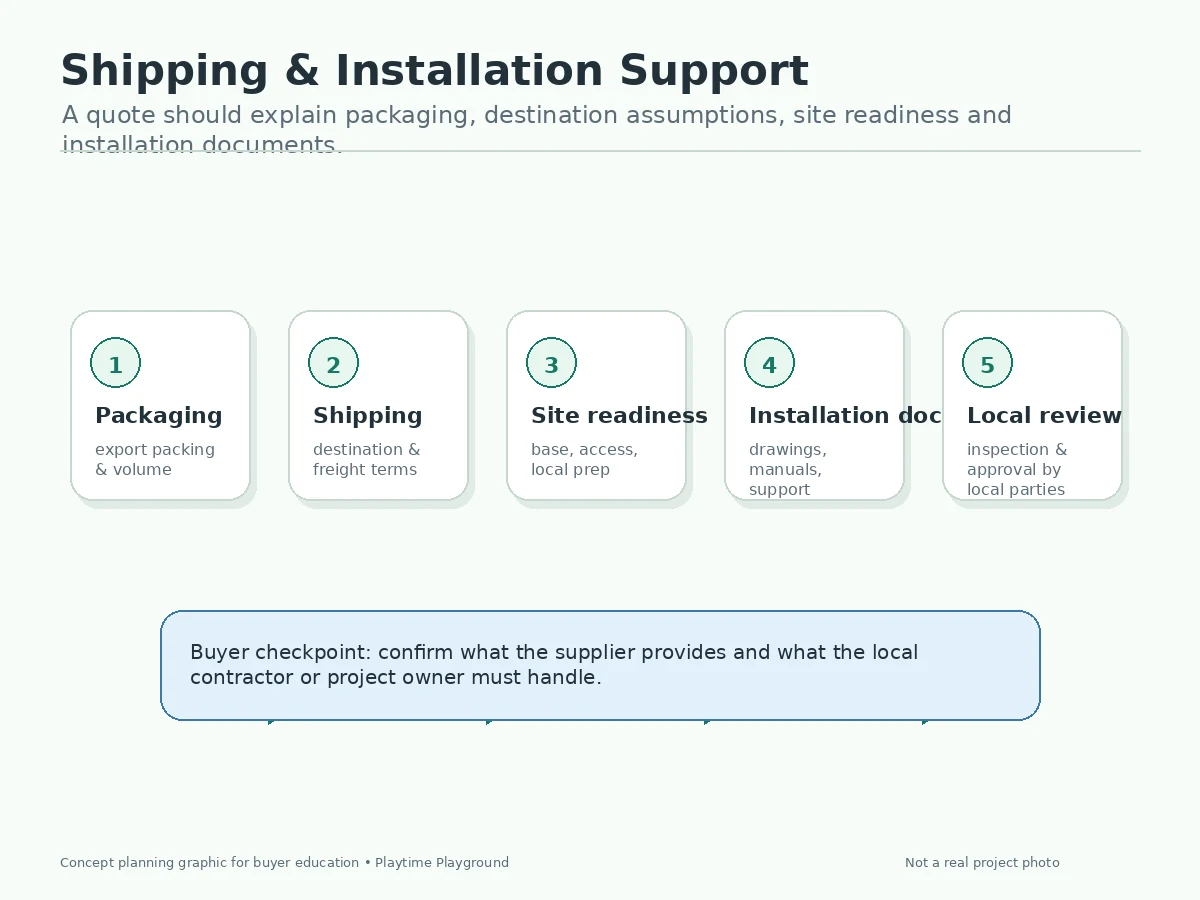
| Scope Item | What Can Change Cost | Käuferfrage |
|---|---|---|
| Export packing | Long components, finish protection, labels, hardware organization and loading sequence | Is a packing list, package-size schedule and loading estimate provided? |
| Freight basis | Incoterm, origin port, destination port, market rate and container count | Which charges and risks transfer at each point? |
| Inland delivery and unloading | Gate width, road access, crane or forklift, time restrictions and storage | Who receives, unloads, checks and stores the shipment? |
| Foundations and anchors | Soil, concrete, embedment, tolerances, drainage and local engineering | Who designs, supplies and verifies the foundation work? |
| Installation labor | Local crew experience, tools, lifting, travel, accommodation and supervision | Is support remote, supervisory or full installation, and what is excluded? |
| Completion and inspection | Punch-list work, surface completion, independent inspection and document handover | What evidence is required before opening? |
During installation planning, a common failure is to discover that the delivery gate is narrower than a long packaged component or that the foundation grid does not match the approved drawing. Another is mobilizing installers before concrete, drainage or surfacing base work is ready. A pre-shipment access review and signed site-readiness checklist reduce both risks.
Was Käufer senden sollten, bevor sie ein Angebot anfordern
A useful RFQ gives each supplier the same site, equipment and responsibility assumptions. Without a common basis, the buyer receives several different concepts rather than comparable quotations.
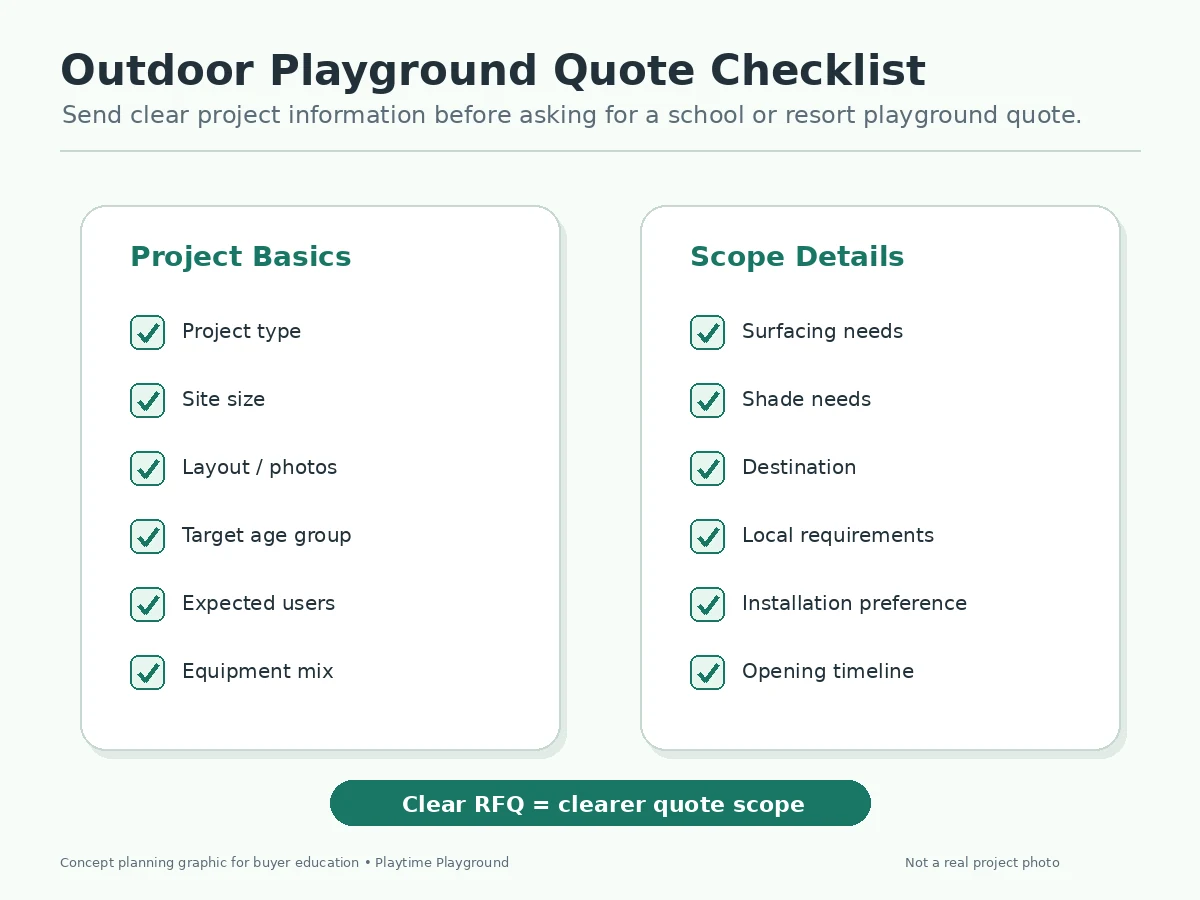
Outdoor Playground RFQ Checklist
- Project type: school, resort, hotel, community site, public park or contractor package
- Dimensioned site plan, survey, CAD file and current site photos
- Marked usable play area, boundaries, slopes, drainage and known utilities
- Exact age groups and planned supervision or guest-use model
- Core equipment, optional equipment and future-phase items
- Known critical-fall-height, surfacing and accessible-route requirements
- Shade, seating, fencing, signage and landscape scope
- Climate and exposure: UV, heat, humidity, coastal air, heavy rain or freeze-thaw
- Destination country, city, port, requested Incoterm and inland-delivery assumption
- Delivery gate, unloading equipment and storage conditions
- Foundation, local labor and installation responsibility
- Required drawings, reports, manuals, spare parts and inspection documents
- Site-readiness date, target opening date and known approval pathway
- Budget direction, with the cost level clearly identified
Before issuing the order, buyers can also use Playtime’s Checkliste für gewerbliche Spielplatzkäufer to verify the final scope.
So vergleichen Sie Angebote für Outdoor-Spielplatzgeräte von verschiedenen Anbietern
Normalize each proposal against the same approved plan and equipment schedule. Mark every row as included, optional, provisional, owner-supplied or excluded. A quotation that cannot be reconciled to a drawing and item list is not ready for final comparison.
| Angebotsposition | Was zu prüfen ist | Warum es wichtig ist |
|---|---|---|
| Genehmigter Grundriss | Drawing revision, usable boundary, use zones, age zones and equipment references | Ensures suppliers are pricing the same site concept |
| Ausstattungsliste | Model, quantity, included panels, roofs, slides, seats, hardware and freestanding items | Prevents missing components and scope substitution |
| Materials and finishes | Project-specific descriptions rather than generic quality claims | Supports environment, appearance and maintenance review |
| Surfacing and access | Area, system, performance basis, base, drainage, accessible route and installation | Can represent a major portion of installed cost |
| Shade and site items | Shade, seating, fencing, signage, foundations and separate engineering | These are often outside the play-equipment scope |
| Documents | Layout, equipment list, installation drawings, maintenance guidance, packing list and available reports | Determines whether the project can be coordinated and inspected |
| Logistics | Incoterm, packed volume, freight assumption, destination charges, inland delivery and unloading | Separates factory price from landed cost |
| Foundations and installation | Concrete, anchors, local labor, tools, supervision, travel and site readiness | Clarifies who owns execution risk |
| Commercial terms | Lead time, revision limit, payment terms, warranty, spare parts and claims process | Prevents assumptions after order placement |
Checkliste zur Lieferantenbewertung für Schulen und Resorts
A competent supplier should clarify the project before presenting a final price. The evaluation should focus on evidence, scope control and communication—not unsupported claims.
| Review Area | Starkes Signal | Risikosignal |
|---|---|---|
| Site review | Asks for dimensions, constraints, users, climate, access and local requirements | Quotes from area alone or sends a standard set without site review |
| Scope control | Separates equipment, surfacing, shade, logistics, foundations and installation | Provides one total without inclusions and exclusions |
| Technical evidence | Identifies which documents, reports and standard editions apply to the quoted products | Uses logos or “international certified” claims without product-specific evidence |
| Outdoor exposure | Discusses UV, heat, rain, coastal or freeze-thaw conditions and maintenance | Calls every product weatherproof or maintenance-free |
| Logistics | Provides packing assumptions, delivery basis and receiving responsibilities | Says shipping is included without Incoterm, destination or exclusions |
| Montage | Defines foundations, local labor, tools, supervision and site-readiness conditions | Says installation is included without responsibility detail |
| After-sales | Explains parts identification, claims, replacements, maintenance support and communication path | No process after shipment |
Worauf Käufer bei Angeboten für Trampolinpark-Ausstattung achten sollten
- No dimensioned layout, equipment schedule or drawing revision
- Total site area used as though it were the usable equipment and surfacing area
- Protective surfacing omitted or described without performance and installation basis
- Independent shade assumed to be included with no structural or foundation scope
- Material claims such as “rustproof,” “UV proof” or “maintenance-free” without project-specific detail
- “ASTM compliant,” “CPSC certified” or “fully ADA compliant” claims without identifying the product, standard edition and evidence
- Shipping included with no Incoterm, destination, packed volume or local-charge boundary
- Installation included with no foundation, labor, tool, travel or site-readiness responsibility
- No inspection, maintenance, spare-parts or claims process
- Fake project photos, school names, resort cases, certificates or test records
Wie Playtime Schul- und Resort-Outdoor-Spielplatzprojekte unterstützt
Playtime Playground supports commercial buyers with project-based equipment selection, layout discussion and quotation preparation. The process starts with site and user inputs rather than one universal package.
Share the plan, photos, age groups, climate, destination and project constraints.
Mark equipment zones, access, landscape constraints and owner-side functions.
Separate core equipment, optional items, surfacing, shade and future phases.
Confirm packing, delivery, foundations, installation support, documents and exclusions.
Issue a project-based quote tied to the stated layout and commercial assumptions.
Buyers can review Playtime’s Spielplatzprojekte, Projektleistungen, Planungsressourcen von Playtime prüfen und Unternehmenshintergrund before requesting a formal quote. Final materials, documentation, warranty, lead time, shipping and installation support should be confirmed project by project.
Request a Scope-Based Outdoor Playground Quote
Send the dimensioned site plan, marked usable play area, target age groups, preferred equipment, surfacing and shade responsibility, climate conditions, destination, delivery access and installation model. Playtime can review the project inputs and prepare a quotation with clearer equipment, logistics and support boundaries.
Send Outdoor Playground Project DetailsOutdoor Playground Equipment Cost FAQ
Wie viel kostet Outdoor-Spielplatzgeräte für eine Schule oder ein Resort?
Es gibt keinen verlässlichen Einheitspreis ohne eine genehmigte Standort- und Ausrüstungsübersicht. Die Kosten hängen von der nutzbaren Spielfläche, den Altersgruppen, dem Ausrüstungsplan, Schutzbelägen, Beschattung, Materialien, Fracht, Fundamenten und der Installationsverantwortung ab. Vergleichen Sie, ob die Angabe ein Angebot für die Ausrüstungslieferung, die angekommenen Ausrüstungsgenehmigung oder ein Budget für ein installiertes Projekt ist.
Was ist normalerweise nicht in einem Angebot für Outdoor-Spielplatzgeräte enthalten?
Übliche Ausschlüsse sind Fracht- oder Zielgebühren, Zoll, Binnentransport, Entladung, Aushub, Entwässerung, Betonfundamente, schützende Oberflächen, barrierefreie Zugangswege, Beschattung, lokale Arbeitskräfte, Inspektionen und Genehmigungen. Die genauen Ausschlüsse müssen im Angebot aufgeführt werden.
Warum können Angebote für Schul- und Resort-Spielplätze variieren?
Schulen legen oft Wert auf Alterszonen, Aufsicht, Barrierefreiheit, Langlebigkeit für den täglichen Gebrauch und Inspektion. Resorts können Themen, Schatten, Sitzgelegenheiten, Gästekreisläufe, Landschaftsintegration und Klimaexposition hinzufügen. Diese unterschiedlichen Prioritäten ändern die Ausrüstung und den Umfang auf Eigentümerseite.
Ist schützender Fallschutz im Gerätepreis enthalten?
Nur wenn es ausdrücklich aufgeführt ist. Bestätigen Sie das Oberflächensystem, die Fläche, die Grundlage für die kritische Fallhöhe, die Untergrundvorbereitung, die Entwässerung, die zugängliche Route sowie die Verantwortung für Installation und Inspektion. Vergleichen Sie kein Angebot nur für Geräte mit einem Angebot für Geräte plus Oberflächensystem.
Welche ASTM-Normen sind für einen öffentlichen Outdoor-Spielplatz in den USA relevant?
Die Norm ASTM F1487-25 behandelt öffentliche Spielplatzgeräte für Nutzer im Alter von 2–12 Jahren. Die Norm ASTM F1292-22 behandelt die Stoßdämpfung von Oberflächen in den Nutzungszonen, und die Norm ASTM F1951-21 behandelt die Zugänglichkeit von Oberflächen. Geräte für Kinder von 6–23 Monaten werden separat behandelt. Lokale Anforderungen müssen noch bestätigt werden.
Sind Sonnenschutzstrukturen im Angebot für Spielplatzgeräte und im Standard enthalten?
Nicht automatisch. Unabhängige Sonnenschutz- und Möbelsysteme können außerhalb des Geltungsbereichs von Spielplatzgeräten liegen und erfordern eine separate strukturelle Überprüfung, Fundamente, Wind- oder Schneelastberechnungen, Genehmigungen und Installationen. Das Angebot sollte Sonnenschutz als enthalten, optional oder vom Eigentümer bereitgestellt kennzeichnen.
Was sollte ich für eine Angebotsanfrage für einen Outdoor-Spielplatz senden?
Senden Sie einen maßstabsgetreuen Lageplan, Fotos, die nutzbare Fläche, Altersgruppen, Prioritäten bei der Ausstattung, Anforderungen an Bodenbelag und Beschattung, klimatische Einflüsse, Zielort, Lieferzugang, Fundament- und Installationsmodell, erforderliche Dokumente, Genehmigungsweg und Zieldatum für die Standortbereitschaft.
Wie vergleiche ich Anbieter von Outdoor-Spielplätzen?
Require each supplier to quote the same drawing and equipment schedule. Compare materials and finishes, surfacing, shade, documents, packing, Incoterm, foundations, installation, warranty, spare parts and exclusions—not only the total number.