






Guida ai costi per parchi giochi outdoor
Costo attrezzature per parchi gioco outdoor per scuole e resort: cosa confrontare per gli acquirenti
Le attrezzature per parchi gioco commerciali outdoor vengono quotate progetto per progetto anziché da un unico listino prezzi universale. Scuole e resort dovrebbero confrontare separatamente tre cifre diverse: il preventivo di fornitura delle attrezzature, il costo delle attrezzature franco destino e il budget completo del progetto installato. La disposizione del sito, la fascia d'età, la lista delle attrezzature, la pavimentazione di sicurezza con altezza di caduta critica, l'ombreggiatura, l'esposizione climatica, il trasporto, le fondazioni e la responsabilità dell'installazione possono modificare il costo finale anche quando due progetti utilizzano una struttura di gioco simile.
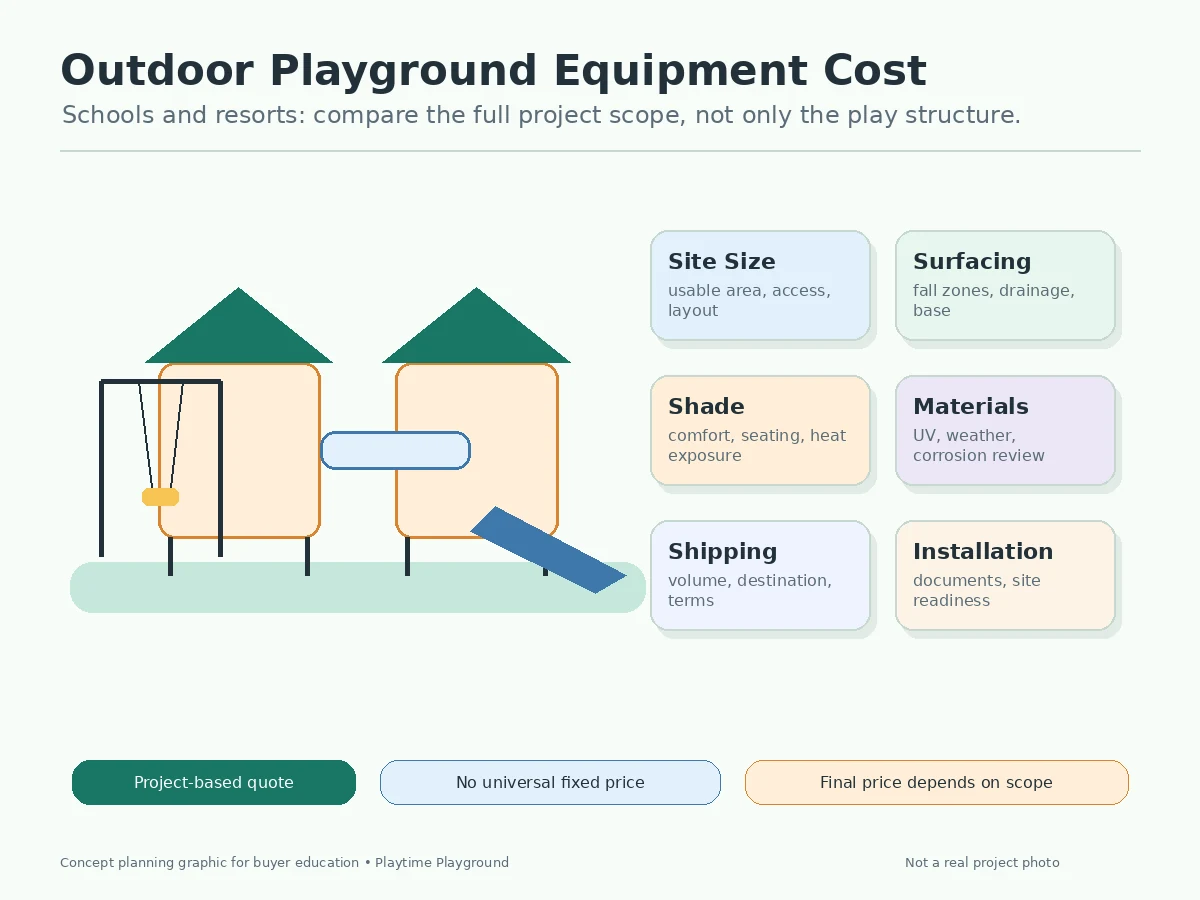
Costo attrezzature parco giochi outdoor vs. costo progetto completo
La prima domanda sui costi dovrebbe essere: a quale livello di budget ci si riferisce? Un preventivo per la fornitura di attrezzature può includere torri gioco, scivoli, strutture per arrampicata, altalene, elementi in corda, pannelli, ferramenta inclusa, documenti di progettazione e imballaggio per l'esportazione. Non include automaticamente trasporto, spese di destinazione, fondazioni, pavimentazione antitrauma, ombreggiatura, manodopera locale, ispezioni o lavori sul sito a carico del committente.
Un budget completo per un parco giochi scolastico o di un resort è più ampio. Può includere lavori edili, drenaggio, percorsi accessibili, pavimentazione ammortizzante, recinzioni, fondazioni per ombreggiatura, lavori elettrici o di illuminazione, paesaggistica, permessi locali, ispezione indipendente, requisiti assicurativi e preparazione per la manutenzione ordinaria. Due fornitori possono quindi preventivare attrezzature simili lasciando all'acquirente costi residui molto diversi.
| Livello di budget | Normalmente include | Richiede ancora conferma | Uso da parte dell'acquirente |
|---|---|---|---|
| Preventivo fornitura attrezzature | Attrezzature di gioco confermate, hardware elencato, ambito di progettazione dichiarato, documenti e imballaggio per esportazione | Spese di spedizione, pavimentazioni, fondazioni, manodopera locale, tettoie, ispezione e lavori a carico del committente, se non espressamente inclusi | Confronta l'ambito delle attrezzature prodotte |
| Costo di sbarco delle attrezzature | Attrezzature più la base di spedizione concordata e qualsiasi elemento di destinazione espressamente elencato | Dazi doganali, tasse, consegna interna, scarico, stoccaggio e accesso al sito possono rimanere al di fuori del preventivo | Stima quanto occorre per portare le attrezzature nella sede del progetto |
| Budget per il progetto di parco giochi installato | Attrezzature, logistica, fondazioni, installazione, pavimentazioni, accesso, tettoie e altri lavori di progetto inclusi | Permessi, revisione professionale locale, ispezione, paesaggistica, assicurazione e preparazione operativa possono rimanere a carico del committente | Supporta la pianificazione e l'approvazione del capitale |
Per gli acquirenti che esaminano attrezzature per parchi gioco outdoor commerciali, il confronto significativo non è il numero più basso in evidenza. È il preventivo che identifica ogni inclusione, opzione, voce di costo, presupposto ed esclusione.
Costo Parco Giochi Scuola vs Resort: Perché l'Ambito è Diverso
Scuole e resort possono acquistare componenti di gioco simili, ma solitamente danno priorità a risultati di progetto diversi. Una scuola generalmente pone maggiore enfasi sull'uso quotidiano, sulla zonizzazione per età, sulla supervisione del personale, sulla circolazione accessibile, sulla durabilità, sulla pianificazione di ispezione e manutenzione. Un resort o un hotel valuta anche l'esperienza degli ospiti, l'integrazione visiva, la visibilità per i genitori, l'ombra, i posti a sedere, il coordinamento paesaggistico e come il parco giochi si relaziona a piscine, ristoranti o aree di alloggio.
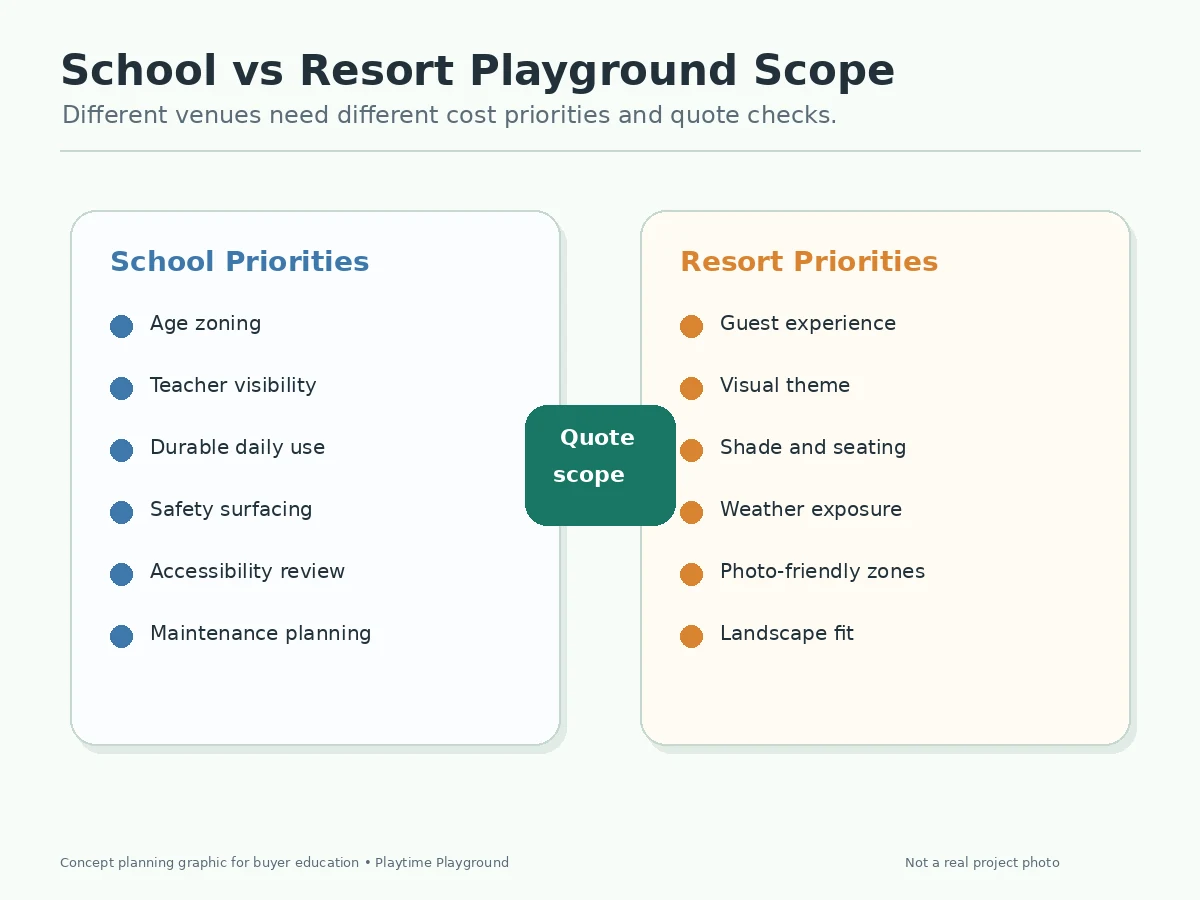
| Tipo di acquirente | Obiettivo primario del progetto | Ambito che spesso cambia il costo | Domanda chiave di approvazione |
|---|---|---|---|
| Scuola | Uso quotidiano da parte degli studenti con chiara supervisione e attività adeguate all'età | Zone per età, indicazioni sulla capacità, percorsi accessibili, pavimentazione, recinzioni, documenti di ispezione e manutenzione | Il progetto corrisponde ai requisiti del distretto scolastico, delle autorità locali e della gestione del rischio? |
| Resort o hotel | Esperienza degli ospiti integrata con la struttura | Tema, ombra, posti a sedere, interfaccia paesaggistica, materiali per zone costiere o ad alto UV e visibilità per i genitori | Il parco giochi si adatta al percorso degli ospiti senza creare conflitti con piscine, strade o aree di servizio? |
| Sito pubblico o comunitario | Ampio accesso pubblico e uso inclusivo | Percorsi accessibili, attrezzature per tutte le età, pavimentazione, segnaletica, pianificazione di ispezione e manutenzione | Quali standard di uso pubblico e requisiti di approvvigionamento si applicano? |
| Appaltatore o distributore | Fornire un ambito tecnico e commerciale definito | Disegni, distinte materiali, imballaggio, Incoterm, fondazioni, documenti di installazione e limiti di garanzia | Ogni articolo quotato può essere riconciliato con le specifiche della gara d'appalto o del proprietario? |
Un tipico errore lato scuola è selezionare attrezzature da un catalogo prima di confermare le linee di supervisione e le zone di caduta utilizzabili. Il risultato può essere un layout che si adatta geometricamente ma blocca la visibilità del personale o lascia una pavimentazione insufficiente. Un tipico errore lato resort è approvare il tema visivo prima di esaminare l'esposizione al sole, i posti a sedere per i genitori e l'accesso alla manutenzione. Entrambi i problemi sono più facili da prevenire prima dell'approvazione del progetto che dopo la produzione.
Principali fattori di costo per le attrezzature per parchi giochi outdoor
Il costo del parco giochi outdoor è determinato dall'ambito del progetto approvato, non solo dalla struttura di gioco visibile. La stessa famiglia di attrezzature può produrre preventivi diversi quando cambiano le ipotesi relative al sito, alla pavimentazione, alle fondazioni, al clima, alla consegna e all'installazione.
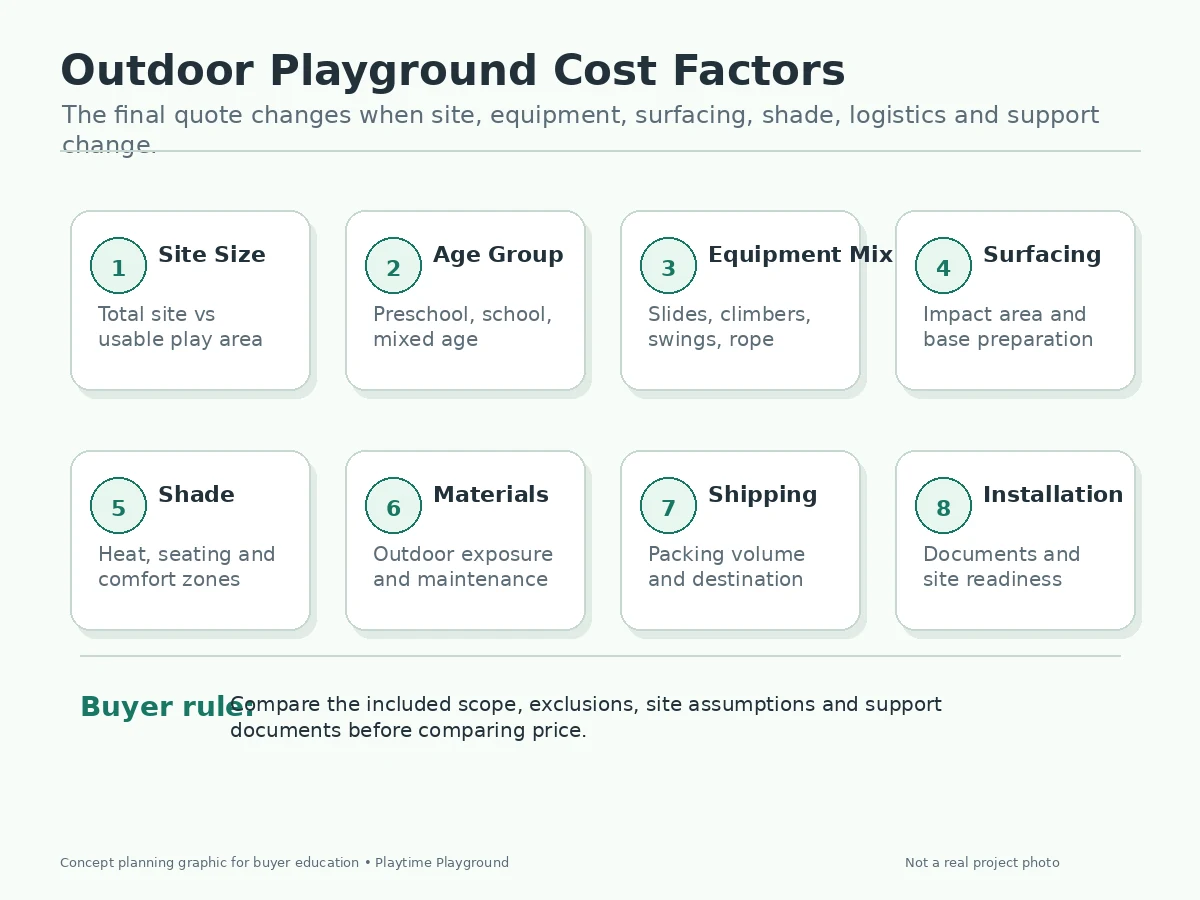
| Fattore di costo | Perché cambia il preventivo | Cosa dovrebbe fornire l'acquirente |
|---|---|---|
| Usable site and layout | Use zones, access routes, trees, slopes, utilities, drainage and boundaries reduce the area available for equipment | Dimensioned plan, survey or marked site sketch with photos |
| Age range and use model | Different users require different access, platform heights, activity intensity, separation and supervision | Exact age groups, school grades or guest profile and operating model |
| Elenco attrezzature | Towers, swings, rope play, inclusive components and freestanding items have different space, foundation and surfacing needs | Core items, optional items and future-phase items |
| Protective surfacing | Area, critical fall height, surface system, accessible route, base, drainage and installation affect project cost | Local requirements, proposed surface type and responsibility matrix |
| Shade and site furniture | Independent shade, seating, fencing and signage may need separate structure, foundations or local review | Comfort requirements, wind exposure and whether these items are supplier- or owner-supplied |
| Outdoor environment | UV, heat, rain, humidity, freeze-thaw cycles and coastal exposure influence finish and maintenance discussions | Climate, coastal distance, exposure and maintenance expectations |
| Logistics | Packed volume, long components, port, Incoterm, inland delivery, unloading and storage affect landed cost | Destination, access route, unloading plan and requested delivery basis |
| Foundations and installation | Anchor design, concrete work, site tolerances, local labor, tools and inspection responsibilities vary by project | Ground condition, local contractor plan, site-readiness date and installation preference |
The most useful quotation is the one that connects each cost to a stated drawing, equipment list, material or finish note, surfacing assumption, logistics basis and installation responsibility.
Dimensioni del sito, layout e area gioco utilizzabile
Total land area is not the same as usable playground area. The design must reserve equipment use zones, circulation, accessible routes, entrances, supervision positions, drainage paths, landscape setbacks, fencing, shaded rest areas and installation access. Existing trees, retaining walls, slopes, utilities and nearby roads, pools or buildings may further reduce the usable footprint.
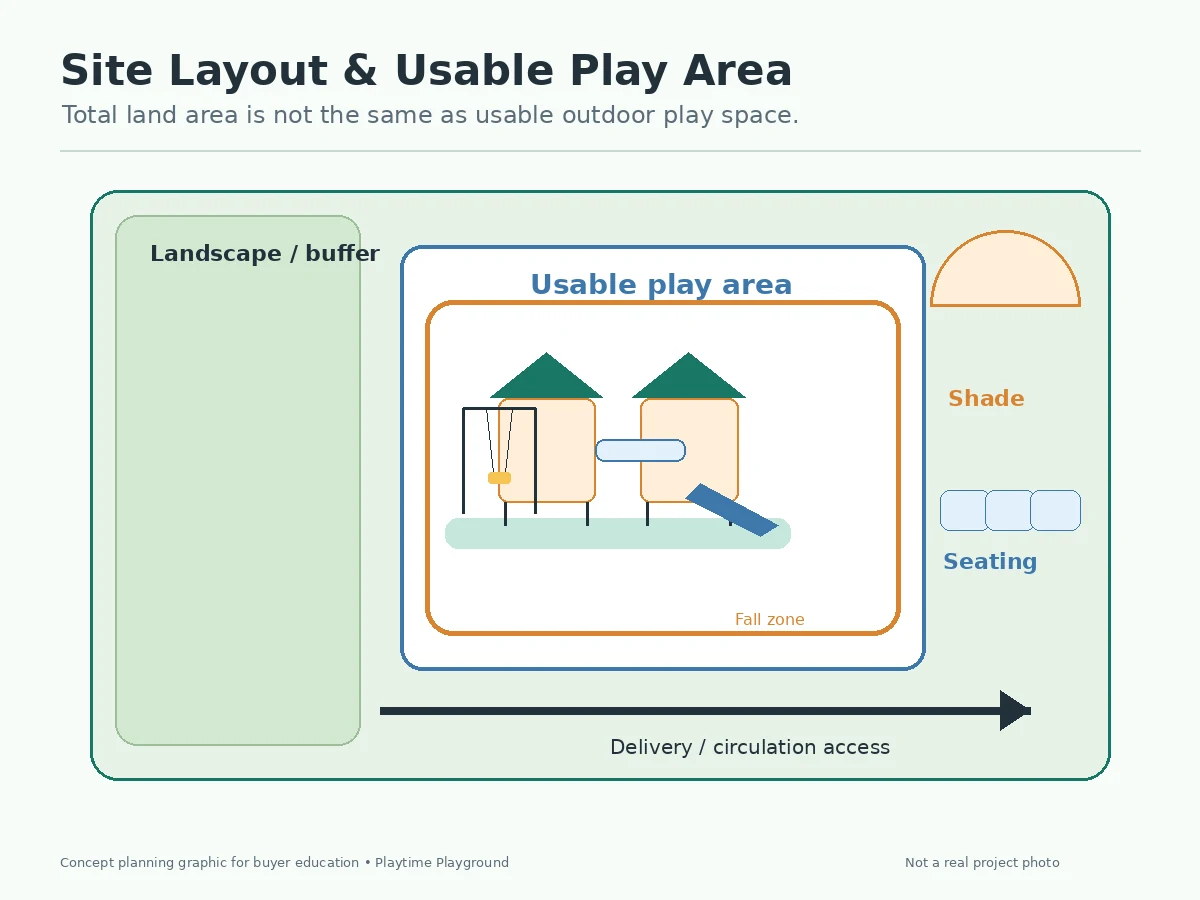
A common planning issue occurs when a buyer reports a large site area but the survey later shows a drainage swale, protected trees, underground services and a narrow delivery gate. The equipment concept then has to be reduced or relocated. Marking these constraints before layout development prevents redesign and makes supplier quotations more comparable.
Informazioni sul sito da preparare
- Dimensioned site plan, survey, CAD file or clearly marked sketch
- Site photos from several directions
- Property boundaries, fences, roads, buildings and adjacent hazards
- Slopes, drainage paths, retaining walls and known underground services
- Existing trees, landscape features and areas that must remain clear
- Proposed entrances, accessible route and supervision positions
- Delivery gate, unloading area and installation access
- Target age groups and planned operating capacity direction
Le risorse di pianificazione per parchi giochi di Playtime can help organize early site information before a formal RFQ is issued.
Checklist per la preparazione di un progetto di parco giochi outdoor
A buyer does not need every engineering detail before the first supplier discussion, but the project team should identify who owns the site, surfacing, foundation, accessibility, logistics and inspection decisions. A quotation based on undefined owner-side work is not yet a complete project budget.
| Area di preparazione | Perché è importante | Cosa confermare |
|---|---|---|
| Accesso al sito | Long or bulky components may need a truck route, unloading space or lifting plan | Gate width, road condition, delivery restrictions and unloading responsibility |
| Ground and drainage | Subgrade, slope and water management affect foundations and surfacing | Who designs and completes excavation, drainage, base and concrete work |
| Utilities and obstructions | Unknown services can conflict with excavation and anchors | Utility locating, exclusion zones and local permit responsibility |
| Climate exposure | High UV, coastal air, heat, heavy rain or freeze-thaw conditions influence finish and maintenance planning | Environmental conditions and requested material or finish documentation |
| Approval pathway | Schools, resorts and public sites may require different professional reviews and inspections | Local authority, school district, resort operator, insurer and independent inspector requirements |
| Site-readiness date | Installation delays occur when foundations, access or surfacing work are incomplete | Handover conditions and who verifies readiness before installers arrive |
For early coordination, buyers can review Playtime’s servizi per progetti di parchi gioco and define which work remains with the owner, local consultant or contractor.
Age Group, User Capacity and Supervision
Age range affects equipment dimensions, access, activity intensity, separation, surfacing and supervision. Capacity should not be calculated from one universal person-per-square-meter rule. It depends on the equipment schedule, use zones, age mix, operating procedures, local requirements, manufacturer information and the owner’s supervision model.
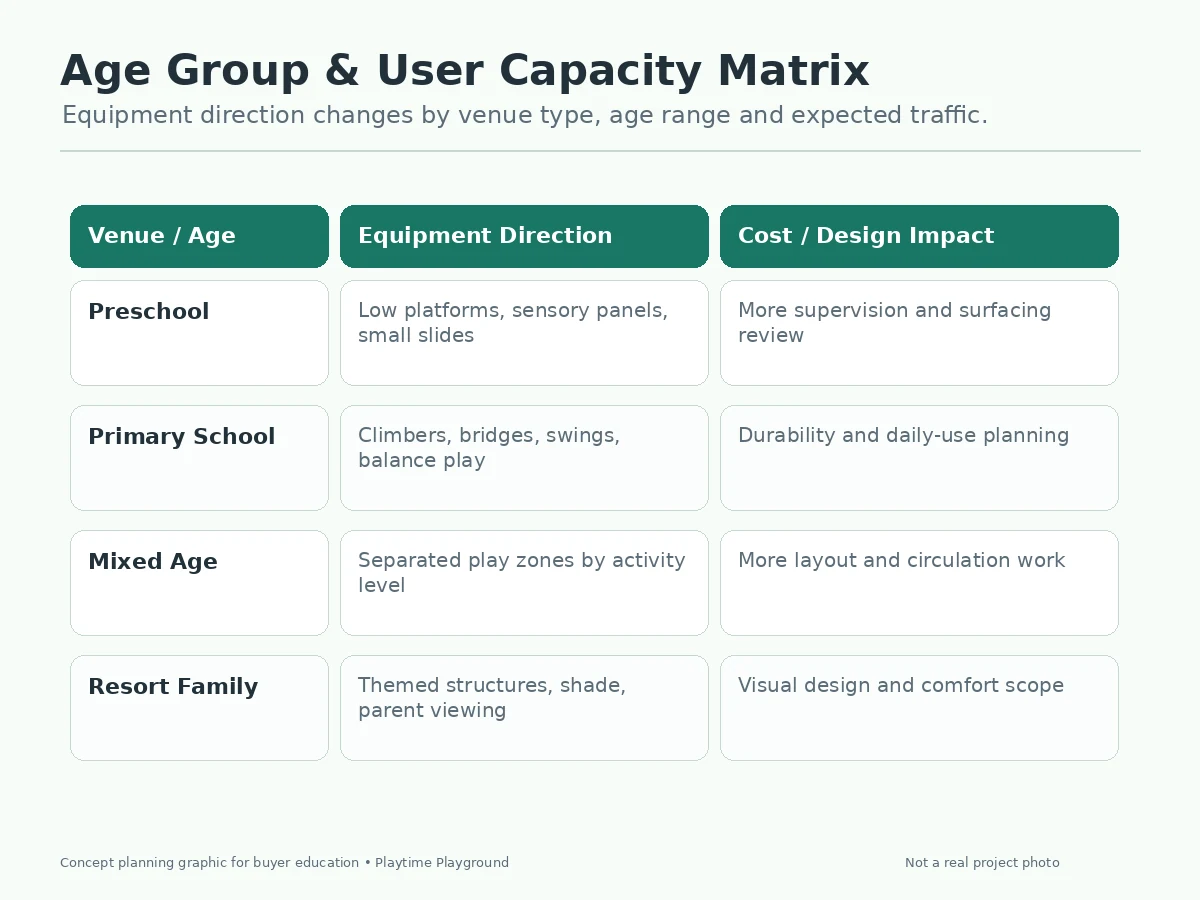
| User Group | Typical Direction | Cost and Layout Effect | Buyer Check |
|---|---|---|---|
| Children 6–23 months | Public-use equipment specifically intended for this age range, low access and direct supervision | Separate product suitability, surfacing and local childcare or early-learning review may be required | Do not assume equipment intended for ages 2–12 automatically applies |
| Preschool and early primary | Lower platforms, smaller slides, panels, bridges and lower-intensity climbing | More emphasis on supervision visibility, age separation and accessible ground-level activity | Confirm the exact intended age range and local rules |
| Scuola primaria | Broader climbing, sliding, balancing and social-play options | More varied equipment, use zones, surfacing and circulation | Confirm grade groups, recess patterns and staff supervision |
| Mixed-age school or resort | Clearly separated zones or equipment selected for distinct user groups | More layout coordination, signage, circulation and supervision planning | Prevent high-speed routes from crossing younger-child areas |
For U.S. public-use projects, ASTM F1487-25 covers public playground equipment for users from the 5th-percentile two-year-old through the 95th-percentile twelve-year-old range, while public-use equipment for children 6–23 months is addressed separately. The applicable standard and local requirements must be confirmed for the actual product and project.
Equipment Mix: What Schools and Resorts Should Compare
Equipment mix changes more than the product price. Each item can affect use-zone area, foundations, surfacing, accessible routes, supervision, inspection and maintenance. Buyers should separate the core play system from freestanding items, inclusive components, shade and future-phase options.
Composite Towers and Slides
Confirm platform levels, access methods, slide exits, use zones, age designation, foundations and all listed panels or roofs.
Swings and Dynamic Equipment
These items can require substantial clearance and dedicated surfacing. Confirm bay count, seat types, separation and whether the layout includes the full use zone.
Climbers, Ropes and Balance Play
Review intended ages, challenge level, fall height, surfacing extent, tensioned components and inspection requirements.
Inclusive and Ground-Level Play
Do not treat one accessible component as a complete accessibility strategy. Review accessible routes, transfer or ramp access, clear ground spaces and the overall play experience.
A school may protect the core age zones and supervision lines first, then add optional freestanding items later. A resort may prioritize one visually distinctive composite structure but should still reserve budget for shade, seating, access and maintenance. Buyers can review Playtime’s outdoor playground equipment range before issuing a layout-based request.
Superfici di sicurezza e preparazione del terreno
Protective surfacing can be a major cost layer because the required system is tied to the equipment layout, use zones and critical fall height—not simply the total site area. The quotation should state the proposed surface system, area, tested performance basis, thickness or installation specification where applicable, base preparation, edging, drainage, accessible-route treatment and maintenance responsibility.
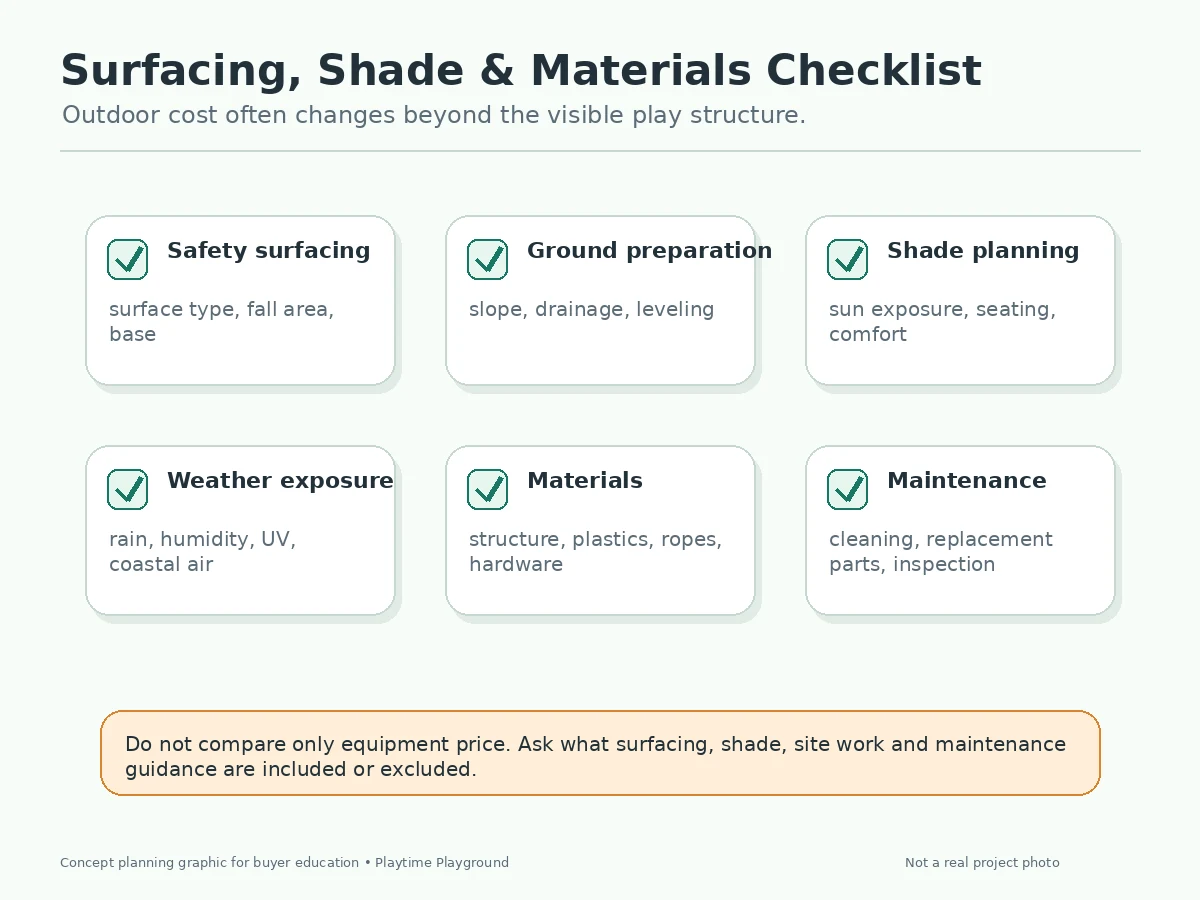
Unitary surfaces, engineered wood fiber and other loose-fill systems have different installation, accessibility, drainage and maintenance characteristics. Artificial turf is not automatically impact attenuating; its complete underlayment system and tested performance must be specified. Likewise, a laboratory-rated product does not eliminate the need to consider installed condition, aging, moisture, compaction, UV exposure and maintenance.
Domande sulla pavimentazione da porre
- Which equipment fall heights and use zones are the surface specification based on?
- Is the surface system included, optional, provisional or owner-supplied?
- Who designs and builds the sub-base, drainage, edging and accessible route?
- Which test reports or product documents apply to the quoted system?
- Who installs and inspects the surface?
- What routine inspection, top-up, repair or replacement is required?
One quotation mistake happens when the equipment price is compared with a second supplier’s equipment-plus-surfacing price. The lower number appears attractive until the buyer adds excavation, base work, drainage and the required surfacing area. Marking surfacing as a separate line item prevents this mismatch.
Safety, Surfacing and Accessibility References for Buyer Review
The references below support buyer due diligence for U.S.-oriented public-use projects. They do not certify Playtime Playground, replace the purchased standards, or substitute for local professional and authority review. International projects should identify the standards and inspection pathway required in the destination country.
General U.S. guidance on layout, hazards, equipment and protective surfacing for public playgrounds.
Review the CPSC handbookCurrent public-use playground equipment safety-performance standard for the covered 2–12-year-old user range. Independent shade and site furniture outside the use zone are not playground equipment under its scope.
Review ASTM F1487-25Impact-attenuation performance requirements for playground surfacing within equipment use zones.
Review ASTM F1292-22Quantitative evaluation of surface firmness and stability for accessible routes and clear ground spaces in playgrounds.
Review ASTM F1951-21Planning guidance for accessible routes, ground-level and elevated play components in ADA-covered play areas.
Review the Access Board guideMateriali, Esposizione agli agenti atmosferici e Manutenzione
Outdoor equipment is exposed to sunlight, rain, humidity, airborne salt, temperature changes, cleaning and repeated use. Buyers should request project-specific information about structural materials, plastic parts, ropes, hardware, connectors, coatings or finishes, drainage details, color and UV considerations, inspection access and replacement components.
Broad statements such as “weatherproof,” “rustproof” or “maintenance-free” are not enough. The quotation or technical schedule should state what material or finish is actually supplied and what environmental assumptions were used. Coastal resorts, high-altitude sites, desert climates and freeze-thaw regions may need different discussions.
A common coastal-project issue occurs when the buyer approves a standard material schedule without identifying salt-air exposure. Fasteners, cut edges, joints and coating damage then require more maintenance than expected. The prevention is not an unsupported “marine grade” claim; it is a documented project review covering the exposure, supplied finish, compatible hardware, inspection interval and repair method.
| Item | Cosa confermare | Perché è importante |
|---|---|---|
| Structural components | Material, finish, connection details and inspection access available for the quoted system | Supports durability and repair planning |
| Plastic and panel components | Product description, color/UV considerations and replacement availability | Outdoor exposure can affect appearance and service life |
| Ropes, nets and connectors | Material, termination details, wear points and inspection guidance | High-contact components need routine review |
| Hardware and fasteners | Specified type, protective finish, tamper protection where applicable and spare parts | Connections influence maintenance and after-sales support |
| Maintenance documents | Daily/weekly visual checks, scheduled inspection, cleaning and component replacement guidance | Equipment safety depends on continued inspection and maintenance after installation |
Shade Structures, Seating and Outdoor Comfort
Shade can affect both capital cost and how the playground is used. Schools may need shade for recess, waiting and supervision; resorts may need it for guest comfort and parent viewing. The design should consider sun path, surface temperature, drainage, sightlines and the relationship to nearby buildings, pools and food-service areas.
Independent shade structures and benches should not be assumed to fall within the same product or standard scope as the playground equipment. In U.S. public-use context, ASTM F1487-25 identifies independent shade and site furnishings outside the equipment use zone as outside the playground-equipment scope. Shade can therefore require a separate supplier, structural design, wind or snow review, foundations, permits and maintenance plan.
Shade and Comfort Scope Questions
- Is shade included, optional or owner-supplied?
- Does the shade avoid interfering with equipment use zones and supervision?
- Who provides structural, wind, snow or local permit review?
- Are foundations, drainage and installation included?
- Are seating, fencing, signage and parent or teacher viewing areas included?
- How will high-touch and sun-exposed surfaces be inspected during hot weather?
Shipping, Packaging, Foundations and Installation Support
International playground quotations should identify the delivery basis and installation boundary. Packed volume alone is not enough: long slides, posts, shade members, surfacing materials and foundation templates can affect container planning, inland transport and unloading.
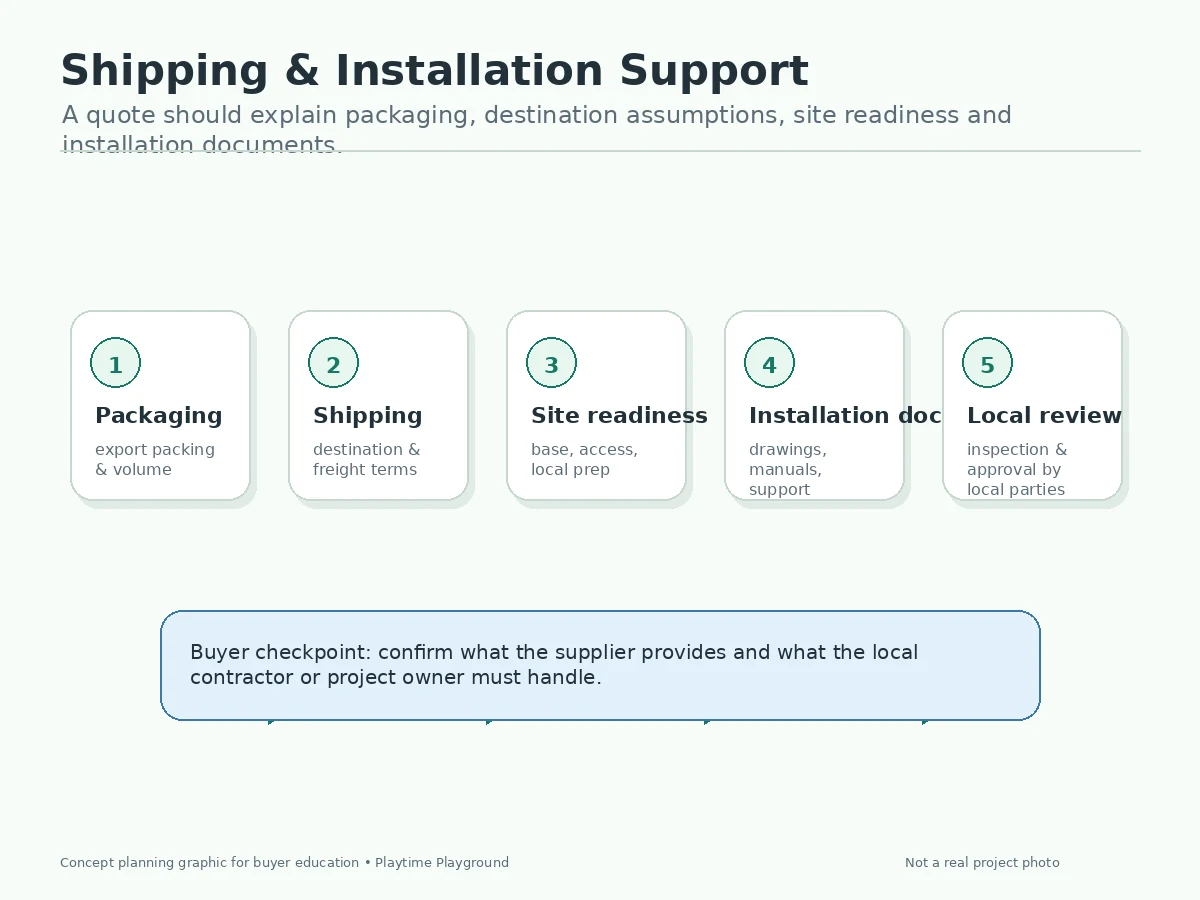
| Scope Item | What Can Change Cost | Domanda dell'acquirente |
|---|---|---|
| Export packing | Long components, finish protection, labels, hardware organization and loading sequence | Is a packing list, package-size schedule and loading estimate provided? |
| Freight basis | Incoterm, origin port, destination port, market rate and container count | Which charges and risks transfer at each point? |
| Inland delivery and unloading | Gate width, road access, crane or forklift, time restrictions and storage | Who receives, unloads, checks and stores the shipment? |
| Foundations and anchors | Soil, concrete, embedment, tolerances, drainage and local engineering | Who designs, supplies and verifies the foundation work? |
| Installation labor | Local crew experience, tools, lifting, travel, accommodation and supervision | Is support remote, supervisory or full installation, and what is excluded? |
| Completion and inspection | Punch-list work, surface completion, independent inspection and document handover | What evidence is required before opening? |
During installation planning, a common failure is to discover that the delivery gate is narrower than a long packaged component or that the foundation grid does not match the approved drawing. Another is mobilizing installers before concrete, drainage or surfacing base work is ready. A pre-shipment access review and signed site-readiness checklist reduce both risks.
Cosa dovrebbero inviare gli acquirenti prima di richiedere un preventivo
A useful RFQ gives each supplier the same site, equipment and responsibility assumptions. Without a common basis, the buyer receives several different concepts rather than comparable quotations.
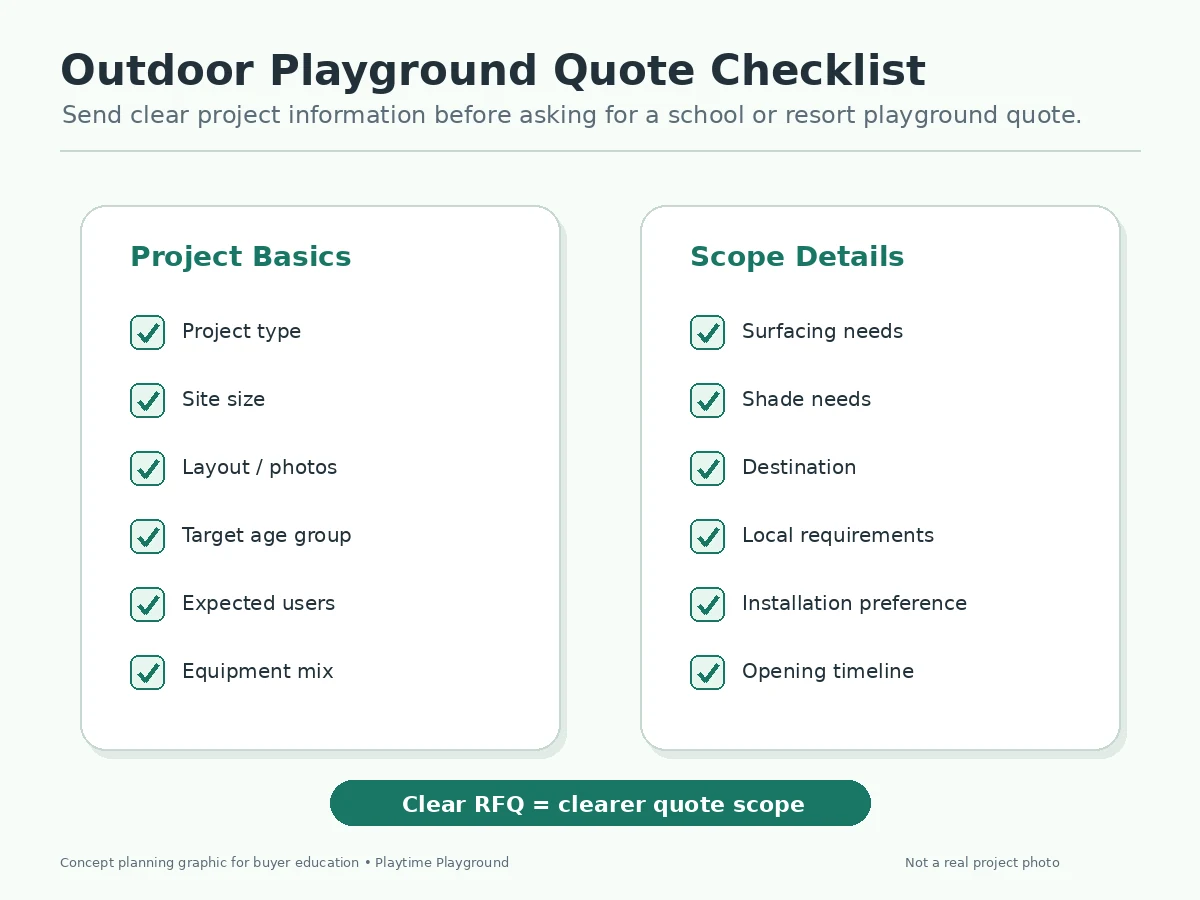
Outdoor Playground RFQ Checklist
- Project type: school, resort, hotel, community site, public park or contractor package
- Dimensioned site plan, survey, CAD file and current site photos
- Marked usable play area, boundaries, slopes, drainage and known utilities
- Exact age groups and planned supervision or guest-use model
- Core equipment, optional equipment and future-phase items
- Known critical-fall-height, surfacing and accessible-route requirements
- Shade, seating, fencing, signage and landscape scope
- Climate and exposure: UV, heat, humidity, coastal air, heavy rain or freeze-thaw
- Destination country, city, port, requested Incoterm and inland-delivery assumption
- Delivery gate, unloading equipment and storage conditions
- Foundation, local labor and installation responsibility
- Required drawings, reports, manuals, spare parts and inspection documents
- Site-readiness date, target opening date and known approval pathway
- Budget direction, with the cost level clearly identified
Before issuing the order, buyers can also use Playtime’s commercial playground buyer checklist to verify the final scope.
Come confrontare i preventivi dei fornitori di attrezzature per parchi giochi outdoor
Normalize each proposal against the same approved plan and equipment schedule. Mark every row as included, optional, provisional, owner-supplied or excluded. A quotation that cannot be reconciled to a drawing and item list is not ready for final comparison.
| Voce del preventivo | Cosa controllare | Perché è importante |
|---|---|---|
| Layout approvato | Drawing revision, usable boundary, use zones, age zones and equipment references | Ensures suppliers are pricing the same site concept |
| Elenco attrezzature | Model, quantity, included panels, roofs, slides, seats, hardware and freestanding items | Prevents missing components and scope substitution |
| Materials and finishes | Project-specific descriptions rather than generic quality claims | Supports environment, appearance and maintenance review |
| Surfacing and access | Area, system, performance basis, base, drainage, accessible route and installation | Can represent a major portion of installed cost |
| Shade and site items | Shade, seating, fencing, signage, foundations and separate engineering | These are often outside the play-equipment scope |
| Documents | Layout, equipment list, installation drawings, maintenance guidance, packing list and available reports | Determines whether the project can be coordinated and inspected |
| Logistics | Incoterm, packed volume, freight assumption, destination charges, inland delivery and unloading | Separates factory price from landed cost |
| Foundations and installation | Concrete, anchors, local labor, tools, supervision, travel and site readiness | Clarifies who owns execution risk |
| Commercial terms | Lead time, revision limit, payment terms, warranty, spare parts and claims process | Prevents assumptions after order placement |
Checklist di valutazione del fornitore per scuole e resort
A competent supplier should clarify the project before presenting a final price. The evaluation should focus on evidence, scope control and communication—not unsupported claims.
| Review Area | Segnale forte | Segnale di rischio |
|---|---|---|
| Site review | Asks for dimensions, constraints, users, climate, access and local requirements | Quotes from area alone or sends a standard set without site review |
| Scope control | Separates equipment, surfacing, shade, logistics, foundations and installation | Provides one total without inclusions and exclusions |
| Technical evidence | Identifies which documents, reports and standard editions apply to the quoted products | Uses logos or “international certified” claims without product-specific evidence |
| Outdoor exposure | Discusses UV, heat, rain, coastal or freeze-thaw conditions and maintenance | Calls every product weatherproof or maintenance-free |
| Logistics | Provides packing assumptions, delivery basis and receiving responsibilities | Says shipping is included without Incoterm, destination or exclusions |
| Installazione | Defines foundations, local labor, tools, supervision and site-readiness conditions | Says installation is included without responsibility detail |
| After-sales | Explains parts identification, claims, replacements, maintenance support and communication path | No process after shipment |
Segnali di allarme nei preventivi che gli acquirenti dovrebbero notare
- No dimensioned layout, equipment schedule or drawing revision
- Total site area used as though it were the usable equipment and surfacing area
- Protective surfacing omitted or described without performance and installation basis
- Independent shade assumed to be included with no structural or foundation scope
- Material claims such as “rustproof,” “UV proof” or “maintenance-free” without project-specific detail
- “ASTM compliant,” “CPSC certified” or “fully ADA compliant” claims without identifying the product, standard edition and evidence
- Shipping included with no Incoterm, destination, packed volume or local-charge boundary
- Installation included with no foundation, labor, tool, travel or site-readiness responsibility
- No inspection, maintenance, spare-parts or claims process
- Fake project photos, school names, resort cases, certificates or test records
Come Playtime Supporta i Progetti di Parchi Giochi Outdoor per Scuole e Resort
Playtime Playground supports commercial buyers with project-based equipment selection, layout discussion and quotation preparation. The process starts with site and user inputs rather than one universal package.
Share the plan, photos, age groups, climate, destination and project constraints.
Mark equipment zones, access, landscape constraints and owner-side functions.
Separate core equipment, optional items, surfacing, shade and future phases.
Confirm packing, delivery, foundations, installation support, documents and exclusions.
Issue a project-based quote tied to the stated layout and commercial assumptions.
Buyers can review Playtime’s progetti di parco giochi, servizi di progetto, risorse di pianificazione e profilo aziendale before requesting a formal quote. Final materials, documentation, warranty, lead time, shipping and installation support should be confirmed project by project.
Request a Scope-Based Outdoor Playground Quote
Send the dimensioned site plan, marked usable play area, target age groups, preferred equipment, surfacing and shade responsibility, climate conditions, destination, delivery access and installation model. Playtime can review the project inputs and prepare a quotation with clearer equipment, logistics and support boundaries.
Send Outdoor Playground Project DetailsOutdoor Playground Equipment Cost FAQ
Quanto costa l'attrezzatura per parchi giochi outdoor per una scuola o un resort?
Non esiste un prezzo universale affidabile senza un sito approvato e un ambito di attrezzature definito. Il costo dipende dall'area di gioco utilizzabile, dalle fasce d'età, dalla selezione delle attrezzature, dalle superfici protettive, dall'ombreggiatura, dai materiali, dal trasporto, dalle fondamenta e dalla responsabilità dell'installazione. Confronta se la cifra è un preventivo di fornitura attrezzature, il costo delle attrezzature sbarcate o il budget del progetto installato.
Cosa è solitamente escluso da un preventivo per attrezzature per parchi giochi outdoor?
Le esclusioni comuni includono costi di trasporto o destinazione, dogane, consegna interna, scarico, scavo, drenaggio, fondazioni in cemento, pavimentazioni protettive, percorsi accessibili, ombreggiatura, manodopera locale, ispezioni e permessi. Le esclusioni esatte devono essere indicate nel preventivo.
Perché i preventivi per parchi gioco scolastici e resort possono differire?
Le scuole spesso enfatizzano la zonizzazione per età, la supervisione, l'accessibilità, la durabilità per l'uso quotidiano e l'ispezione. I resort possono aggiungere temi, ombreggiatura, posti a sedere, circolazione degli ospiti, integrazione paesaggistica ed esposizione agli agenti atmosferici. Queste diverse priorità modificano le attrezzature e l'ambito di responsabilità del proprietario.
La pavimentazione protettiva è inclusa nel prezzo dell'attrezzatura?
Solo se specificato. Confermare il sistema di superficie, l'area, la base per l'altezza di caduta critica, la preparazione del sottofondo, il drenaggio, il percorso accessibile, la responsabilità dell'installazione e dell'ispezione. Non confrontare un preventivo solo per le attrezzature con un preventivo per attrezzature più superficie.
Quali standard ASTM sono pertinenti per un parco giochi outdoor di uso pubblico negli Stati Uniti?
Lo standard ASTM F1487-25 riguarda le attrezzature per parchi giochi pubblici coperte per utenti nella fascia d'età 2-12 anni. Lo standard ASTM F1292-22 riguarda l'attenuazione dell'impatto delle superfici nelle zone di utilizzo, e lo standard ASTM F1951-21 riguarda l'accessibilità delle superfici. Le attrezzature per bambini da 6 a 23 mesi sono trattate separatamente. È ancora necessaria la conferma dei requisiti locali.
Le strutture ombreggianti sono incluse nel preventivo e negli standard delle attrezzature per parchi gioco?
Non automaticamente. Ombrelloni indipendenti e arredi esterni potrebbero essere al di fuori dell'ambito delle attrezzature per parchi gioco e richiedere una revisione strutturale separata, fondazioni, progettazione per vento o neve, permessi e installazione. Il preventivo dovrebbe identificare l'ombreggiatura come inclusa, opzionale o fornita dal proprietario.
Cosa devo inviare per una richiesta di preventivo per parco giochi outdoor?
Invia una planimetria quotata del sito, foto, area utilizzabile indicata, gruppi di età, priorità delle attrezzature, requisiti di pavimentazione e ombreggiatura, esposizione climatica, destinazione, accesso per la consegna, modello di fondazione e installazione, documenti richiesti, percorso di approvazione e data target di preparazione del sito.
Come confrontare i fornitori di parchi giochi outdoor?
Richiedere a ciascun fornitore di quotare lo stesso disegno e programma delle attrezzature. Confrontare materiali e finiture, pavimentazioni, ombreggiatura, documenti, imballaggio, Incoterm, fondazioni, installazione, garanzia, pezzi di ricambio ed esclusioni, non solo il numero totale.