






Guida ai costi del soft play per asili nido
Costo attrezzature soft play per asili nido: cosa confrontare per gli acquirenti
Le attrezzature soft play per asili nido vengono solitamente quotate progetto per progetto anziché da un unico listino prezzi universale. Il dato utile non è solo il prezzo di forme in gommapiuma o scivoli: gli acquirenti devono anche confermare pavimentazione, rivestimenti murali, ambito di progettazione, imballaggio per l'esportazione, trasporto e responsabilità dell'installazione. Le dimensioni della stanza, l'area gioco utilizzabile, la fascia d'età, la visibilità di supervisione e l'accesso per la pulizia possono modificare il preventivo tanto quanto le dimensioni nominali della stanza.
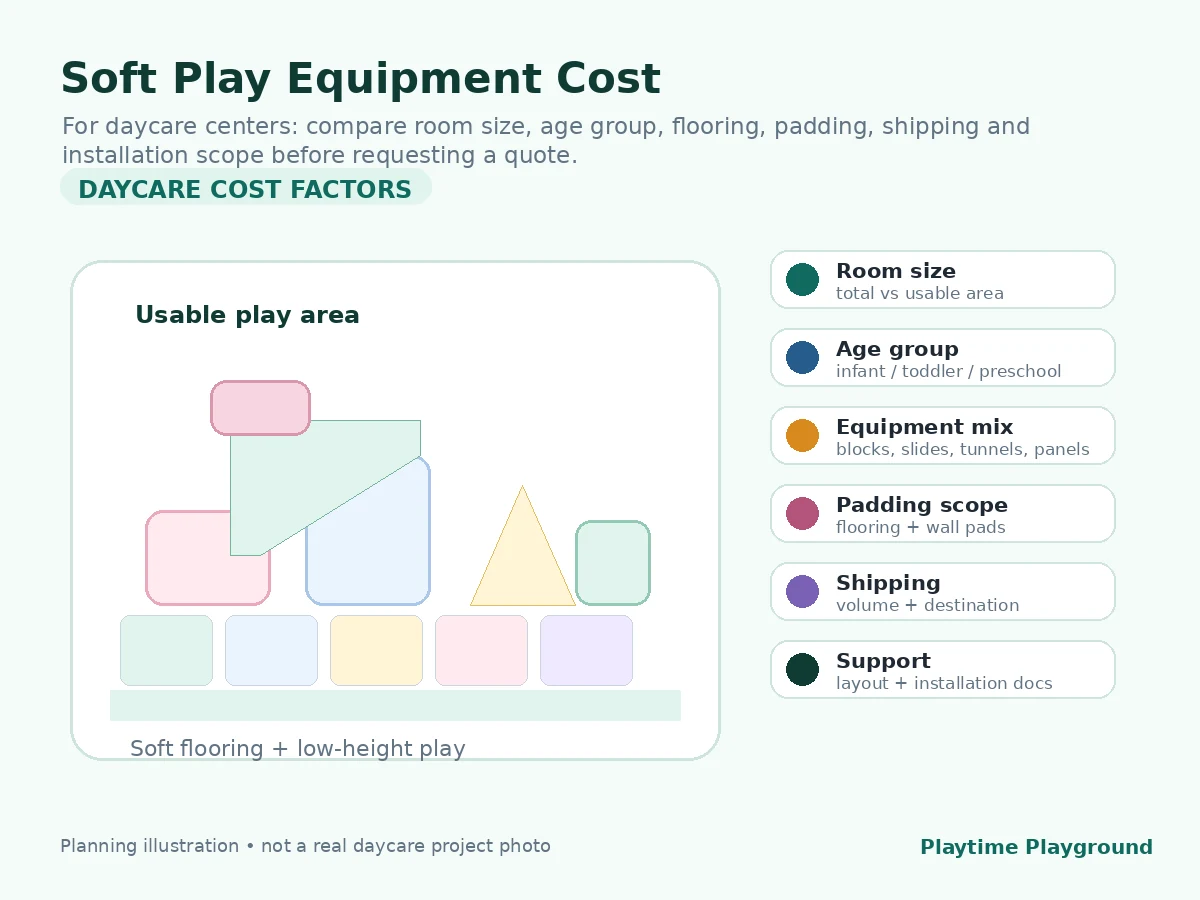
Prezzo attrezzature soft play, costo franco destino e costo allestimento completo per asilo nido
Prima di confrontare i fornitori, definisci a quale livello di costo corrisponde ciascun numero. Un preventivo per attrezzature di fabbrica, una stima delle attrezzature sdoganate e il budget totale per l'allestimento di un asilo nido non sono intercambiabili.
| Livello di costo | Inclusioni tipiche | Esclusioni tipiche | Punto di controllo per l'acquirente |
|---|---|---|---|
| Preventivo fornitura attrezzature | Articoli soft-play quotati, pavimentazione o pannelli murali concordati, documenti di progettazione, imballaggio e supporto lato fornitore elencati nell'offerta | Trasporto, oneri di importazione, consegna locale, manodopera locale e lavori nella sede, se non specificamente inclusi | Richiedi un elenco dettagliato delle attrezzature e un layout marcato. |
| Costo di sbarco delle attrezzature | Fornitura attrezzature più imballaggio per l'esportazione concordato, base di trasporto, spese di destinazione, consegna interna o articoli di scarico | Ristrutturazione dell'asilo nido, licenze, arredamento per aule, personale e spese operative | Conferma l'Incoterm, la destinazione, le tasse, i dazi e la responsabilità della consegna finale. |
| Budget completo per l'allestimento dell'asilo nido | Attrezzature e logistica più ristrutturazione lato proprietario, lavori elettrici, lavori antincendio o di accessibilità, approvazioni, assicurazione, arredamento e costi di apertura | Non si deve dare nulla per scontato; il proprietario o il team di progetto deve definire il budget completo | Non presentare un preventivo di attrezzature come costo di apertura dell'asilo nido. |
Per gli acquirenti che esaminano attrezzature soft play commerciali, il primo confronto dovrebbe riguardare l'ambito incluso piuttosto che il prezzo totale. Un'offerta può includere pavimentazione, pannelli murali e supporto per il layout, mentre un'altra può coprire solo attrezzature sfuse.
Cosa dovrebbe essere incluso in un preventivo per attrezzature soft play per asili nido?
Un preventivo utile dovrebbe collegare ogni articolo prezzato alla stanza effettiva e alla fascia d'età. A seconda dell'ambito approvato, può includere forme modulari in schiuma, strutture basse, scivoli per bambini piccoli, tunnel gattonanti, ponti morbidi, pannelli sensoriali, elementi per il gioco di finzione, aree con palline compatte, pavimentazione morbida, imbottitura per pareti, trattamento dei bordi protettivi, pannelli a tema, disegni del layout, informazioni sull'imballaggio e indicazioni per l'installazione.
Il preventivo dovrebbe anche separare le attrezzature fisse dai pezzi mobili. Ciò influisce sull'ancoraggio, sull'installazione, sull'accesso per la pulizia, sulla flessibilità della stanza e sulla responsabilità dell'operatore dell'asilo nido dopo la consegna.
Domande sull'ambito prima di confrontare il prezzo
- Il preventivo si basa sulla stanza quotata piuttosto che su un set di prodotti generico?
- Il layout indica porte, finestre, colonne, radiatori, prese, aree di stoccaggio e aree ristrette?
- Sono elencati separatamente attrezzature, pavimentazione, pannelli murali, pannelli decorativi e materiali di installazione?
- I prodotti proposti sono adatti alla fascia d'età esatta servita in quella stanza?
- Il fornitore identifica componenti fissi, modulari e mobili?
- Le revisioni del progetto, l'imballaggio, la base di trasporto e il supporto all'installazione sono chiaramente definiti?
- I termini di garanzia, pezzi di ricambio e manutenzione sono confermati nel preventivo o contratto finale?
Gli acquirenti che stanno ancora definendo la categoria di prodotto possono rivedere cosa include l'attrezzatura soft play indoor prima di richiedere un layout specifico per asilo nido.
Fattori di costo principali per attrezzature soft play per asili nido
Il costo cambia perché cambiano la stanza, gli utenti e le routine quotidiane. Una stanza compatta per bambini piccoli con pezzi modulari sfusi ha uno scopo diverso da una sala per la scuola dell'infanzia attrezzata con pavimentazione continua, pannelli murali, strutture fisse e pannelli personalizzati.
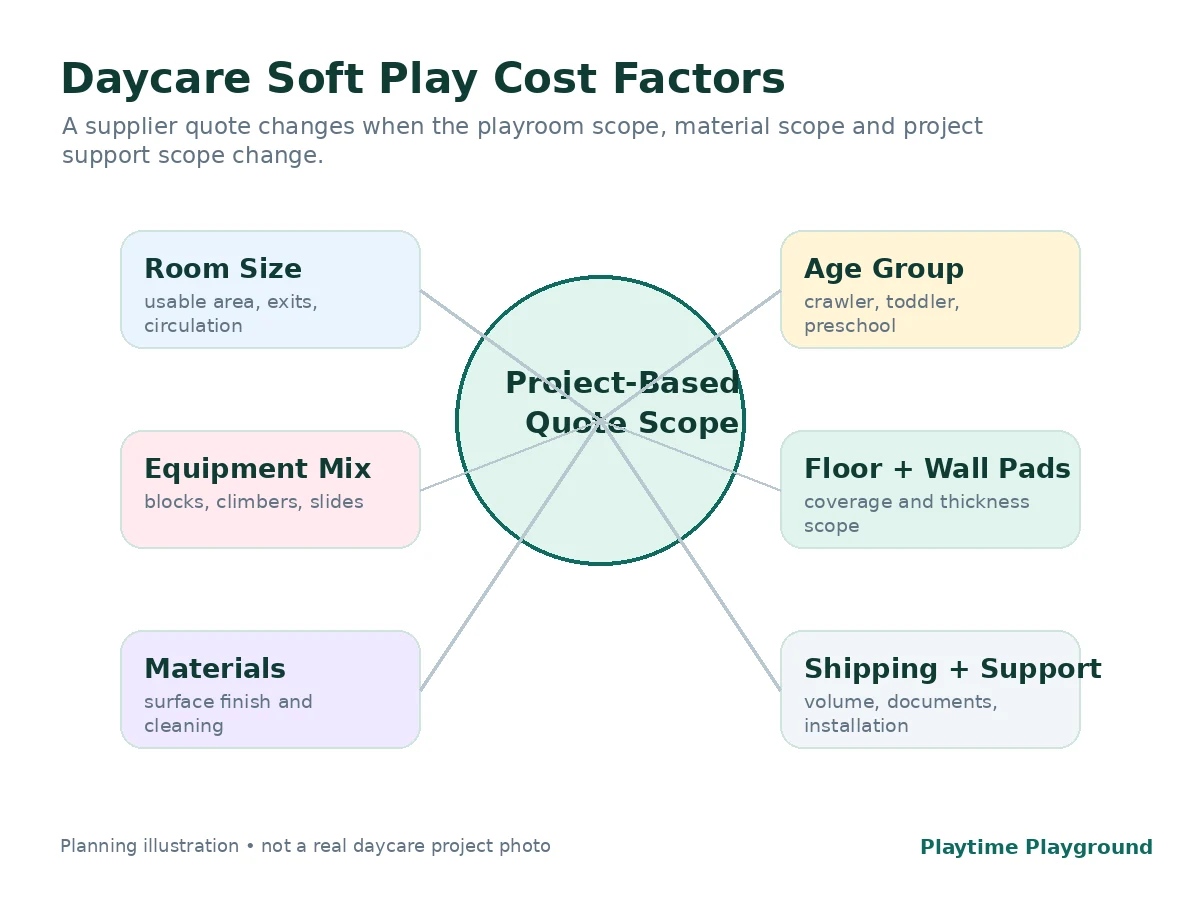
| Fattore di costo | Perché cambia il preventivo | Cosa devono confermare gli acquirenti |
|---|---|---|
| Area di gioco utilizzabile | Determina la quantità di attrezzature, pavimentazione, imbottiture e lavoro di installazione | Segna il confine effettivo dell'attrezzatura, non solo la dimensione lorda della stanza. |
| Fascia d'età | Le stanze per neonati, bambini piccoli e scuole dell'infanzia richiedono prodotti, altezze, schemi di movimento e supervisione diversi | Fornire l'intervallo di età esatto e la categoria di licenza locale. |
| Utilizzo previsto | Daily group size, rotation pattern and frequency affect durability, storage and operating layout | Describe how many children use the room at one time without treating this as a universal capacity formula. |
| Mix di attrezzature | Slides, climbers, tunnels, sensory panels, pretend-play pieces and ball areas use different space and materials | Separate must-have items from optional items. |
| Flooring and wall protection | Coverage area, edge details, wall conditions and installation method can materially change the scope | Show which floor and wall areas require treatment. |
| Material and cleanability requirements | Surface type, seams, removable covers and compatible cleaning methods affect production and maintenance | Request product-specific cleaning and maintenance guidance. |
| Design personalizzato | Custom colors, shapes, brand graphics and irregular room conditions require more design and production work | Confirm what 2D, 3D and graphic work is included. |
| Logistics and installation | Packed volume, destination, delivery access, local labor and site readiness affect landed cost | Confirm freight terms, door and elevator access, unloading and installation responsibility. |
Room Size Is Not the Same as Usable Soft Play Area
A daycare room also needs teacher circulation, clear entry and exit paths, storage access, opening space for doors, fixed furniture, emergency access and uninterrupted sightlines. These areas should be marked before equipment is selected.
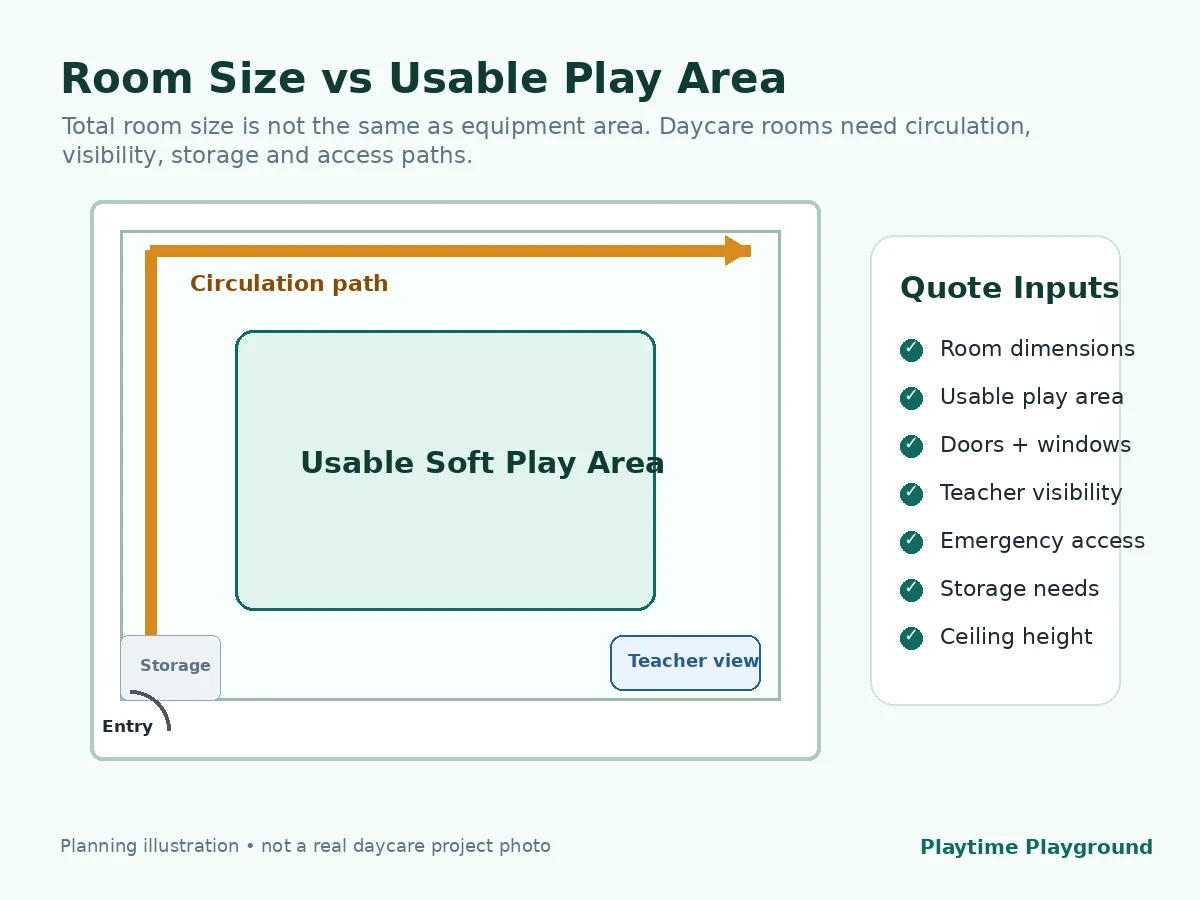
A common planning problem occurs when a buyer gives only the room’s length and width. After a concept is prepared, the team discovers that an outward-opening door, storage cabinet, radiator or teacher work area occupies part of the proposed equipment zone. The layout must then be reduced or redesigned. A marked floor plan prevents this avoidable revision.
Another frequent error is filling the perimeter with tall or bulky pieces. This may create hidden corners and make cleaning behind the equipment difficult. In a compact daycare room, low open equipment, wall activity panels and a limited number of well-spaced movement elements often provide better operating value than maximum equipment density.
Le risorse di pianificazione per parchi giochi di Playtime can help buyers organize the room brief before requesting a final quote.
Infant, Toddler and Preschool Rooms Need Different Equipment
“Daycare children” is not a precise design group. A crawler room, a toddler room and a preschool activity room have different movement abilities, supervision patterns and product requirements. A quotation should state which age group each component is intended to serve.
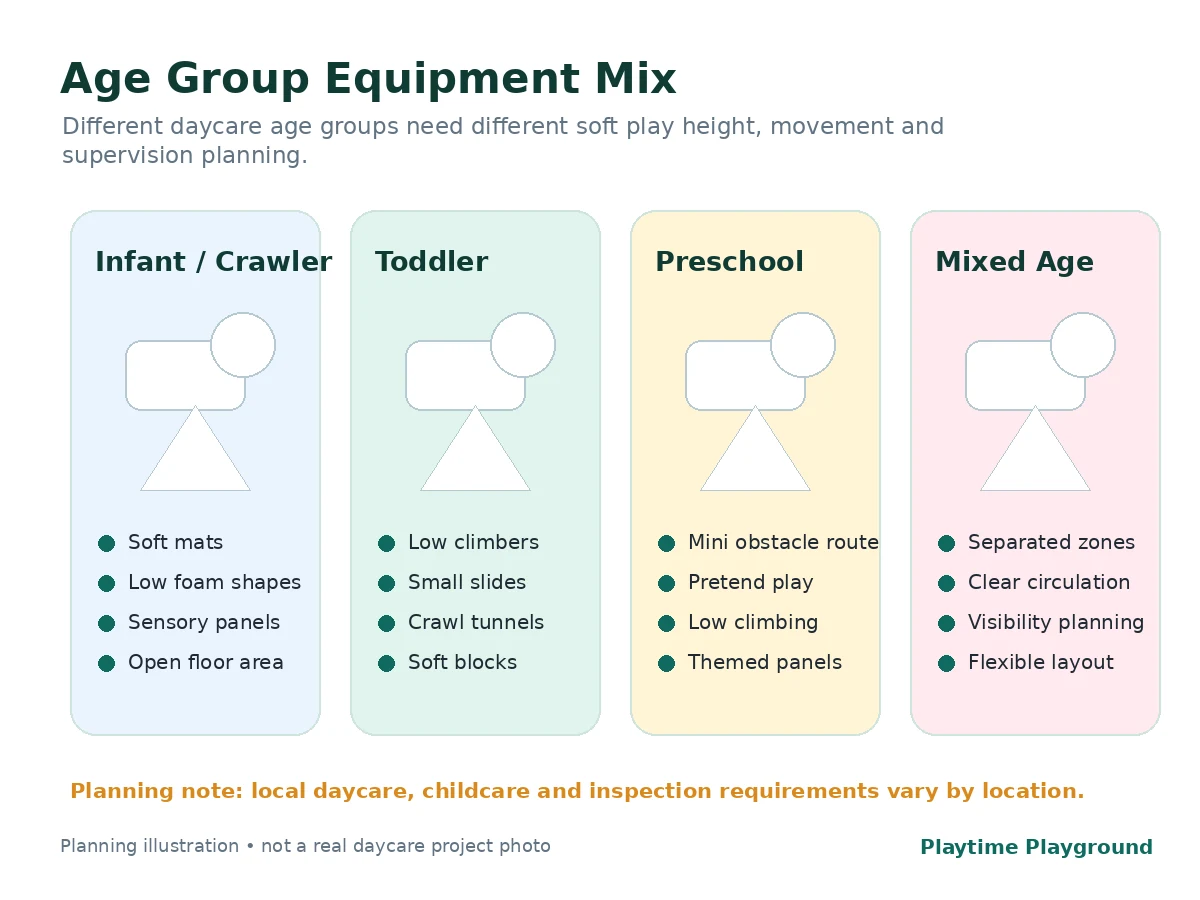
| User Group | Direzione tipica delle attrezzature | Design and Cost Impact | Priorità dell'acquirente |
|---|---|---|---|
| Neonato / gattonante | Open padded floor, very low forms and selected sensory activity | Requires separate product-suitability and local early-care review; products for older children cannot be assumed suitable | Direct supervision, mouthing behavior, hygiene, low access and local licensing requirements |
| Bambini piccoli | Low climbers, short slides, crawl routes, soft steps and open-ended foam forms | Requires clear sightlines, controlled movement and adequate space around active elements | Age-appropriate height, predictable circulation and cleaning access |
| Scuola dell'infanzia | Low obstacle sequences, pretend play, varied climbing and themed activity panels | A broader activity mix increases layout and equipment detail | Variety without creating blind spots or conflicting movement paths |
| Età mista | Clearly separated zones or scheduled use for different activity levels | Additional zoning, dividers, signage and operational planning may be needed | Preventing younger children from entering faster or more difficult play routes |
ASTM F1918-21 addresses soft contained play equipment for users from the 5th-percentile two-year-old through the 95th-percentile twelve-year-old. It should not be presented as automatic coverage for an infant room. ASTM F2373-24 addresses certain public-use play equipment for children six through twenty-three months in early-care and other public settings, but its scope excludes soft contained play equipment. The practical conclusion is that an infant-room proposal needs a product-specific and jurisdiction-specific review rather than a simple transfer of one standard label.
Equipment Mix: Compare Play Value, Supervision and Cleaning
A daycare does not automatically need a large indoor playground structure. In many rooms, a focused soft-play arrangement is easier to supervise, rotate, clean and maintain. Each item should have a clear purpose in the daily program.
Modular Foam Forms
Useful for flexible movement activities and room reconfiguration. Confirm dimensions, weight, surface material, storage method and whether covers or components can be replaced.
Low Climbers, Steps and Slides
Suitable for controlled gross-motor activity when the age group, surrounding space and supervision plan are appropriate. Confirm the complete landing and floor-protection scope.
Crawl Tunnels and Soft Obstacles
Add route variety but can block sightlines if placed poorly. Check teacher viewing positions, cleaning access and whether children can enter from conflicting directions.
Sensory and Wall Activities
Can add play value without using much floor space. Confirm mounting responsibility, wall condition, cleaning method and whether small detachable parts are involved.
Ball Areas
Require defined boundaries, ball management and a practical cleaning routine. Ask how balls, base surfaces and surrounding padding will be accessed and maintained.
Flooring and Wall Padding
These are separate scope items, not automatic accessories. Confirm coverage drawings, seams, edges, transitions, wall conditions and local installation responsibility.
Larger facilities may combine soft play with compact indoor playground equipment. That decision should follow the primary age group, clear height, supervision model and local requirements rather than the desire to add more components.
Matrice di allestimento per stanze asilo nido
The best quote is the one that fits the actual operating scenario. The matrix below helps buyers decide which scope is more appropriate before asking suppliers to price it.
| Scenario Asilo Nido | Indicazione Attrezzature più adatte | Cost-Scope Tendency | Key Supplier Question |
|---|---|---|---|
| Infant or crawler room | Open padded area and separately reviewed very-low activity products | Limited equipment quantity, but hygiene, flooring and product suitability remain important | What evidence supports suitability for the stated age range and local setting? |
| Piccola stanza per bambini piccoli | Low modular forms, short slide, crawl element and selected wall activity | Compact equipment scope with meaningful flooring and padding coverage | Can staff see and reach every active area? |
| Stanza attività scuola dell'infanzia | Low obstacle route, pretend-play pieces, varied movement and themed panels | More component variety and design coordination | Which parts are fixed, modular or removable for room changes? |
| Centro per l'infanzia per diverse fasce d'età | Separated zones, scheduled access or distinct rooms for different abilities | Additional zoning, barriers and operating controls | How does the layout prevent cross-traffic between age groups? |
| Larger daycare or preschool facility | Soft play plus a compact project-specific indoor play zone | Higher design, shipping and installation coordination | Is the quote based on a complete room plan and responsibility matrix? |
Set Soft Play Standard vs. Design Personalizzato per Sala Asilo Nido
A standard or modular set may be sufficient when the room is regular, the age group is clear and the buyer can maintain adequate circulation. A custom layout becomes more useful when the room has unusual dimensions, fixed obstacles, multiple age groups, continuous floor or wall treatment, or a defined visual identity.
| Opzione | Adatto per | Cost and Project Impact | Domanda dell'acquirente |
|---|---|---|---|
| Standard modular set | Simple rooms and limited equipment requirements | More predictable product scope, but the buyer must still verify fit and age suitability | Does the complete set fit while preserving circulation and sightlines? |
| Room-based modular layout | Programs that want flexible pieces arranged for a specific room | Adds layout work without creating a fully built-in environment | Can the pieces be safely rearranged and stored? |
| Custom fitted playroom | Irregular rooms, continuous flooring or padding, fixed components and branded interiors | Higher design, production and installation coordination | What drawings, revisions, graphics and site work are included? |
| Mixed soft play and indoor play structure | Larger preschool or childcare facilities with appropriate users and space | Greater structural, zoning and compliance complexity | Are the age groups and operating rules clearly separated? |
A common quotation mistake occurs when one supplier prices a loose standard set while another prices a fitted room with flooring, wall pads and custom panels. The totals do not represent the same deliverable. Compare the approved layout and equipment schedule line by line.
Materials, Padding, Hygiene and Cleaning Access
Daycare buyers need more than a broad statement that a product is “easy to clean.” The room should be designed so staff can reach high-touch surfaces, seams, edges, gaps, the backs of fixed pieces and the floor beneath or around equipment. The supplier should also state which cleaning products or methods are compatible with the quoted surfaces.
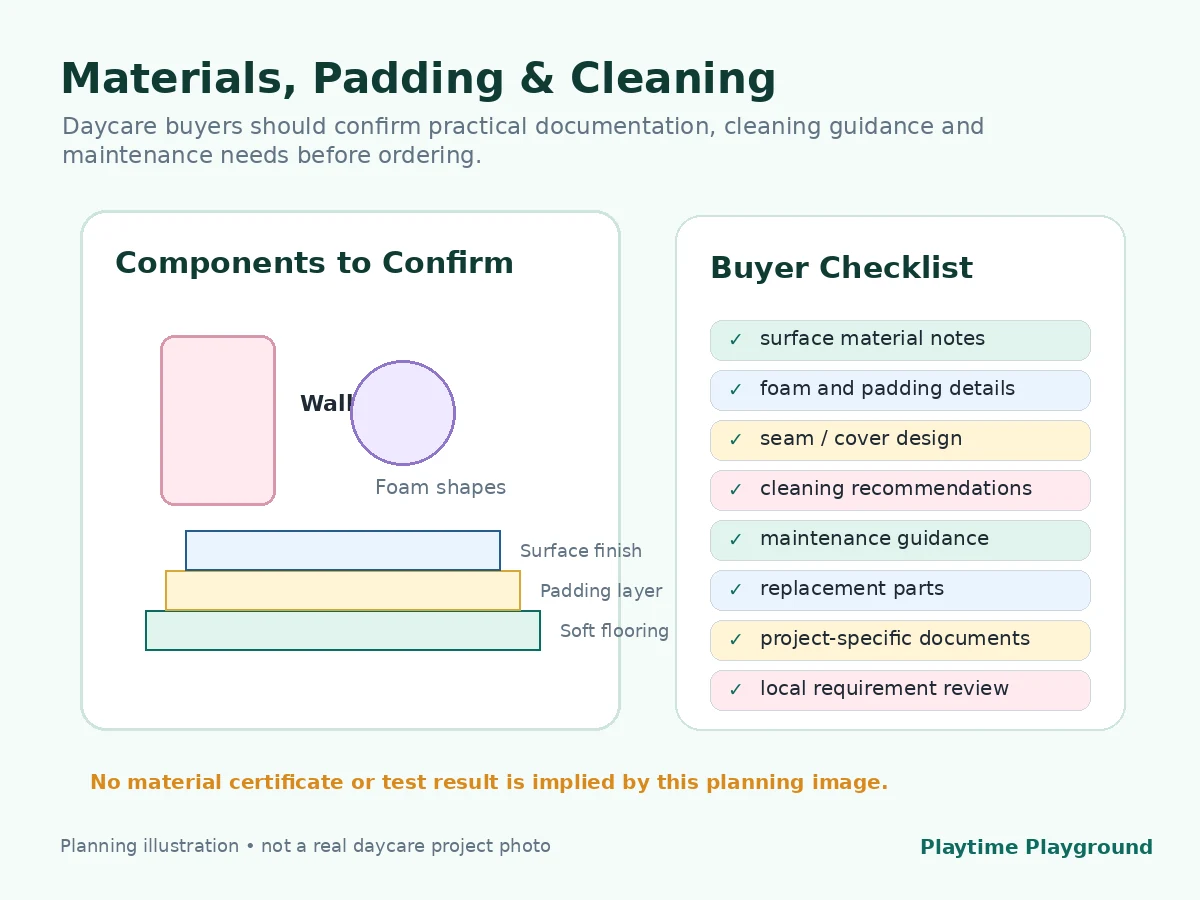
Material and Cleanability Questions
- What surface material is used on each quoted component?
- Where are seams, fasteners, zippers or access openings located?
- Can covers or high-wear components be removed or replaced where applicable?
- What cleaning, sanitizing or disinfecting products are compatible with the surfaces?
- Can staff access the floor, walls and gaps around fixed equipment?
- How should ball areas, tunnels and enclosed spaces be emptied or opened for cleaning?
- What maintenance frequency and inspection points does the supplier recommend?
- What material notes, test information or project documents are available for the final quoted scope?
CDC guidance for early-care and education settings distinguishes cleaning from sanitizing and disinfecting and advises users to follow product instructions and manufacturer compatibility. The equipment supplier should therefore provide surface-specific guidance rather than one universal cleaning claim.
Authoritative References for Buyer Review
These sources support planning discussions; they do not certify Playtime or prove that one product automatically complies in every jurisdiction.
- ASTM F1918-21 for soft contained play equipment — relevant to equipment within its stated product and user scope.
- ASTM F2373-24 for public-use play equipment for children 6–23 months — relevant context for certain early-care play equipment, while explicitly excluding soft contained play equipment.
- CPSC Public Playground Safety Handbook, 2025 edition — voluntary U.S. public-playground guidance for purchasers, installers, maintainers and childcare personnel.
- Supervisione attiva Head Start — early-childhood guidance supporting visibility, staff positioning and intentional observation.
- CDC cleaning and disinfection guidance for early-care settings — practical context for cleaning, sanitizing and disinfecting surfaces and objects.
Shipping, Delivery Access and Installation Support
Soft-play products can use substantial container or vehicle volume even when individual pieces are lightweight. A reliable logistics discussion should identify packed dimensions, estimated volume, labeling, freight basis, destination charges, inland delivery, unloading and the party responsible for moving the packages into the room.
Delivery access matters. A common installation problem occurs when a large padded piece or preassembled panel cannot pass through the building entrance, corridor or elevator. The team then has to repack, disassemble or modify the installation sequence. Provide door, corridor, stair and elevator dimensions before final packing is approved.
Site readiness also affects installation cost. Flooring conditions, wall preparation, moisture, electrical work, skirting, fixed furniture and room access should be completed or clearly coordinated before the installation team starts. A second visit caused by an unfinished room is normally an owner-side cost unless the contract says otherwise.
| Scope Item | Perché è importante | Cosa confermare |
|---|---|---|
| Export packing | Foam shapes, floor panels and custom pieces can create significant volume | Packing method, estimated volume, labels and component list |
| Freight basis | EXW, FOB, CIF, DAP and other terms allocate costs and risks differently | Incoterm, named place, freight validity and excluded charges |
| Final delivery access | Doors, lifts, stairs and unloading restrictions affect handling | Largest packed item, access dimensions, unloading equipment and delivery hours |
| Supporto all'installazione | Loose modular sets and fitted rooms require different support | Drawings, manuals, remote guidance, on-site support and local labor responsibility |
| Site readiness | Unfinished floors, walls or utilities can delay installation | Buyer-side prerequisites, inspection hold points and opening schedule |
For broader coordination, review Playtime’s servizi per progetti di parchi gioco before the final equipment and logistics scope is confirmed.
Cosa dovrebbero inviare gli acquirenti prima di richiedere un preventivo
A supplier can give only a rough product reference when the room and operating requirements are unknown. A layout-based quotation needs a clear project brief.
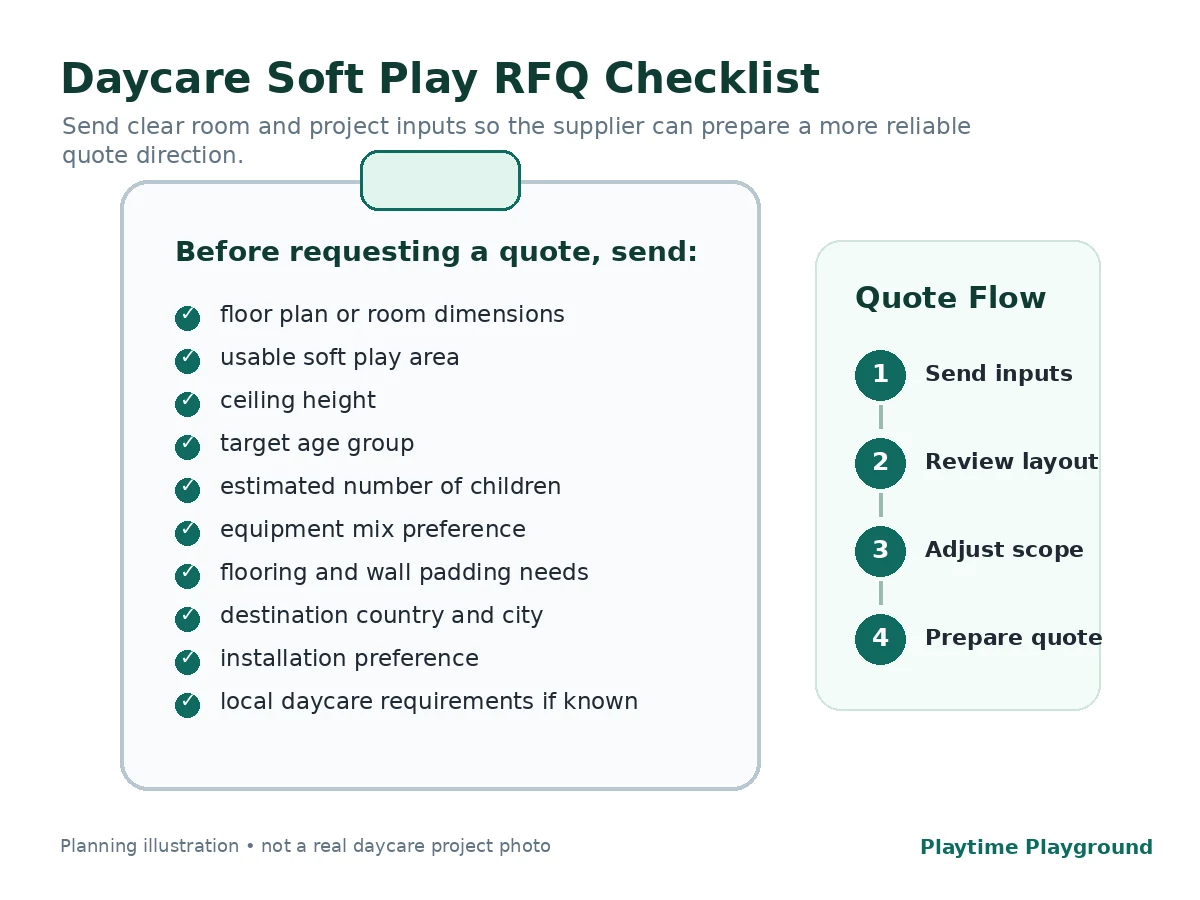
Daycare Soft Play RFQ Checklist
- Dimensioned floor plan, CAD file or accurate room sketch
- Gross room area and marked usable equipment area
- Clear ceiling height and any low beams or ceiling equipment
- Doors, windows, columns, radiators, outlets, cabinets and restricted areas
- Exact target age group for each room or zone
- Expected simultaneous user range and staff supervision model
- Required fixed, modular and movable equipment
- Soft-flooring and wall-padding coverage
- Cleaning, hygiene or material requirements from the operator
- Theme, color or brand direction
- Destination country, city and requested delivery basis
- Door, corridor, stair, elevator and unloading access
- Installation preference and available local labor
- Opening timeline and site-readiness date
- Known daycare licensing, fire, accessibility or inspection requirements
- Budget direction, clearly stating whether it covers equipment only or the landed scope
Buyers can also use Playtime’s lista di controllo RFQ per attrezzature per parchi giochi indoor to structure supplier submissions and document responsibilities.
How to Compare Daycare Soft Play Supplier Quotes
Place supplier quotations beside the same approved floor plan and compare included, optional and excluded items. A lower total is not meaningful when the equipment schedule, surface coverage or logistics basis is different.
| Voce del preventivo | Cosa controllare | Perché è importante |
|---|---|---|
| Layout approvato | Same usable area, doors, fixed obstacles and circulation assumptions | Prevents suppliers from pricing different room boundaries |
| Elenco attrezzature | Dimensions, quantity, fixed or modular status and age-group assignment | Shows whether the play value and installation scope are comparable |
| Flooring and wall pads | Coverage area, edge details, seams, substrate assumptions and installation | These items can represent a substantial part of a fitted room |
| Materials and cleanability | Surface notes, cleaning compatibility, replaceable parts and maintenance guidance | Supports daily daycare operation and lifecycle planning |
| Design and revisions | 2D layout, 3D concept, graphics and number or basis of revisions | Prevents later charges or design misunderstandings |
| Documentazione | Equipment list, layout, material notes, packing list, manuals and maintenance information | Supports installation, handover and local review |
| Logistics | Packing, Incoterm, destination, freight validity, duties, local delivery and unloading | Separates factory price from landed cost |
| Installazione | Local labor, tools, wall or floor preparation, remote support and on-site support | Clarifies who owns execution risk |
| Commercial terms | Lead time, payment terms, warranty, spare parts and after-sales process | Allows comparison beyond the initial purchase number |
For a wider supplier review, use Playtime’s indoor playground supplier checklist e commercial playground buyer checklist.
Segnali di allarme nei preventivi che gli acquirenti dovrebbero notare
- One total price with no marked layout or equipment schedule
- A design prepared without the exact age group or daycare-room use
- Infant products described as covered by a standard whose stated user range begins at age two
- Flooring and wall pads described only as “standard” with no coverage drawing
- Material claims such as “non-toxic,” “antibacterial,” “fireproof” or “easy to clean” without scope-specific evidence or instructions
- No explanation of fixed, modular and movable pieces
- No cleaning, maintenance or replacement-part discussion
- “Shipping included” without an Incoterm, named destination or excluded-charge list
- “Installation included” without local labor, tools, travel and site-preparation responsibilities
- No delivery-access review for doors, corridors, stairs or elevators
- Claims that one product or layout meets all daycare requirements worldwide
- Pressure to approve production before local requirements and final drawings are confirmed
How Playtime Supports Daycare Soft Play Projects
Playtime Playground can discuss daycare soft-play projects using the actual room, age group and requested equipment scope rather than a universal package price. Support should be confirmed project by project in the final quotation.
Share the marked floor plan, age group, operating needs and destination.
Review access, circulation, staff sightlines, cleaning space and fixed obstacles.
Separate core movement, sensory, flooring and wall-protection requirements.
Confirm layout, equipment list, design, packing, freight basis and exclusions.
Review site readiness, delivery access, installation support and handover documents.
Buyers can review Playtime’s progetti di parco giochi, servizi di progetto e risorse di pianificazione before submitting the formal room brief.
Request a Layout-Based Daycare Soft Play Quote
Send the dimensioned room plan, marked usable play area, clear height, exact age group, expected simultaneous users, equipment priorities, flooring and wall-padding scope, destination, delivery access and installation preference. Playtime can review the project inputs and discuss a quotation based on the defined room and responsibility scope.
Send Daycare Project DetailsDaycare Soft Play Equipment Cost FAQ
Quanto costa l'attrezzatura soft play per un asilo nido?
Non esiste un prezzo universale affidabile senza un ambito definito di stanza e attrezzature. Il costo dipende dall'area utilizzabile, dalla fascia d'età, dall'elenco delle attrezzature, dalla pavimentazione, dai rivestimenti murali, dal lavoro di progettazione, dal volume imballato, dalla destinazione e dalla responsabilità dell'installazione. Richiedi un preventivo basato sul layout e conferma se rappresenta il prezzo dell'attrezzatura, il costo dell'attrezzatura sbarcata o il budget completo per l'allestimento dell'asilo nido.
Qual è la differenza tra il prezzo dell'attrezzatura e il costo totale per l'allestimento di un asilo nido?
Il prezzo dell'attrezzatura copre solo i prodotti e i servizi del fornitore elencati nel preventivo. Il costo completo dell'allestimento può includere anche trasporto, dazi, consegna locale, installazione, ristrutturazione, arredi, lavori elettrici e antincendio, licenze, assicurazione, personale e spese di pre-apertura. Queste categorie dovrebbero essere preventivate separatamente.
Il pavimento morbido è incluso in un preventivo per soft play per asilo nido?
Solo quando elencato nel preventivo. Confermare l'area coperta, il materiale, le cuciture, le transizioni, le ipotesi sul substrato, la responsabilità dell'installazione e i requisiti locali. Non presumere che tappetini o pavimentazioni morbide continue siano inclusi con i pezzi dell'attrezzatura.
Quali attrezzature soft play sono adatte per neonati e bambini piccoli?
L'idoneità dipende dall'età esatta e dalla categoria di prodotto. Le aree per bambini piccoli possono utilizzare strutture per arrampicata basse, scivoli corti, percorsi striscianti e forme modulari morbide. Le aree per neonati o gattonanti richiedono una revisione specifica del prodotto e delle licenze locali; le attrezzature destinate a bambini di età pari o superiore a due anni non devono essere automaticamente specificate per i neonati.
Di quanto spazio necessita un'area soft play per asilo nido?
L'area non può essere calcolata solo dalla superficie delle attrezzature. La stanza deve inoltre consentire la circolazione degli insegnanti, la visibilità, le porte, lo stoccaggio, l'accesso di emergenza, la pulizia e i requisiti di spazio locali. Invia una planimetria quotata anziché solo i metri quadrati o piedi quadrati totali della stanza.
Quali informazioni sulla pulizia dovrebbe fornire il fornitore?
Richiedi istruzioni specifiche per la pulizia e la manutenzione in base alla superficie, prodotti o metodi compatibili, accesso a cuciture e aree nascoste, parti rimovibili o sostituibili ove applicabile e indicazioni per i componenti ad alto contatto. L'asilo nido dovrà quindi allineare tali istruzioni con le procedure locali di sanità pubblica e di licenza.
I costi di spedizione e installazione sono inclusi nel prezzo delle attrezzature soft play?
Non automaticamente. Confermare imballaggio, Incoterm, costi di destinazione, consegna interna, scarico, accesso porta o ascensore, manodopera locale, strumenti, preparazione del sito, manuali, supporto remoto e qualsiasi assistenza in loco. Il preventivo finale deve indicare ogni inclusione ed esclusione.
Quali standard e requisiti locali dovrebbero esaminare gli acquirenti di asili nido?
La risposta dipende dal prodotto e dalla fascia d'età. Lo standard ASTM F1918-21 copre le attrezzature soft contained play nell'intervallo d'età da due a dodici anni specificato. Lo standard ASTM F2373-24 copre determinate attrezzature per uso pubblico per bambini da sei a ventitré mesi, ma esclude le attrezzature soft contained play. Gli acquirenti devono inoltre verificare i requisiti locali per licenze per asili nido, edilizia, antincendio, accessibilità, sanità pubblica, assicurazioni e ispezioni.