






Daycare Soft Play Cost Guide
Soft Play Equipment Cost for Daycare Centers: What Buyers Should Compare
Daycare soft play equipment is normally quoted project by project rather than from one universal retail price list. The useful number is not only the price of foam shapes or slides: buyers also need to confirm flooring, wall padding, design scope, export packing, freight and installation responsibility. Room dimensions, usable play area, age group, supervision visibility and cleaning access can change the quote as much as the nominal room size.
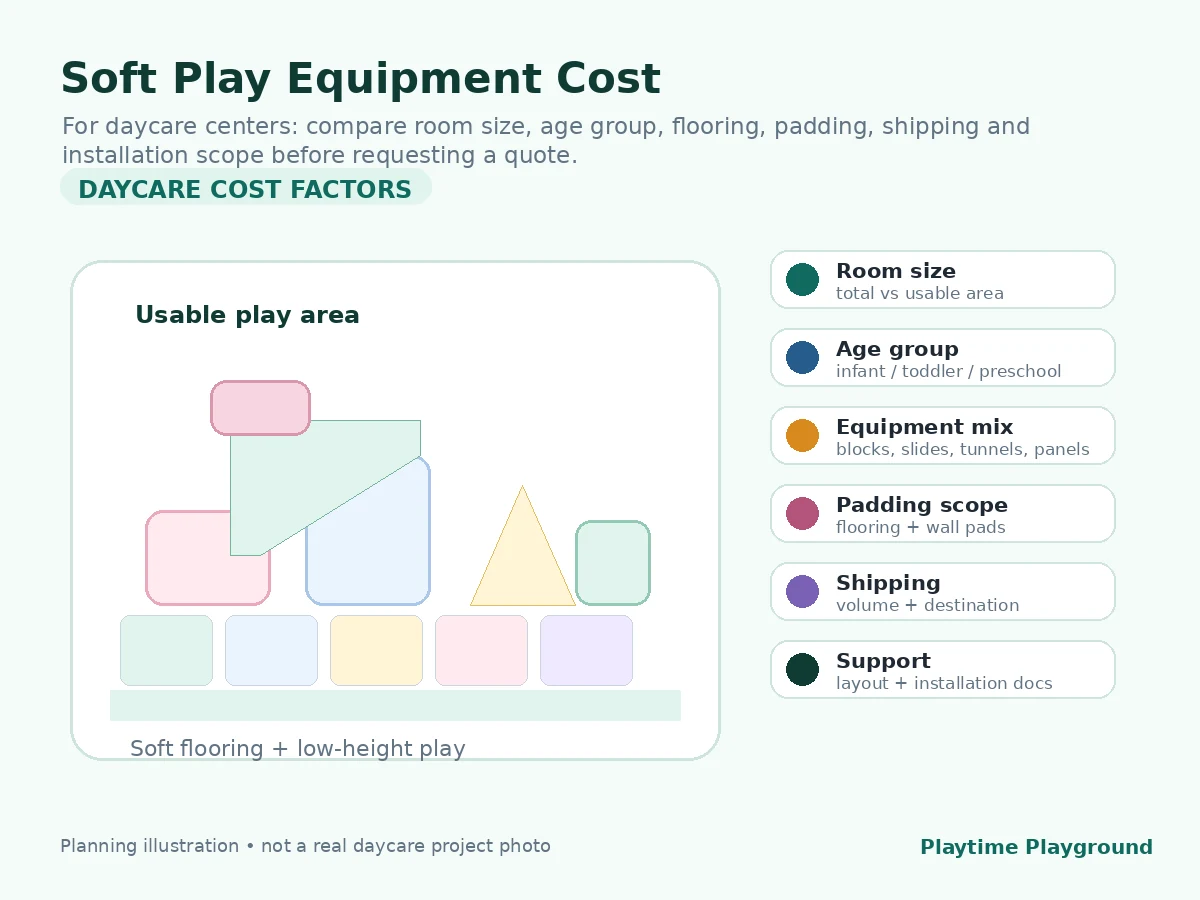
Soft Play Equipment Price, Landed Cost and Full Daycare Setup Cost
Before comparing suppliers, define which cost level each number represents. A factory equipment quote, a landed equipment estimate and the total daycare setup budget are not interchangeable.
| Cost Level | Typical Inclusions | Typical Exclusions | Buyer Checkpoint |
|---|---|---|---|
| Equipment-supply quote | Quoted soft-play items, agreed flooring or wall pads, design documents, packing and supplier-side support listed in the offer | Freight, import charges, local delivery, local labor and venue work unless specifically included | Request an itemized equipment schedule and marked layout. |
| Landed equipment cost | Equipment supply plus the agreed export packing, freight basis, destination charges, inland delivery or unloading items | Daycare renovation, licensing, classroom furniture, staffing and operating expenses | Confirm the Incoterm, destination, taxes, duties and final-delivery responsibility. |
| Full daycare setup budget | Equipment and logistics plus owner-side renovation, electrical work, fire or accessibility work, approvals, insurance, furniture and opening costs | Nothing should be assumed; the owner or project team must build the complete budget | Do not present an equipment quotation as the cost of opening the daycare. |
For buyers reviewing commercial soft-play equipment, the first comparison should be the included scope rather than the total price. One offer may include flooring, wall pads and layout support, while another may cover only loose equipment pieces.
What Should Be Included in a Daycare Soft Play Equipment Quote?
A useful quotation should connect every priced item to the actual room and age group. Depending on the approved scope, it may include modular foam shapes, low climbers, toddler slides, crawl tunnels, soft bridges, sensory panels, pretend-play pieces, compact ball areas, soft flooring, wall padding, protective edge treatment, themed panels, layout drawings, packing information and installation guidance.
The quote should also separate fixed equipment from movable pieces. This affects anchoring, installation, cleaning access, room flexibility and the daycare operator’s responsibility after handover.
Scope Questions Before Comparing Price
- Is the quote based on the dimensioned room rather than a generic product set?
- Does the layout mark doors, windows, columns, radiators, outlets, storage and restricted areas?
- Are equipment, flooring, wall pads, decorative panels and installation materials listed separately?
- Are the proposed products suitable for the exact age range served in that room?
- Does the supplier identify fixed, modular and movable components?
- Are design revisions, packing, freight basis and installation support clearly defined?
- Are warranty, replacement-part and maintenance terms confirmed in the final quotation or contract?
Buyers who are still defining the product category can review what indoor soft-play equipment includes before requesting a daycare-specific layout.
Main Cost Factors for Daycare Soft Play Equipment
Cost changes because the room, users and daily routines change. A compact toddler room with loose modular pieces has a different scope from a fitted preschool playroom with continuous flooring, wall pads, fixed climbers and custom panels.
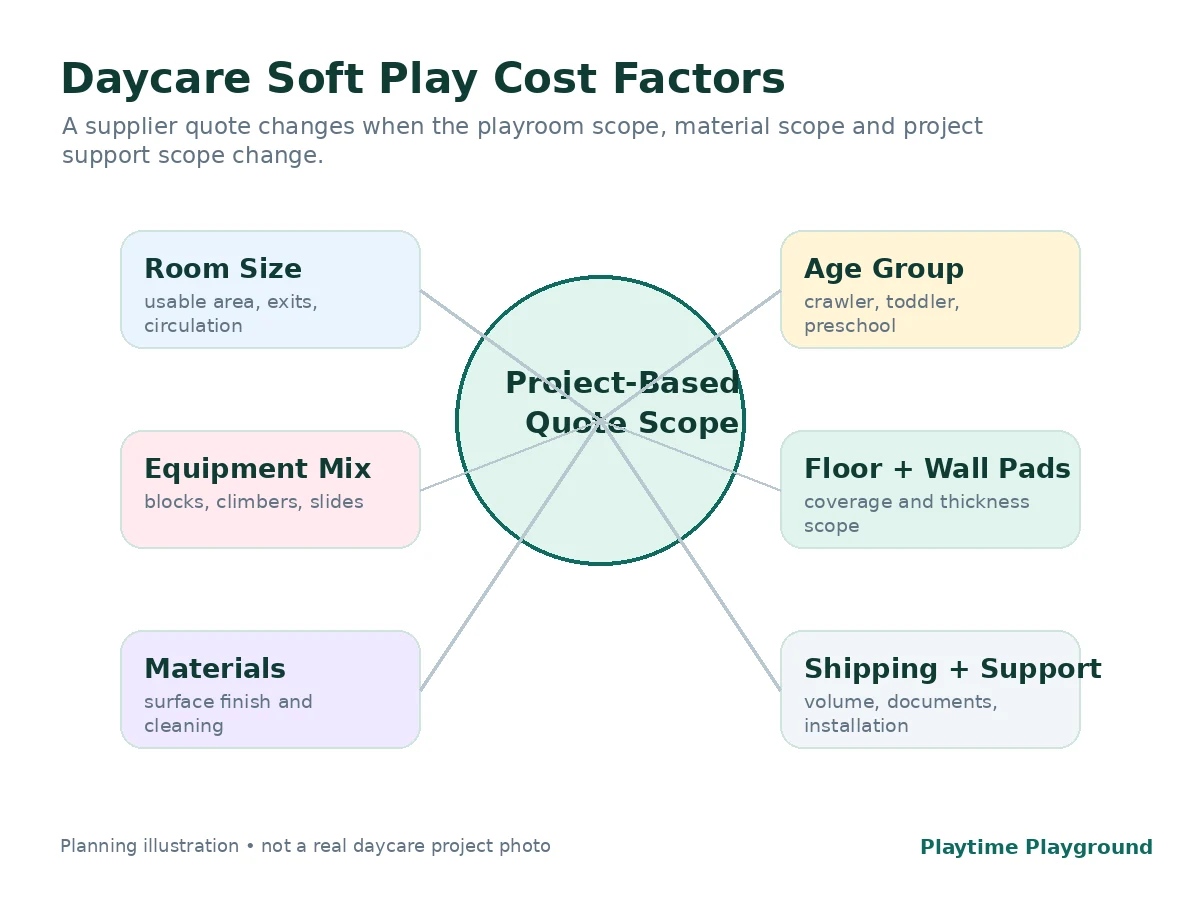
| Cost Factor | Why It Changes the Quote | What Buyers Should Confirm |
|---|---|---|
| Usable play area | Determines the amount of equipment, flooring, padding and installation work | Mark the actual equipment boundary, not only the gross room size. |
| Age group | Infant, toddler and preschool rooms require different products, heights, movement patterns and supervision | Provide the exact age range and the local licensing category. |
| Expected use | Daily group size, rotation pattern and frequency affect durability, storage and operating layout | Describe how many children use the room at one time without treating this as a universal capacity formula. |
| Equipment mix | Slides, climbers, tunnels, sensory panels, pretend-play pieces and ball areas use different space and materials | Separate must-have items from optional items. |
| Flooring and wall protection | Coverage area, edge details, wall conditions and installation method can materially change the scope | Show which floor and wall areas require treatment. |
| Material and cleanability requirements | Surface type, seams, removable covers and compatible cleaning methods affect production and maintenance | Request product-specific cleaning and maintenance guidance. |
| Custom design | Custom colors, shapes, brand graphics and irregular room conditions require more design and production work | Confirm what 2D, 3D and graphic work is included. |
| Logistics and installation | Packed volume, destination, delivery access, local labor and site readiness affect landed cost | Confirm freight terms, door and elevator access, unloading and installation responsibility. |
Room Size Is Not the Same as Usable Soft Play Area
A daycare room also needs teacher circulation, clear entry and exit paths, storage access, opening space for doors, fixed furniture, emergency access and uninterrupted sightlines. These areas should be marked before equipment is selected.
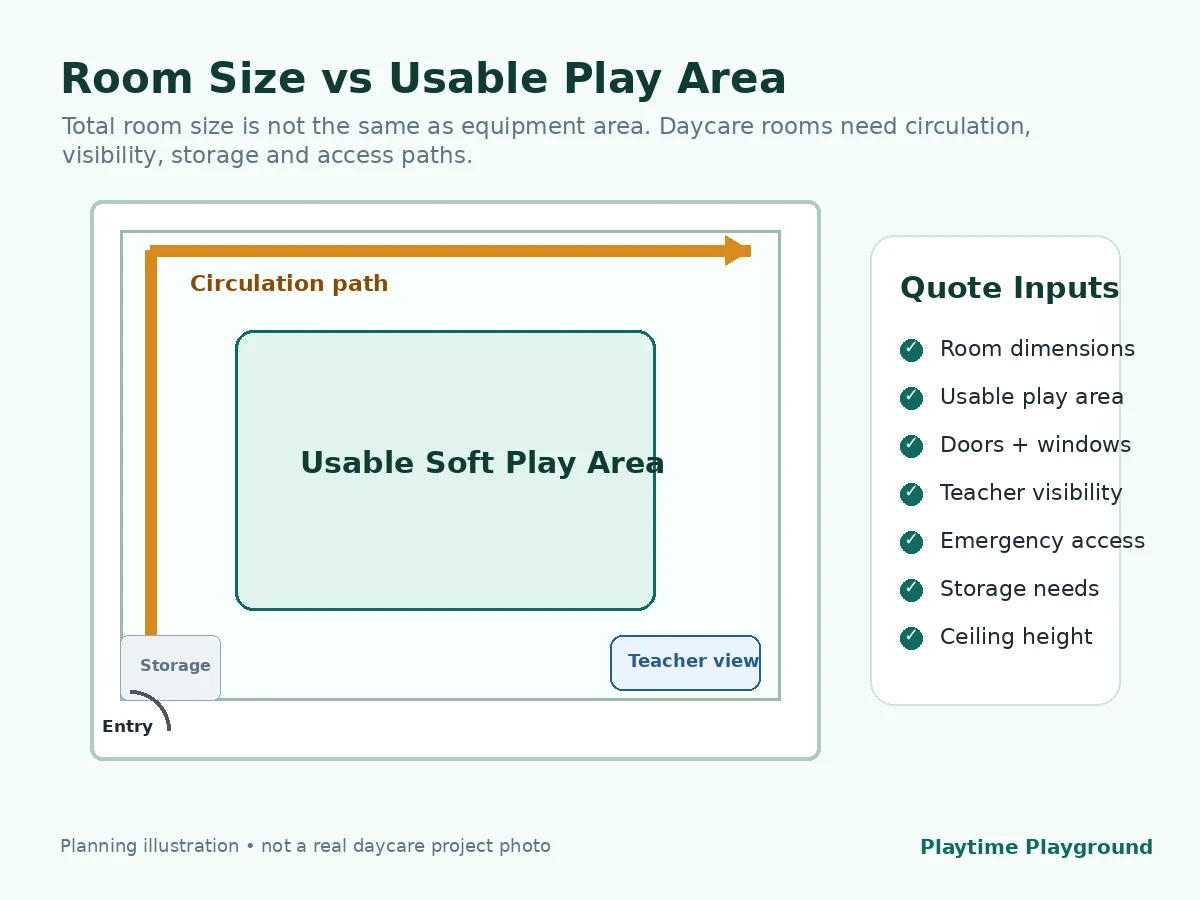
A common planning problem occurs when a buyer gives only the room’s length and width. After a concept is prepared, the team discovers that an outward-opening door, storage cabinet, radiator or teacher work area occupies part of the proposed equipment zone. The layout must then be reduced or redesigned. A marked floor plan prevents this avoidable revision.
Another frequent error is filling the perimeter with tall or bulky pieces. This may create hidden corners and make cleaning behind the equipment difficult. In a compact daycare room, low open equipment, wall activity panels and a limited number of well-spaced movement elements often provide better operating value than maximum equipment density.
Playtime’s playground planning resources can help buyers organize the room brief before requesting a final quote.
Infant, Toddler and Preschool Rooms Need Different Equipment
“Daycare children” is not a precise design group. A crawler room, a toddler room and a preschool activity room have different movement abilities, supervision patterns and product requirements. A quotation should state which age group each component is intended to serve.
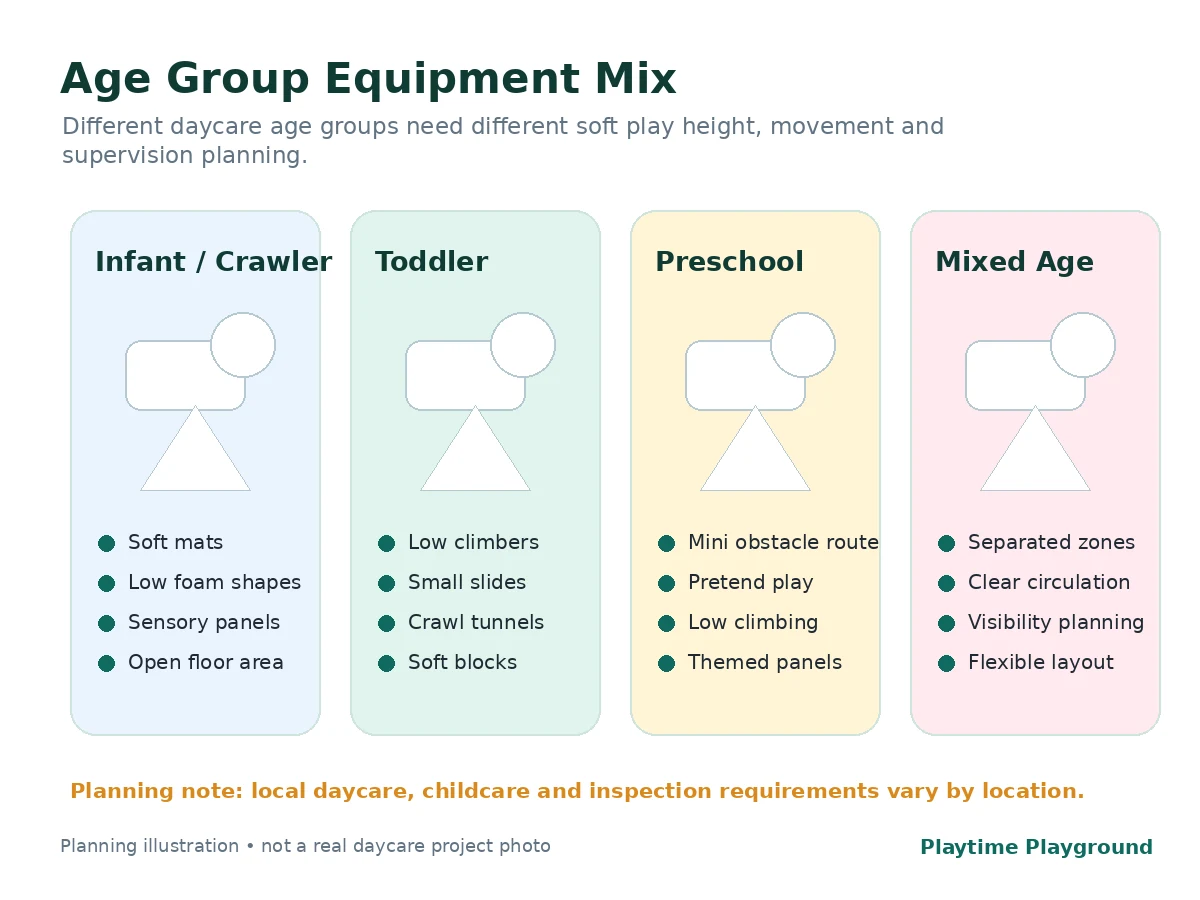
| User Group | Typical Equipment Direction | Design and Cost Impact | Buyer Priority |
|---|---|---|---|
| Infant / crawler | Open padded floor, very low forms and selected sensory activity | Requires separate product-suitability and local early-care review; products for older children cannot be assumed suitable | Direct supervision, mouthing behavior, hygiene, low access and local licensing requirements |
| Toddler | Low climbers, short slides, crawl routes, soft steps and open-ended foam forms | Requires clear sightlines, controlled movement and adequate space around active elements | Age-appropriate height, predictable circulation and cleaning access |
| Preschool | Low obstacle sequences, pretend play, varied climbing and themed activity panels | A broader activity mix increases layout and equipment detail | Variety without creating blind spots or conflicting movement paths |
| Mixed age | Clearly separated zones or scheduled use for different activity levels | Additional zoning, dividers, signage and operational planning may be needed | Preventing younger children from entering faster or more difficult play routes |
ASTM F1918-21 addresses soft contained play equipment for users from the 5th-percentile two-year-old through the 95th-percentile twelve-year-old. It should not be presented as automatic coverage for an infant room. ASTM F2373-24 addresses certain public-use play equipment for children six through twenty-three months in early-care and other public settings, but its scope excludes soft contained play equipment. The practical conclusion is that an infant-room proposal needs a product-specific and jurisdiction-specific review rather than a simple transfer of one standard label.
Equipment Mix: Compare Play Value, Supervision and Cleaning
A daycare does not automatically need a large indoor playground structure. In many rooms, a focused soft-play arrangement is easier to supervise, rotate, clean and maintain. Each item should have a clear purpose in the daily program.
Modular Foam Forms
Useful for flexible movement activities and room reconfiguration. Confirm dimensions, weight, surface material, storage method and whether covers or components can be replaced.
Low Climbers, Steps and Slides
Suitable for controlled gross-motor activity when the age group, surrounding space and supervision plan are appropriate. Confirm the complete landing and floor-protection scope.
Crawl Tunnels and Soft Obstacles
Add route variety but can block sightlines if placed poorly. Check teacher viewing positions, cleaning access and whether children can enter from conflicting directions.
Sensory and Wall Activities
Can add play value without using much floor space. Confirm mounting responsibility, wall condition, cleaning method and whether small detachable parts are involved.
Ball Areas
Require defined boundaries, ball management and a practical cleaning routine. Ask how balls, base surfaces and surrounding padding will be accessed and maintained.
Flooring and Wall Padding
These are separate scope items, not automatic accessories. Confirm coverage drawings, seams, edges, transitions, wall conditions and local installation responsibility.
Larger facilities may combine soft play with compact indoor playground equipment. That decision should follow the primary age group, clear height, supervision model and local requirements rather than the desire to add more components.
Daycare Playroom Fit Matrix
The best quote is the one that fits the actual operating scenario. The matrix below helps buyers decide which scope is more appropriate before asking suppliers to price it.
| Daycare Scenario | Better-Fit Equipment Direction | Cost-Scope Tendency | Key Supplier Question |
|---|---|---|---|
| Infant or crawler room | Open padded area and separately reviewed very-low activity products | Limited equipment quantity, but hygiene, flooring and product suitability remain important | What evidence supports suitability for the stated age range and local setting? |
| Small toddler room | Low modular forms, short slide, crawl element and selected wall activity | Compact equipment scope with meaningful flooring and padding coverage | Can staff see and reach every active area? |
| Preschool activity room | Low obstacle route, pretend-play pieces, varied movement and themed panels | More component variety and design coordination | Which parts are fixed, modular or removable for room changes? |
| Mixed-age childcare center | Separated zones, scheduled access or distinct rooms for different abilities | Additional zoning, barriers and operating controls | How does the layout prevent cross-traffic between age groups? |
| Larger daycare or preschool facility | Soft play plus a compact project-specific indoor play zone | Higher design, shipping and installation coordination | Is the quote based on a complete room plan and responsibility matrix? |
Standard Soft Play Set vs Custom Daycare Playroom Design
A standard or modular set may be sufficient when the room is regular, the age group is clear and the buyer can maintain adequate circulation. A custom layout becomes more useful when the room has unusual dimensions, fixed obstacles, multiple age groups, continuous floor or wall treatment, or a defined visual identity.
| Option | Suitable For | Cost and Project Impact | Buyer Question |
|---|---|---|---|
| Standard modular set | Simple rooms and limited equipment requirements | More predictable product scope, but the buyer must still verify fit and age suitability | Does the complete set fit while preserving circulation and sightlines? |
| Room-based modular layout | Programs that want flexible pieces arranged for a specific room | Adds layout work without creating a fully built-in environment | Can the pieces be safely rearranged and stored? |
| Custom fitted playroom | Irregular rooms, continuous flooring or padding, fixed components and branded interiors | Higher design, production and installation coordination | What drawings, revisions, graphics and site work are included? |
| Mixed soft play and indoor play structure | Larger preschool or childcare facilities with appropriate users and space | Greater structural, zoning and compliance complexity | Are the age groups and operating rules clearly separated? |
A common quotation mistake occurs when one supplier prices a loose standard set while another prices a fitted room with flooring, wall pads and custom panels. The totals do not represent the same deliverable. Compare the approved layout and equipment schedule line by line.
Materials, Padding, Hygiene and Cleaning Access
Daycare buyers need more than a broad statement that a product is “easy to clean.” The room should be designed so staff can reach high-touch surfaces, seams, edges, gaps, the backs of fixed pieces and the floor beneath or around equipment. The supplier should also state which cleaning products or methods are compatible with the quoted surfaces.
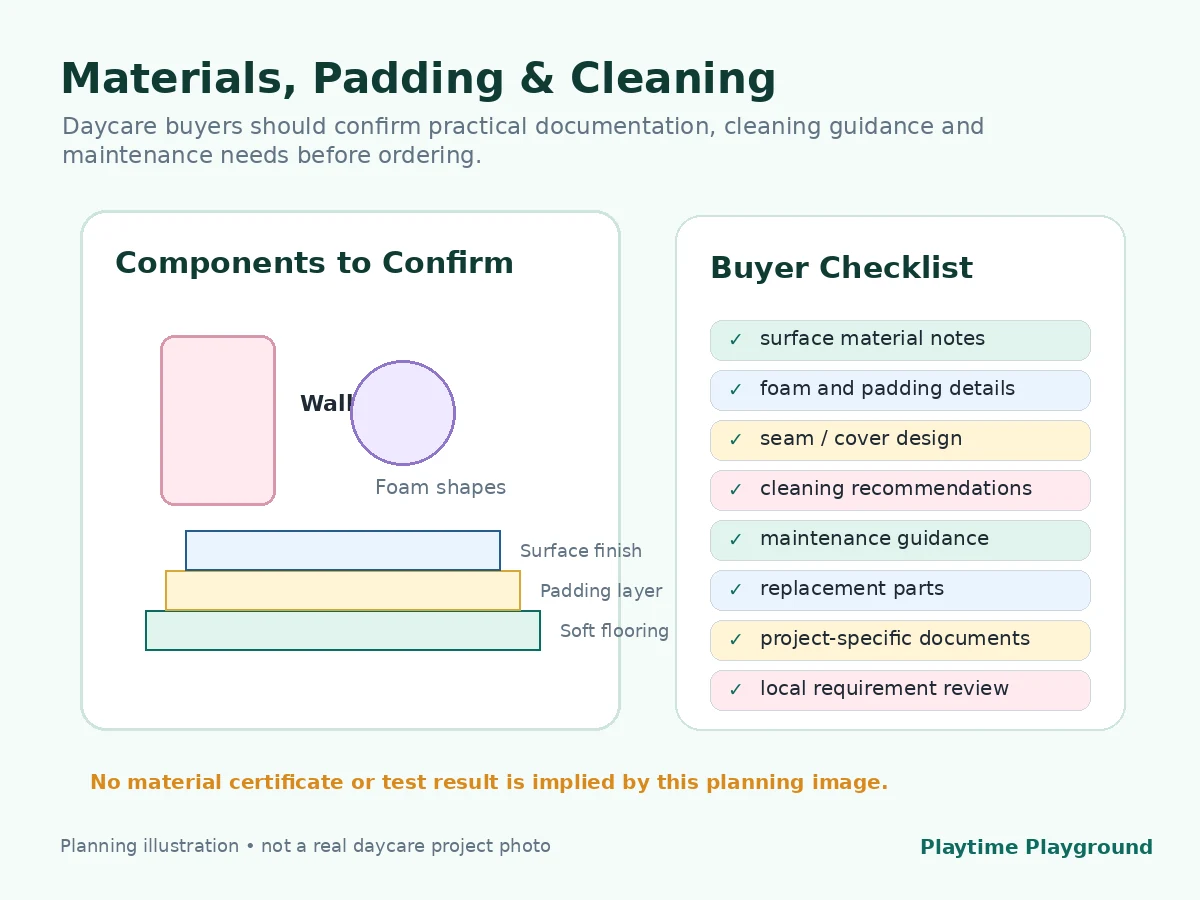
Material and Cleanability Questions
- What surface material is used on each quoted component?
- Where are seams, fasteners, zippers or access openings located?
- Can covers or high-wear components be removed or replaced where applicable?
- What cleaning, sanitizing or disinfecting products are compatible with the surfaces?
- Can staff access the floor, walls and gaps around fixed equipment?
- How should ball areas, tunnels and enclosed spaces be emptied or opened for cleaning?
- What maintenance frequency and inspection points does the supplier recommend?
- What material notes, test information or project documents are available for the final quoted scope?
CDC guidance for early-care and education settings distinguishes cleaning from sanitizing and disinfecting and advises users to follow product instructions and manufacturer compatibility. The equipment supplier should therefore provide surface-specific guidance rather than one universal cleaning claim.
Authoritative References for Buyer Review
These sources support planning discussions; they do not certify Playtime or prove that one product automatically complies in every jurisdiction.
- ASTM F1918-21 for soft contained play equipment — relevant to equipment within its stated product and user scope.
- ASTM F2373-24 for public-use play equipment for children 6–23 months — relevant context for certain early-care play equipment, while explicitly excluding soft contained play equipment.
- CPSC Public Playground Safety Handbook, 2025 edition — voluntary U.S. public-playground guidance for purchasers, installers, maintainers and childcare personnel.
- Head Start Active Supervision — early-childhood guidance supporting visibility, staff positioning and intentional observation.
- CDC cleaning and disinfection guidance for early-care settings — practical context for cleaning, sanitizing and disinfecting surfaces and objects.
Shipping, Delivery Access and Installation Support
Soft-play products can use substantial container or vehicle volume even when individual pieces are lightweight. A reliable logistics discussion should identify packed dimensions, estimated volume, labeling, freight basis, destination charges, inland delivery, unloading and the party responsible for moving the packages into the room.
Delivery access matters. A common installation problem occurs when a large padded piece or preassembled panel cannot pass through the building entrance, corridor or elevator. The team then has to repack, disassemble or modify the installation sequence. Provide door, corridor, stair and elevator dimensions before final packing is approved.
Site readiness also affects installation cost. Flooring conditions, wall preparation, moisture, electrical work, skirting, fixed furniture and room access should be completed or clearly coordinated before the installation team starts. A second visit caused by an unfinished room is normally an owner-side cost unless the contract says otherwise.
| Scope Item | Why It Matters | What to Confirm |
|---|---|---|
| Export packing | Foam shapes, floor panels and custom pieces can create significant volume | Packing method, estimated volume, labels and component list |
| Freight basis | EXW, FOB, CIF, DAP and other terms allocate costs and risks differently | Incoterm, named place, freight validity and excluded charges |
| Final delivery access | Doors, lifts, stairs and unloading restrictions affect handling | Largest packed item, access dimensions, unloading equipment and delivery hours |
| Installation support | Loose modular sets and fitted rooms require different support | Drawings, manuals, remote guidance, on-site support and local labor responsibility |
| Site readiness | Unfinished floors, walls or utilities can delay installation | Buyer-side prerequisites, inspection hold points and opening schedule |
For broader coordination, review Playtime’s playground project services before the final equipment and logistics scope is confirmed.
What Buyers Should Send Before Asking for a Quote
A supplier can give only a rough product reference when the room and operating requirements are unknown. A layout-based quotation needs a clear project brief.
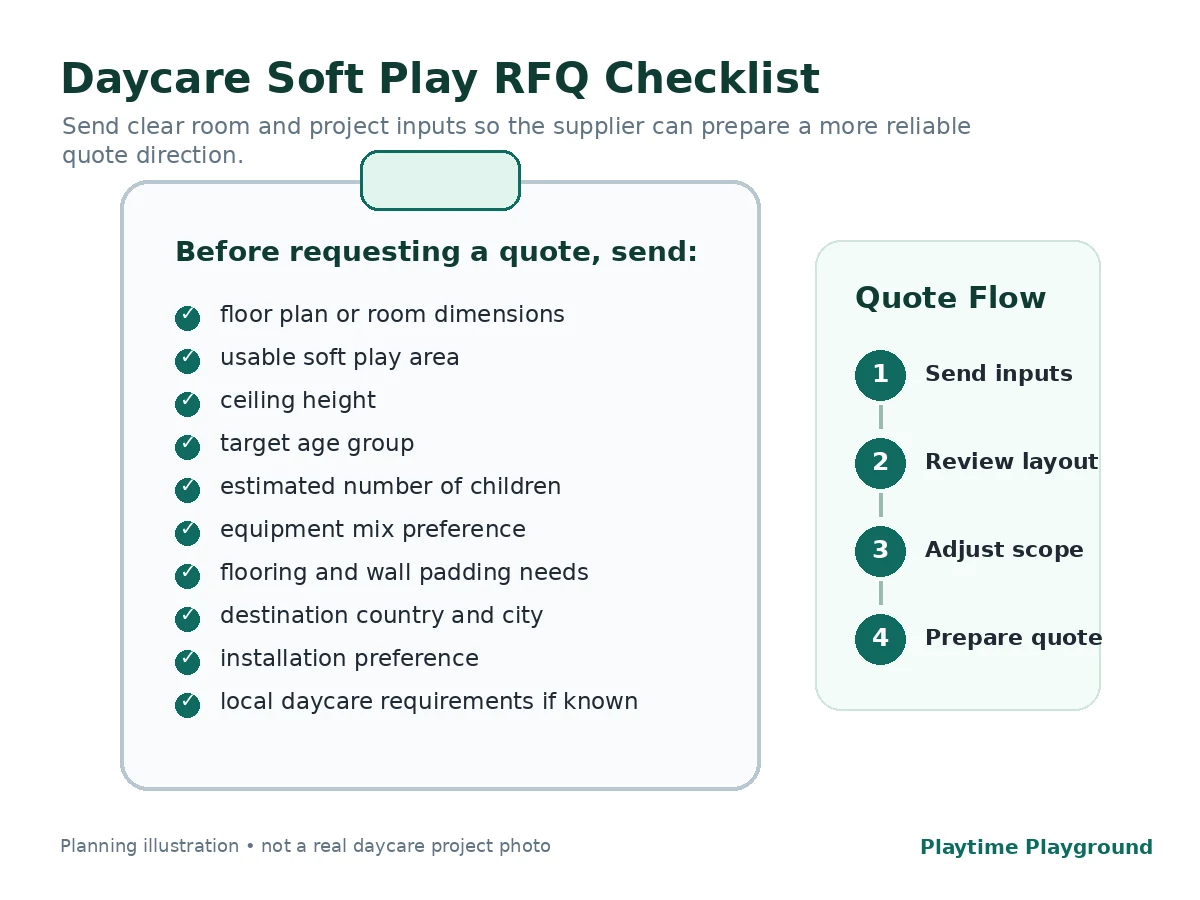
Daycare Soft Play RFQ Checklist
- Dimensioned floor plan, CAD file or accurate room sketch
- Gross room area and marked usable equipment area
- Clear ceiling height and any low beams or ceiling equipment
- Doors, windows, columns, radiators, outlets, cabinets and restricted areas
- Exact target age group for each room or zone
- Expected simultaneous user range and staff supervision model
- Required fixed, modular and movable equipment
- Soft-flooring and wall-padding coverage
- Cleaning, hygiene or material requirements from the operator
- Theme, color or brand direction
- Destination country, city and requested delivery basis
- Door, corridor, stair, elevator and unloading access
- Installation preference and available local labor
- Opening timeline and site-readiness date
- Known daycare licensing, fire, accessibility or inspection requirements
- Budget direction, clearly stating whether it covers equipment only or the landed scope
Buyers can also use Playtime’s indoor playground equipment RFQ checklist to structure supplier submissions and document responsibilities.
How to Compare Daycare Soft Play Supplier Quotes
Place supplier quotations beside the same approved floor plan and compare included, optional and excluded items. A lower total is not meaningful when the equipment schedule, surface coverage or logistics basis is different.
| Quote Item | What to Check | Why It Matters |
|---|---|---|
| Approved layout | Same usable area, doors, fixed obstacles and circulation assumptions | Prevents suppliers from pricing different room boundaries |
| Equipment schedule | Dimensions, quantity, fixed or modular status and age-group assignment | Shows whether the play value and installation scope are comparable |
| Flooring and wall pads | Coverage area, edge details, seams, substrate assumptions and installation | These items can represent a substantial part of a fitted room |
| Materials and cleanability | Surface notes, cleaning compatibility, replaceable parts and maintenance guidance | Supports daily daycare operation and lifecycle planning |
| Design and revisions | 2D layout, 3D concept, graphics and number or basis of revisions | Prevents later charges or design misunderstandings |
| Documentation | Equipment list, layout, material notes, packing list, manuals and maintenance information | Supports installation, handover and local review |
| Logistics | Packing, Incoterm, destination, freight validity, duties, local delivery and unloading | Separates factory price from landed cost |
| Installation | Local labor, tools, wall or floor preparation, remote support and on-site support | Clarifies who owns execution risk |
| Commercial terms | Lead time, payment terms, warranty, spare parts and after-sales process | Allows comparison beyond the initial purchase number |
For a wider supplier review, use Playtime’s indoor playground supplier checklist and commercial playground buyer checklist.
Quote Red Flags Buyers Should Watch For
- One total price with no marked layout or equipment schedule
- A design prepared without the exact age group or daycare-room use
- Infant products described as covered by a standard whose stated user range begins at age two
- Flooring and wall pads described only as “standard” with no coverage drawing
- Material claims such as “non-toxic,” “antibacterial,” “fireproof” or “easy to clean” without scope-specific evidence or instructions
- No explanation of fixed, modular and movable pieces
- No cleaning, maintenance or replacement-part discussion
- “Shipping included” without an Incoterm, named destination or excluded-charge list
- “Installation included” without local labor, tools, travel and site-preparation responsibilities
- No delivery-access review for doors, corridors, stairs or elevators
- Claims that one product or layout meets all daycare requirements worldwide
- Pressure to approve production before local requirements and final drawings are confirmed
How Playtime Supports Daycare Soft Play Projects
Playtime Playground can discuss daycare soft-play projects using the actual room, age group and requested equipment scope rather than a universal package price. Support should be confirmed project by project in the final quotation.
Share the marked floor plan, age group, operating needs and destination.
Review access, circulation, staff sightlines, cleaning space and fixed obstacles.
Separate core movement, sensory, flooring and wall-protection requirements.
Confirm layout, equipment list, design, packing, freight basis and exclusions.
Review site readiness, delivery access, installation support and handover documents.
Buyers can review Playtime’s playground projects, project services and planning resources before submitting the formal room brief.
Request a Layout-Based Daycare Soft Play Quote
Send the dimensioned room plan, marked usable play area, clear height, exact age group, expected simultaneous users, equipment priorities, flooring and wall-padding scope, destination, delivery access and installation preference. Playtime can review the project inputs and discuss a quotation based on the defined room and responsibility scope.
Send Daycare Project DetailsDaycare Soft Play Equipment Cost FAQ
How much does soft play equipment cost for a daycare center?
There is no reliable universal price without a defined room and equipment scope. Cost depends on usable area, age group, equipment list, flooring, wall padding, design work, packed volume, destination and installation responsibility. Request a layout-based quote and confirm whether it represents equipment price, landed equipment cost or the full daycare setup budget.
What is the difference between equipment price and full daycare setup cost?
Equipment price covers only the products and supplier services listed in the quotation. Full setup cost may also include freight, duties, local delivery, installation, renovation, furniture, electrical and fire work, licensing, insurance, staffing and pre-opening expenses. These categories should be budgeted separately.
Is soft flooring included in a daycare soft-play quote?
Only when the quotation lists it. Confirm the covered area, material, seams, transitions, substrate assumptions, installation responsibility and local requirements. Do not assume that floor mats or continuous soft flooring are included with the equipment pieces.
What soft-play equipment is suitable for infants and toddlers?
Suitability depends on the exact age and product category. Toddler rooms may use low climbers, short slides, crawl routes and soft modular forms. Infant or crawler rooms require separate product-specific and local licensing review; equipment intended for children age two and older should not automatically be specified for infants.
How much space does a daycare soft-play area need?
Space cannot be calculated from equipment area alone. The room must also support teacher circulation, sightlines, doors, storage, emergency access, cleaning and any local spacing requirements. Send a marked floor plan rather than only the room’s total square meters or square feet.
What cleaning information should the supplier provide?
Ask for surface-specific cleaning and maintenance instructions, compatible products or methods, access to seams and hidden areas, removable or replaceable parts where applicable, and guidance for high-touch components. The daycare should then align those instructions with local public-health and licensing procedures.
Are shipping and installation included in soft-play equipment cost?
Not automatically. Confirm packing, Incoterm, destination charges, inland delivery, unloading, door or elevator access, local labor, tools, site preparation, manuals, remote support and any on-site assistance. The final quotation should state every inclusion and exclusion.
Which standards and local requirements should daycare buyers review?
The answer depends on the product and age group. ASTM F1918-21 covers soft contained play equipment within its stated two-to-twelve-year user range. ASTM F2373-24 covers certain public-use equipment for children six through twenty-three months but excludes soft contained play equipment. Buyers must also confirm local daycare licensing, building, fire, accessibility, public-health, insurance and inspection requirements.