






Trampoline Park Cost Guide
Trampoline Park Equipment Cost Breakdown: What Buyers Should Compare
A commercial trampoline park does not have one universal equipment price. A reliable quote depends on the usable court area, ceiling and beam clearances, attraction mix, frame and mat system, pad coverage, export packaging, destination and installation responsibility. Buyers should compare three separate numbers: the equipment-supply quote, the landed equipment cost and the wider opening budget. This guide explains how to normalize supplier quotes before making a purchase decision.
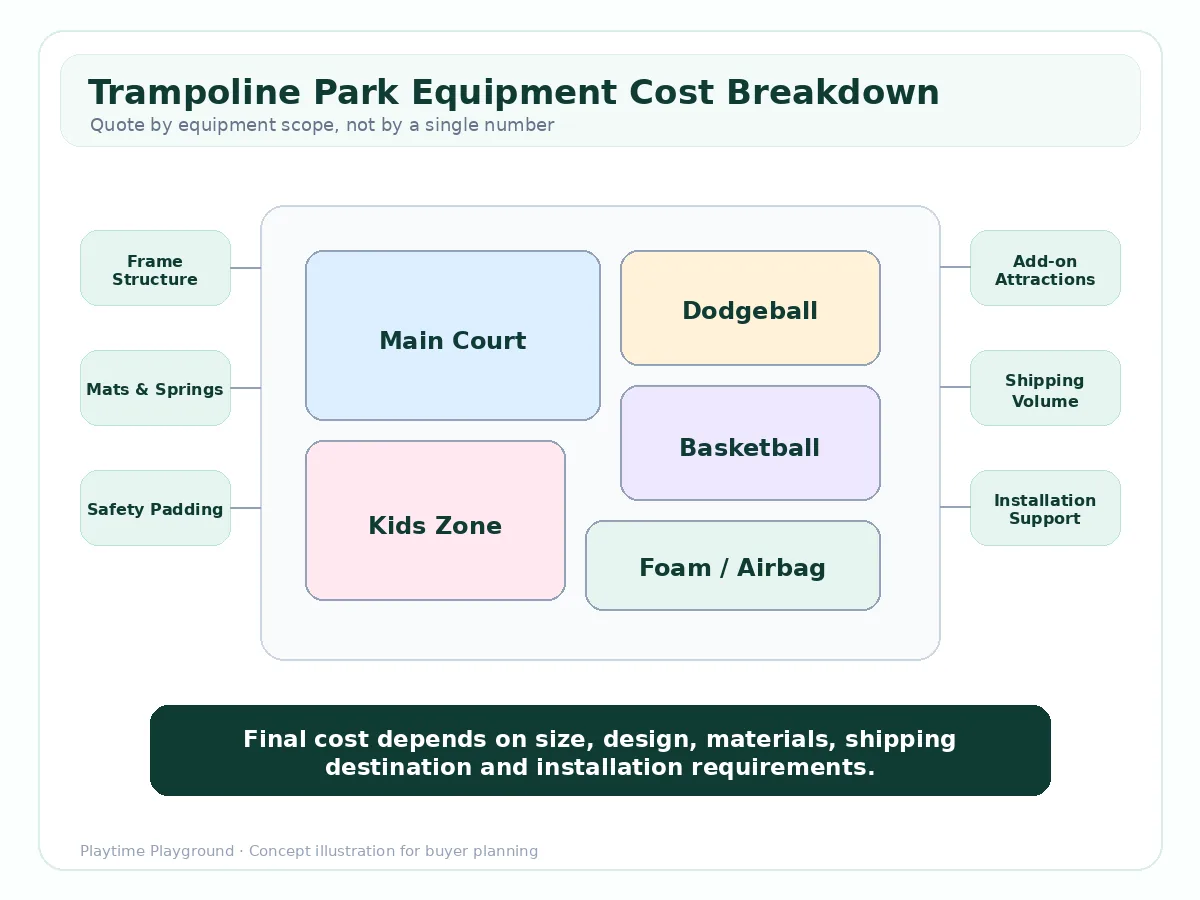
Trampoline Equipment Quote vs Landed Cost vs Opening Budget
Before comparing prices, define which cost level each number represents. A supplier’s equipment quote is not automatically the amount required to open the venue. Freight, import charges, local construction, installation labor and operating preparation may sit outside the quoted equipment scope.
| Budget Level | Typical Scope | Items Often Outside This Level |
|---|---|---|
| Equipment-supply quote | Specified trampoline courts, frames, mats, pads, netting, listed attraction zones, supplier drawings and export packaging where stated | International freight, duties, inland delivery, local labor, building work and operating setup |
| Landed equipment cost | Equipment-supply quote plus agreed freight, port or customs-related charges, inland delivery and unloading assumptions | Venue fit-out, local installation labor, permits, insurance, staffing and pre-opening expenses |
| Full opening budget | Landed equipment, site preparation, installation, professional review, permits, utilities, software, staffing, training, insurance and launch costs | Ongoing rent, payroll, utilities, maintenance, marketing and replacement parts after opening |
This article focuses on the equipment and supplier-quote portion of a commercial trampoline park equipment project. It does not promise a fixed opening cost or return on investment.
What May Be Included in Trampoline Park Equipment Cost?
A commercial trampoline quote should be based on a defined court layout and equipment schedule, not one unexplained total. Depending on the project, the supply scope may include the main trampoline court, steel support system, jumping beds, springs or other elastic components used by the selected system, safety pads, wall pads, edge protection, netting, decks, walkways, dividers and separately listed attraction zones.
Optional zones may include dodgeball courts, basketball dunk lanes, performance areas, foam pits, airbag landings, kids courts and obstacle or ninja course elements. Design renderings, branded entrances, spare parts, tools, freight and installation support should never be assumed; they should be identified as included, optional or excluded.
| Quote Category | Potentially Included | Items Requiring Explicit Confirmation | Common Buyer-Side Scope |
|---|---|---|---|
| Core court system | Listed frames, trampoline beds, pads, netting, decks and court dividers | Wall trampolines, angled beds, elevated decks, complete pad coverage and interfaces with the building | Floor or slab preparation and approval of building interfaces |
| Add-on attractions | Only the zones shown in the final equipment schedule | Dodgeball, dunk lanes, airbag, foam pit, performance court, kids zone and ninja obstacles | Operating rules, staffing model and local approval |
| Design and documents | Layout drawings and installation information according to the agreement | 3D rendering, custom graphics, engineering review, maintenance documents and revision limits | Local architect, engineer, fire consultant or authority review where required |
| Packaging and logistics | Export packaging and component labels when stated | Container estimate, Incoterm, ocean freight, insurance, customs, port charges, delivery and unloading | Importer arrangements, site access and receiving resources unless contracted otherwise |
| Installation support | Manuals, drawings or remote guidance according to the quote | On-site supervision, installer travel, visas, accommodation, tools, lifting equipment and local labor | Site readiness, utilities, permits, local labor and inspection coordination unless agreed otherwise |
| Handover and after-sales | Agreed documentation and listed spare components | Initial spare-parts kit, replacement lead times, warranty boundaries and response process | Daily inspections, staff training, maintenance records and operating controls |
One quotation mistake occurs when a buyer compares a main-court-only price with a second proposal that includes full perimeter padding, several attraction zones, packaging and installation documents. The totals look far apart, but the scope is not equivalent. The correction is to mark every line as included, optional or excluded before comparing totals.
Trampoline Park Equipment Cost Impact by Attraction Zone
Different attractions use different structures, landing systems, barriers and supervision patterns. The qualitative cost impact below is useful for early planning, but it is not a price list. A higher-impact zone is not automatically a better commercial choice; it should support the target user group and operating model.
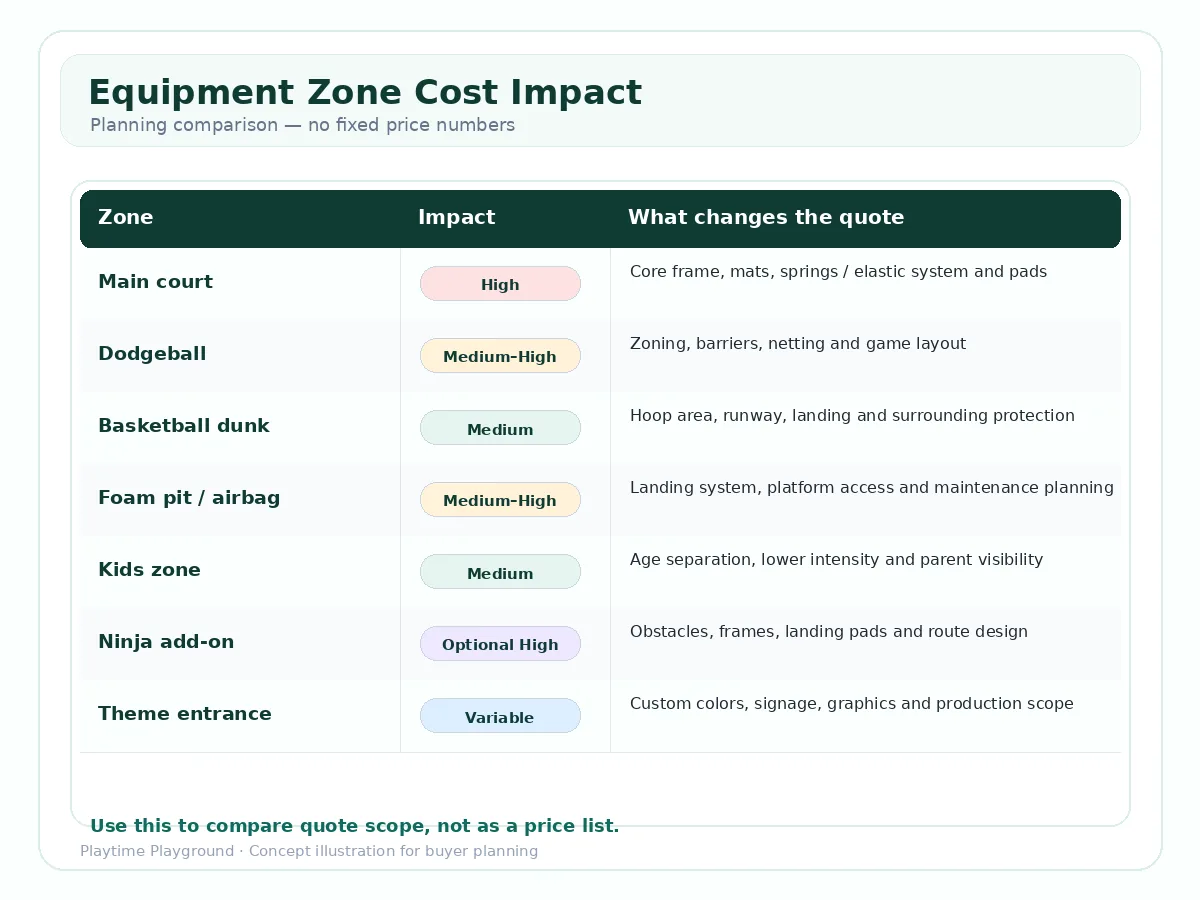
| Zone | Typical Cost Impact | Scope Drivers to Confirm |
|---|---|---|
| Main trampoline court | High; core project scope | Court geometry, bed count, frame, wall beds, pads, decks, netting and circulation interfaces |
| Dodgeball court | Medium to high | Court dimensions, dividers, wall protection, entry points and game-flow separation |
| Basketball dunk lanes | Medium | Lane count, run-up, hoop support, landing arrangement and surrounding protection |
| Foam pit | Medium to high | Pit construction, launch platform, surrounding pads, foam quantity, cleaning and replacement planning |
| Airbag landing | Medium to high | Airbag system, blower and electrical needs, platform interface, inspection and maintenance access |
| Kids trampoline zone | Medium | Age separation, lower-intensity layout, controlled entry and parent or staff sightlines |
| Ninja or obstacle add-on | Optional high | Independent frames, hanging elements, fall or landing areas, route difficulty and supervision |
| Custom entrance and graphics | Variable | Branding, decorative panels, signage, color matching and installation interfaces |
Why Total Venue Area Is Not the Same as Usable Trampoline Area
Quoting from total lease area alone can produce a misleading cost expectation. Reception, lockers, shoe-changing, queueing, parent seating, party rooms, storage, staff areas, restrooms, emergency routes and circulation all reduce the space available for equipment. Columns, irregular walls, low beams, sprinklers, HVAC ducts and service clearances can reduce it further.
A common planning issue occurs when a buyer sends only a total area figure. After the floor plan is marked, a meaningful portion of the venue is unavailable for trampoline courts. The early price expectation then appears to change, even though the real issue is that the original quote was based on the wrong area.
Ask every supplier to quote from the same marked floor plan showing the usable equipment boundary. Buyers can organize dimensions, obstructions and operating areas with Playtime’s playground planning resources before submitting an RFQ.
Mark These Areas Before Requesting a Court Layout
- Total venue boundary and usable equipment boundary
- Clear ceiling height and underside of beams
- Columns, braces, low obstructions and irregular walls
- Sprinklers, lighting, HVAC ducts and other overhead services
- Entrances, emergency exits and required circulation routes
- Reception, lockers, seating, party rooms, storage and staff areas
- Delivery doors, corridors, elevators and unloading route
Main Trampoline Court Cost Factors
The main court normally represents a large share of the equipment scope, but bed count alone is not enough to compare proposals. Court shape, wall-trampoline areas, angled beds, raised decks, walkway width, pad coverage, netting, access points and structural interfaces can change the quantity and complexity of components.
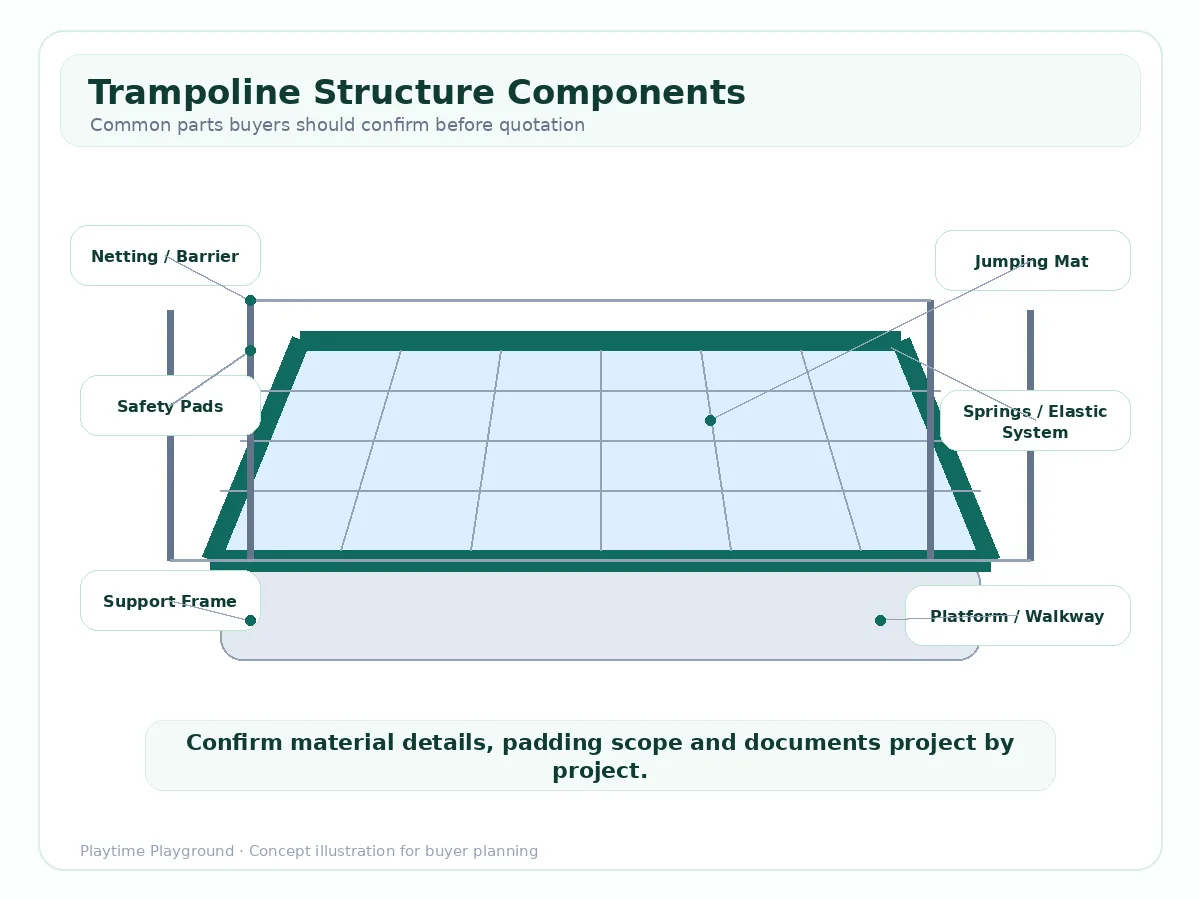
Main Court Confirmation Checklist
- Dimensioned court layout rather than bed count alone
- Frame and support system included in the supply scope
- Jumping-bed, spring or elastic-component scope
- Pad thickness and material details available for the quoted system
- Pad coverage at frames, dividers, decks, walls and transitions
- Netting, gates, barriers and controlled access points
- Wall trampolines, angled beds or elevated elements
- Walkways, maintenance access and replaceable-component access
- Interfaces with the building floor, walls or supporting structure
- Initial spare components and future replacement process
In one typical comparison, two proposals may show the same number of jumping beds. One includes full transition pads, wall protection and access gates, while the other lists those items separately. A bed-count comparison therefore understates the real difference in scope.
Add-On Attraction Cost Factors
Add-on attractions should be classified as required, optional or future-phase items before quotation. This prevents the core project from being distorted by attractions that do not match the target age group, clear height, staffing plan or opening budget.
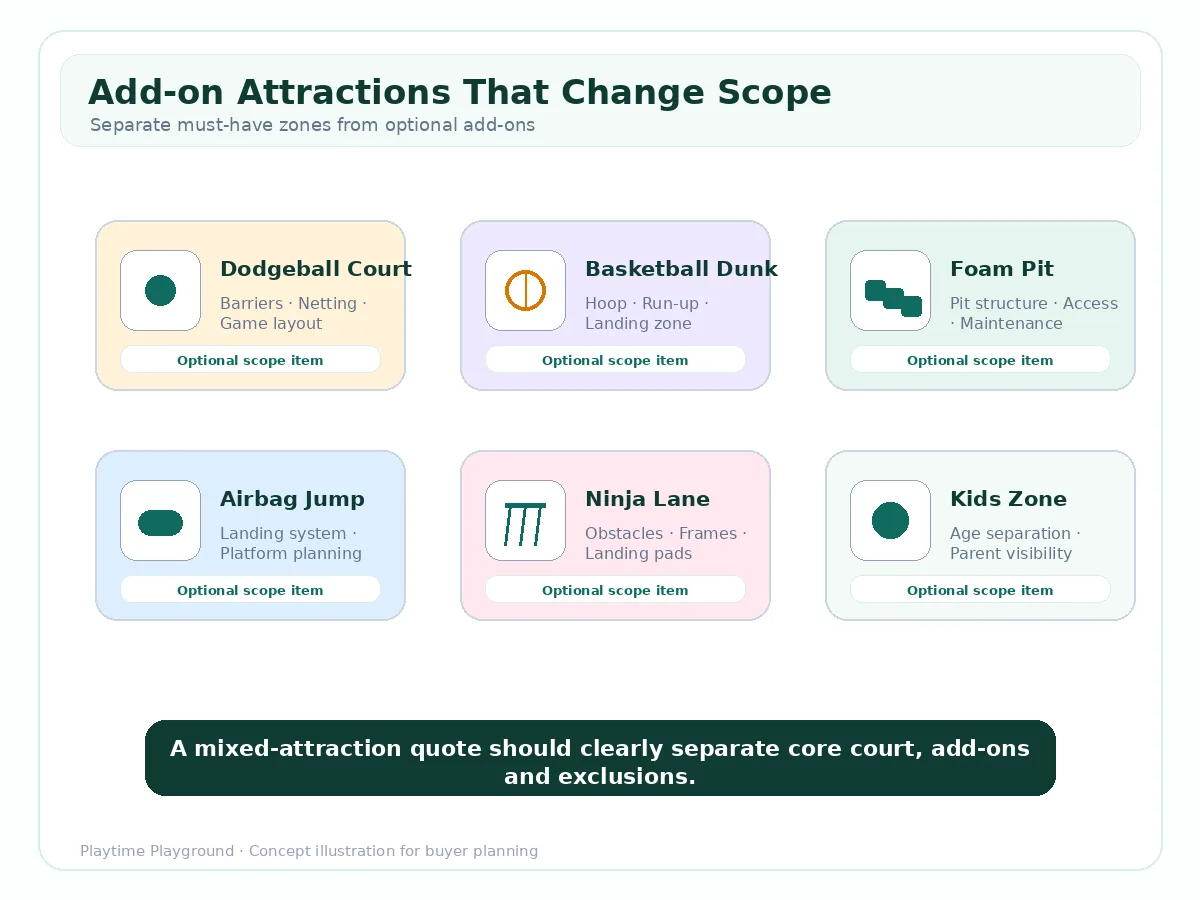
Dodgeball Court
Confirm court dimensions, divider systems, entry points, wall protection and whether the court is independent or shares part of the main frame.
Basketball Dunk Zone
Confirm the number of lanes, hoop structure, run-up, landing area, overhead clearance and surrounding pad scope.
Foam Pit or Airbag
Do not treat these as interchangeable lines. Confirm the selected landing system, platform, electrical or blower needs where applicable, maintenance access, consumables and local acceptance.
Kids or Mixed-Play Zone
Confirm age separation, controlled entry and sightlines. When combining courts with indoor playground equipment, define the boundary and traffic flow between different activity intensities.
Standard Trampoline Layout vs Custom Mixed-Attraction Layout
A standard court arrangement can reduce design revisions and make component quantities more predictable. A custom project may be justified when the venue has an irregular floor plan, requires branded presentation or combines trampoline, ninja, kids and other FEC zones. Customization should solve a site or operating requirement, not simply add visual complexity.
| Layout Direction | When It May Fit | Quote Implications | Buyer Confirmation |
|---|---|---|---|
| Standard main-court layout | Regular venue shape and straightforward operating model | More predictable components and fewer custom interfaces | Verify that it still fits columns, exits, clear height and circulation |
| Compact custom layout | Limited or irregular usable area | May require more detailed coordination despite smaller area | Confirm that space efficiency does not remove supervision or maintenance access |
| Mixed-attraction layout | Larger parks and FEC projects | More zones, transitions, barriers, documents and installation coordination | Separate core attractions from optional add-ons in the quote |
| Branded or themed layout | Destination venues and brand-led concepts | Additional design, graphics, panels and revision scope | Confirm the number of design revisions and final artwork responsibility |
A typical design-rework problem occurs when the theme is approved before the court zoning and budget are stable. Later reductions force entrance panels, graphics and custom shapes to be redesigned. Confirm the functional layout and required attractions before freezing decorative work.
Materials, Padding and ASTM F2970 Context
Material comparison should be tied to the final system and documented quote. Buyers should ask for project-relevant information about the frame, trampoline beds, springs or elastic components, pad foam and covers, netting, deck surfaces, wall protection, fasteners and replacement components. Broad phrases such as “high quality” or “international standard” are not a substitute for an equipment schedule and applicable documents.
ASTM F2970-25 is the current ASTM practice for the design, manufacture, installation, operation, maintenance, inspection and major modification of commercial or institutional trampoline courts. Its scope is broader than manufacturing alone: owners, operators, installers, inspectors and other project parties also have responsibilities. Referencing the standard does not by itself prove that a supplier, product or completed venue is certified or compliant.
Local requirements may differ by country, state, province, city, insurer and authority. The project owner should confirm building, fire, accessibility, amusement-facility, inspection and operating requirements before the layout and order are finalized.
Focused External References
- ASTM F2970-25 trampoline court practice — official scope covering commercial or institutional trampoline-court design, manufacture, installation, operation, maintenance, inspection and major modification.
- ASTM Subcommittee F24.61 on Adventure Attractions — official committee context showing F2970 within ASTM’s adventure-attraction standards work.
- Indoor Adventure Parks Association standards and research — industry resource for operators reviewing trampoline and adventure-park standards context.
Packaging, Freight and Installation Responsibility
International freight can materially change the landed equipment cost. Frames, pads, nets, platforms, airbag systems and custom decorative parts have different packing densities. Buyers should request the estimated shipment volume or container assumption only after the equipment scope is reasonably stable.
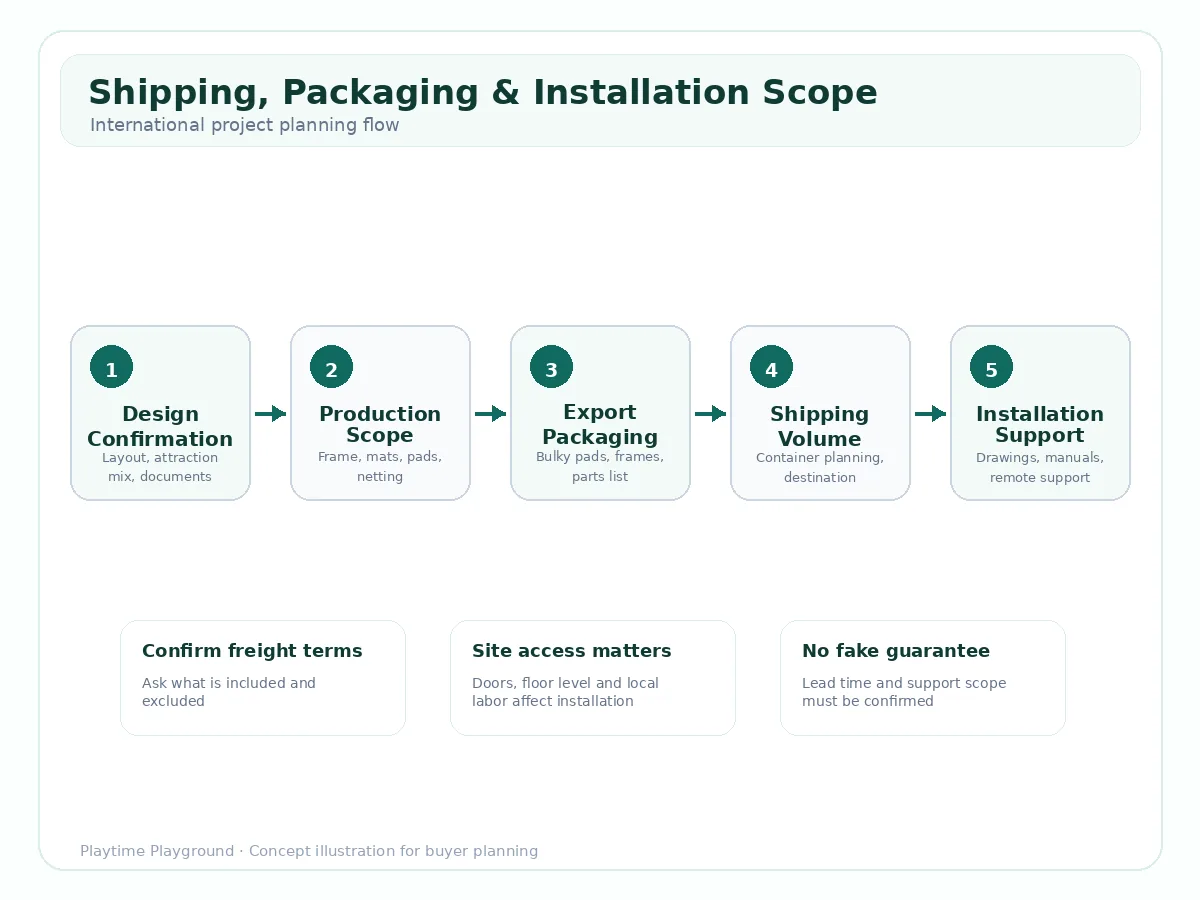
The quote should state the Incoterm or equivalent shipping basis, export packaging, estimated packing volume, freight assumptions, insurance, destination charges, customs responsibility, inland delivery and unloading. “Shipping included” is not sufficiently precise without the named destination and responsibility boundary.
Installation scope should also identify who provides local labor, tools, lifting equipment, temporary power, travel, accommodation, supervision and final site coordination. Installation drawings or remote support are not the same as a complete installed-price contract.
During installation planning, a recurring avoidable problem is discovering that long components or packed assemblies cannot pass through the delivery door, corridor or elevator. Another is mobilizing installers before the slab, lighting, HVAC or fire-system work is complete. Confirm the receiving route and site-readiness checklist before shipment and installation travel are booked.
Buyers can review Playtime’s playground project services to understand which planning, shipping and installation-support discussions may be available for a specific project.
What Buyers Should Send Before Requesting a Trampoline Park Quote
A useful RFQ gives the supplier enough information to define the usable court area, attraction zones, structural interfaces, export scope and support responsibility. A floor area and WhatsApp photo alone are rarely sufficient for a final quotation.
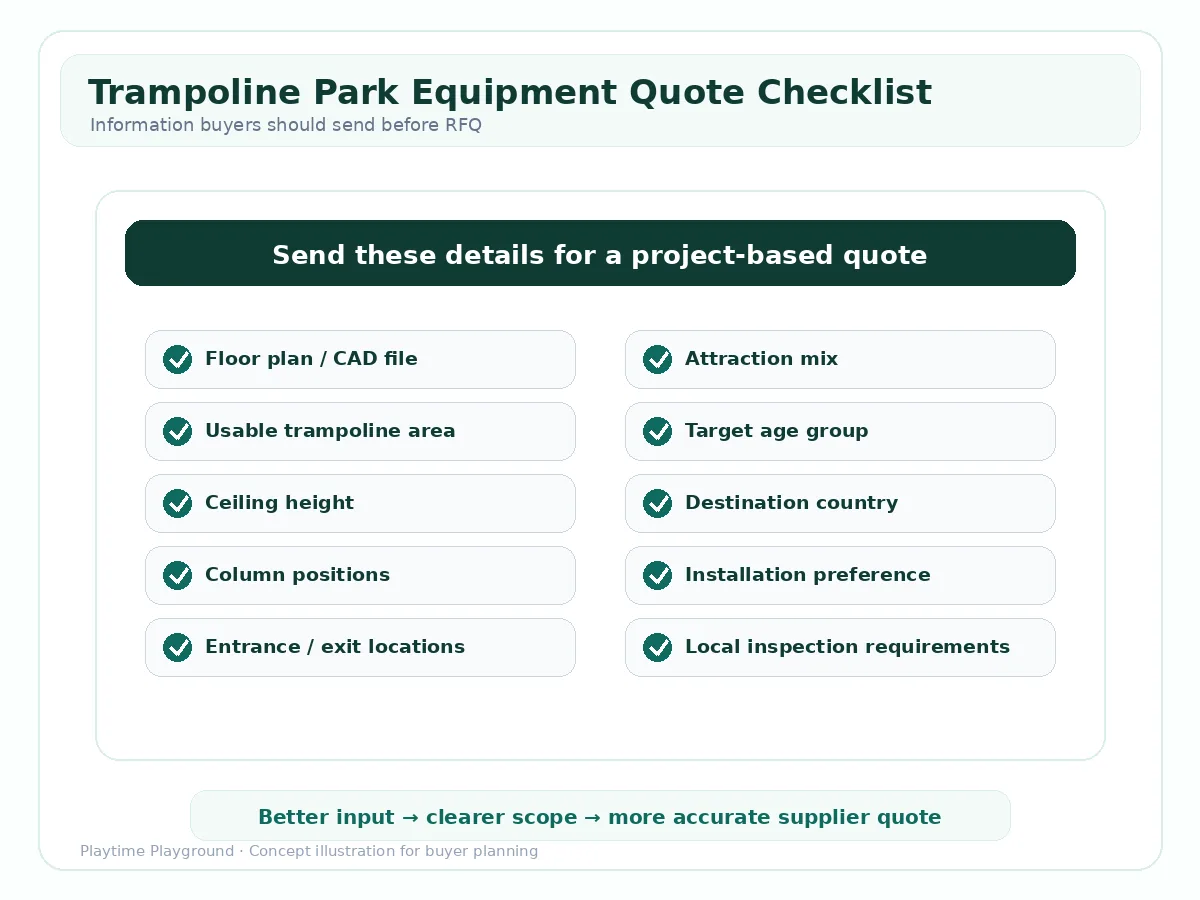
Trampoline Park RFQ Checklist
- Floor plan, CAD file or dimensioned drawing
- Total venue area and marked usable trampoline area
- Clear ceiling height and beam heights
- Columns, braces, walls and overhead obstructions
- Sprinklers, lighting, HVAC ducts and service restrictions
- Entrances, emergency exits and required circulation routes
- Delivery doors, corridors, elevators and unloading access
- Target users and required age-separated zones
- Core, optional and future-phase attractions
- Estimated capacity direction and supervision model, if available
- Theme, color or branding direction
- Destination country, city and preferred shipping basis
- Local labor availability and installation preference
- Opening timeline and current site-readiness stage
- Applicable local inspection or approval requirements, if known
- Budget direction, with clear indication of whether it covers equipment only or the full project
The broader commercial playground RFQ checklist can help buyers structure site, document, shipping and responsibility questions. Trampoline-specific information should then be added for court systems, landing zones, clear height and operating requirements.
How to Normalize Trampoline Park Supplier Quotes
Do not compare the final totals until each supplier is responding to the same floor plan, attraction list and responsibility matrix. Normalize the proposals into a single comparison sheet and request clarification where a line is blank or bundled into a vague total.
| Comparison Line | Evidence to Request | Normalization Question |
|---|---|---|
| Dimensioned layout | Floor-plan-based equipment drawing | Are all suppliers quoting the same usable boundary and attraction zones? |
| Core court system | Equipment schedule or bill of scope | Are frame, beds, pads, decks, netting and transitions all included? |
| Pad and barrier coverage | Layout callouts or component schedule | Are wall pads, dividers, gates and perimeter protection included to the same extent? |
| Add-on attractions | Zone-by-zone list | Which attractions are included, optional or excluded? |
| Design and revisions | Deliverable list | Does the quote include 2D, 3D, branding and a defined number of revisions? |
| Documents and spare parts | Document and spare-component list | What is supplied for installation, maintenance, handover and replacement planning? |
| Packaging and shipping | Packing basis, volume estimate and freight term | Are the destination and responsibility boundaries identical? |
| Installation support | Responsibility matrix | Who supplies labor, supervision, travel, tools, lifting equipment and site coordination? |
| Commercial terms | Written warranty, lead-time and payment terms | Are warranty boundaries, production triggers and excluded costs stated clearly? |
For a wider pre-purchase review, use the commercial playground buyer checklist. Buyers evaluating supplier process and documentation can also review the supplier evaluation checklist.
Trampoline Park Quote Red Flags
A low quote is not automatically a red flag, but an untraceable scope is. Ask for clarification before accepting a proposal with any of the following conditions.
| Red Flag | Project Risk | Buyer Response |
|---|---|---|
| One total price with no dimensioned layout or equipment schedule | The included court and attraction scope cannot be verified | Request a floor-plan-based, zone-by-zone equipment list |
| No distinction between total venue area and usable court area | Early price and capacity assumptions may be misleading | Issue the same marked usable boundary to every supplier |
| Padding, wall protection or netting described only as “standard” | Coverage differences may appear after order confirmation | Request layout callouts and component descriptions for the quoted system |
| ASTM or “international certification” claim without matching evidence | The claim may not apply to the final product, installation or operating responsibilities | Ask what document applies, to which scope and under whose review |
| Shipping included without Incoterm, destination or exclusions | Port, customs, inland-delivery or unloading costs may remain with the buyer | Request a written shipping responsibility boundary |
| Installation included without labor and travel details | The buyer may still need to provide installers, tools, accommodation or site services | Use a buyer-supplier-local contractor responsibility matrix |
| No maintenance, spare-parts or replacement process | Routine wear items may be difficult to manage after opening | Confirm initial spares, ordering process and expected documentation |
How Playtime Supports Trampoline Park Equipment Planning
Playtime Playground can discuss trampoline park equipment scope from the buyer’s floor plan, clear height, target users, attraction priorities, destination and installation preference. Final design, documents, materials, shipping terms, lead time, warranty and support responsibilities should be confirmed in the project quotation and order documents.
Share the floor plan, usable court boundary, clear heights, obstructions, destination and opening target.
Separate the core court and required zones from optional or later-phase attractions.
Clarify equipment, design, documents, packaging, shipping and installation responsibilities.
Approve the layout and written inclusions before production, shipment and installation planning.
Buyers can review Playtime’s commercial trampoline equipment range, playground project examples and project services before preparing a formal request.
Request a Scope-Based Trampoline Park Equipment Quote
Send your dimensioned floor plan, usable trampoline area, clear ceiling and beam heights, attraction priorities, destination and installation preference. Playtime can review the project inputs and prepare a quotation direction based on the confirmed equipment and responsibility scope.
Request a Trampoline Park Equipment QuoteFAQ
What is normally included in trampoline park equipment cost?
The equipment quote may include the specified court frame, trampoline beds, springs or elastic components, pads, wall protection, netting, decks, gates and listed attraction zones. Design documents, packaging, freight, installation support, spare parts and local labor vary by quotation and should be marked as included, optional or excluded.
Is trampoline park equipment priced by square meter?
Area may support an early estimate, but it is not a reliable final pricing method. The usable court boundary, attraction mix, court geometry, pad coverage, clear height, custom design, shipping destination and installation responsibility can make two projects with similar areas materially different.
What is the difference between equipment price and full project cost?
Equipment price covers the agreed supply scope. Landed cost may add freight, destination charges and delivery. Full project cost may also include fit-out, local installation, professional review, permits, insurance, utilities, staff preparation and opening expenses.
Why do trampoline park supplier quotes vary so much?
Suppliers may quote different usable areas, court systems, pad coverage, attraction zones, documents, packing methods, freight terms and installation support. Compare a dimensioned layout and line-by-line responsibility matrix before comparing the totals.
Does an airbag or foam pit increase the quote?
Usually, because each landing system adds its own platform, surrounding protection, access, maintenance and possible electrical or consumable requirements. Confirm which system is included and whether local reviewers or insurers have specific requirements.
What information is needed for an accurate trampoline park RFQ?
Send a floor plan, marked usable court area, clear ceiling and beam heights, columns and overhead services, entrances and exits, attraction priorities, target users, destination, installation preference, delivery access and known local approval requirements.
Are shipping and installation included in trampoline equipment cost?
Not automatically. Confirm export packaging, estimated shipment volume, freight basis, destination charges, inland delivery, unloading, installation documents, local labor, tools, travel and on-site support in writing.
Which standard is relevant to commercial trampoline courts?
ASTM F2970-25 is an important U.S. industry practice for commercial or institutional trampoline courts and addresses design, manufacture, installation, operation, maintenance, inspection and major modification. It does not replace local building, fire, accessibility, insurance, authority or professional-review requirements.