






Guia de Custo de Equipamentos Soft Play para Creches
Custo de Equipamentos Soft Play para Creches: O que os Compradores Devem Comparar
Equipamentos soft play para creches são normalmente orçados projeto a projeto, em vez de uma lista de preços de varejo universal. O número útil não é apenas o preço das formas de espuma ou escorregadores: os compradores também precisam confirmar o piso, o acolchoamento das paredes, o escopo do projeto, a embalagem de exportação, o frete e a responsabilidade pela instalação. As dimensões da sala, a área de lazer utilizável, a faixa etária, a visibilidade da supervisão e o acesso para limpeza podem alterar o orçamento tanto quanto o tamanho nominal da sala.
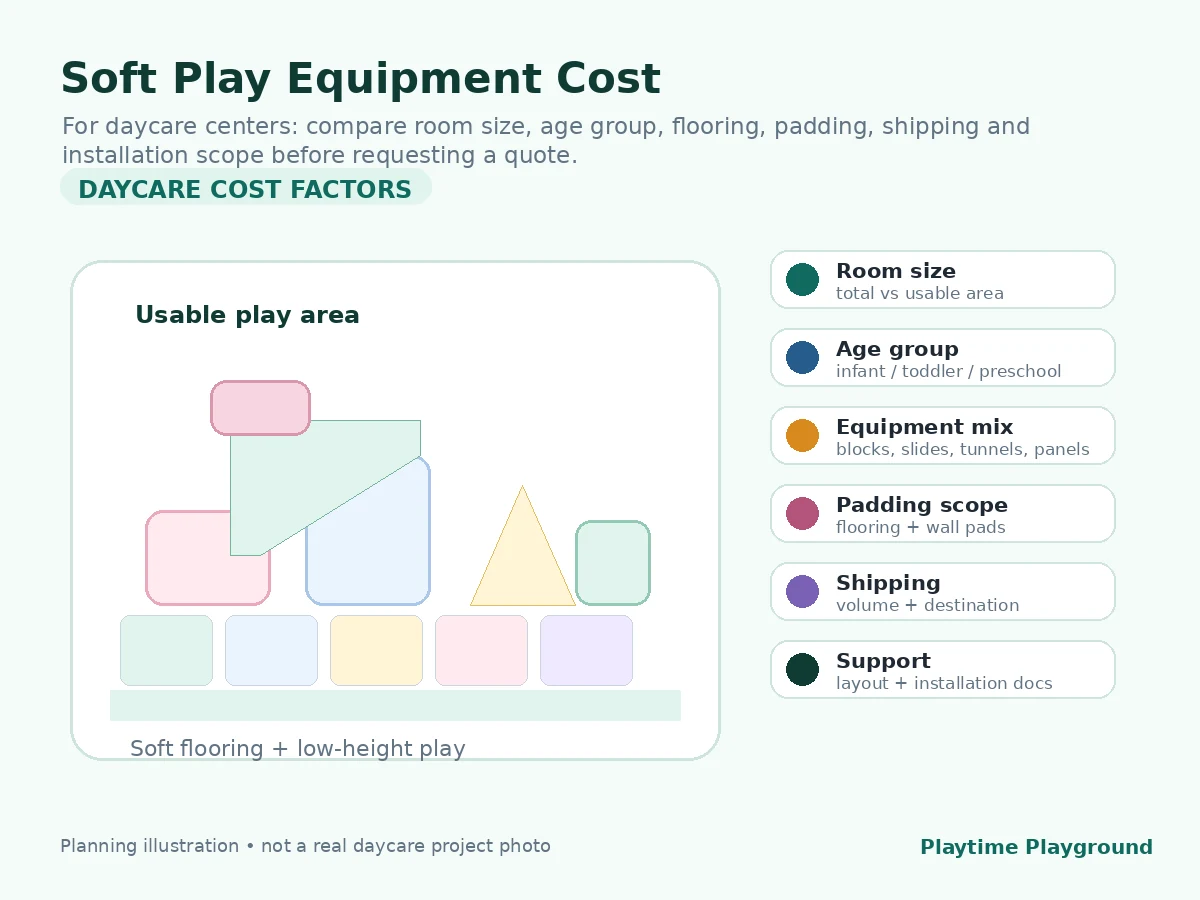
Preço de Equipamentos Soft Play, Custo de Frete e Custo Total para Montagem de Creche
Antes de comparar fornecedores, defina a que nível de custo cada número se refere. Um orçamento de equipamentos de fábrica, uma estimativa de equipamentos entregues no destino e o orçamento total para a montagem da creche não são intercambiáveis.
| Nível de Custo | Inclusões Típicas | Exclusões Típicas | Ponto de Verificação do Comprador |
|---|---|---|---|
| Cotação de fornecimento de equipamentos | Itens de soft play orçados, piso ou painéis de parede acordados, documentos de projeto, embalagem e suporte do lado do fornecedor listados na oferta | Frete, encargos de importação, entrega local, mão de obra local e obras no local, a menos que especificamente incluídos | Solicite um cronograma de equipamentos detalhado e um layout marcado. |
| Custo do equipamento entregue | Fornecimento de equipamentos mais a embalagem de exportação acordada, base de frete, encargos de destino, entrega interna ou itens de descarregamento | Renovação da creche, licenciamento, mobiliário da sala de aula, pessoal e despesas operacionais | Confirme o Incoterm, destino, impostos, taxas e responsabilidade pela entrega final. |
| Orçamento completo para montagem da creche | Equipamentos e logística mais reformas por conta do proprietário, trabalhos elétricos, obras de incêndio ou acessibilidade, aprovações, seguro, mobiliário e custos de abertura | Nada deve ser assumido; o proprietário ou a equipe do projeto deve construir o orçamento completo | Não apresente uma cotação de equipamentos como o custo de abertura da creche. |
Para compradores que revisam equipamentos soft play comerciais, a primeira comparação deve ser o escopo incluído em vez do preço total. Uma oferta pode incluir piso, painéis de parede e suporte de layout, enquanto outra pode cobrir apenas peças de equipamentos soltas.
O que deve ser incluído em uma cotação de equipamentos soft play para creche?
Uma cotação útil deve conectar cada item precificado à sala real e ao grupo etário. Dependendo do escopo aprovado, pode incluir formas modulares de espuma, escaladores baixos, escorregadores para crianças pequenas, túneis para engatinhar, pontes macias, painéis sensoriais, peças de faz de conta, áreas compactas com bolas, piso macio, acolchoamento de parede, tratamento de borda protetora, painéis temáticos, desenhos de layout, informações de embalagem e orientação de instalação.
A cotação também deve separar equipamentos fixos de peças móveis. Isso afeta a ancoragem, a instalação, o acesso de limpeza, a flexibilidade da sala e a responsabilidade do operador da creche após a entrega.
Perguntas sobre o Escopo Antes de Comparar Preços
- A cotação é baseada na sala dimensionada em vez de um conjunto de produtos genérico?
- O layout marca portas, janelas, colunas, radiadores, tomadas, armários e áreas restritas?
- Equipamentos, piso, painéis de parede, painéis decorativos e materiais de instalação estão listados separadamente?
- Os produtos propostos são adequados para a faixa etária exata atendida naquela sala?
- O fornecedor identifica componentes fixos, modulares e móveis?
- As revisões de design, embalagem, base de frete e suporte de instalação estão claramente definidas?
- Os termos de garantia, peças de reposição e manutenção são confirmados na cotação final ou contrato?
Compradores que ainda estão definindo a categoria de produto podem revisar o que os equipamentos soft play indoor incluem antes de solicitar um layout específico para creche.
Principais Fatores de Custo para Equipamentos Soft Play de Creche
O custo muda porque o espaço, os usuários e as rotinas diárias mudam. Uma sala compacta para bebês com peças modulares soltas tem um escopo diferente de uma sala de pré-escola equipada com piso contínuo, painéis de parede, escaladores fixos e painéis personalizados.
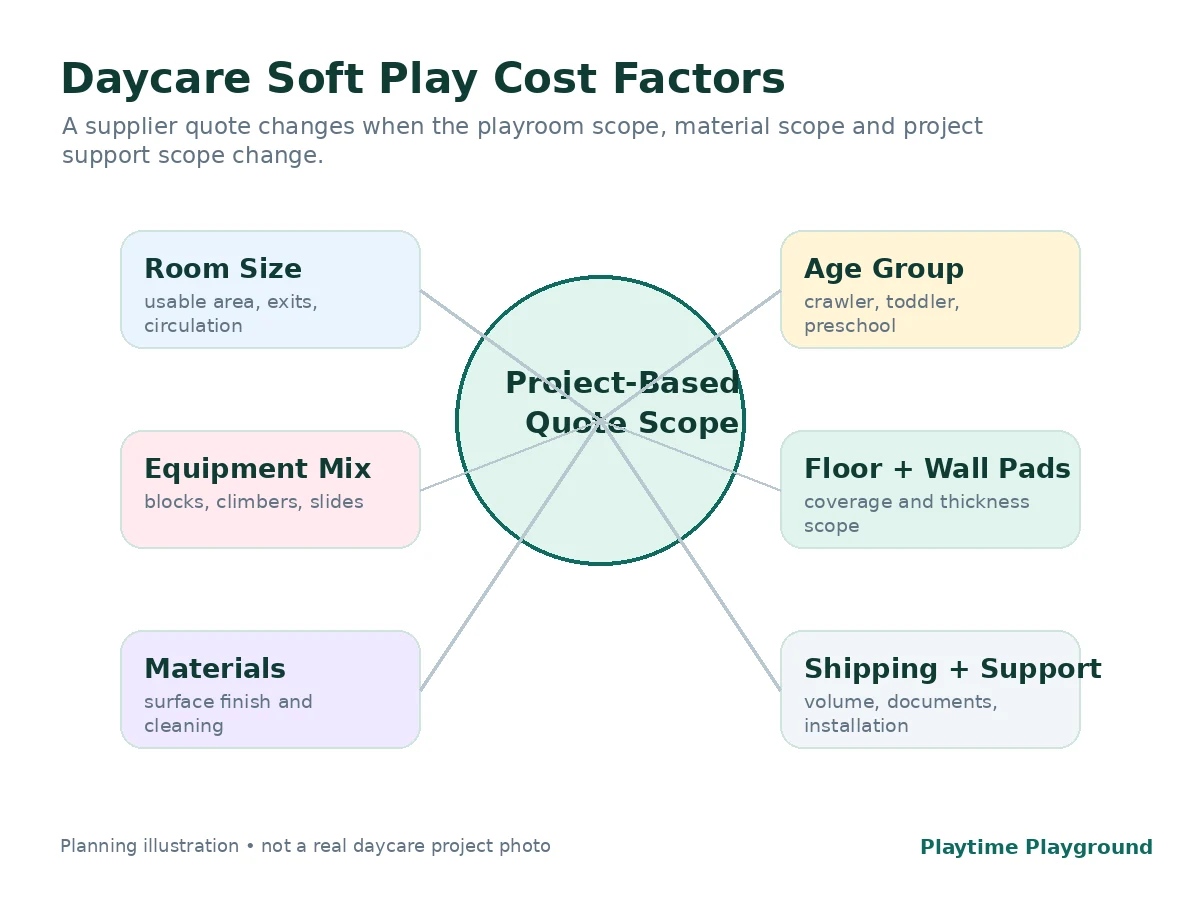
| Fator de Custo | Por que o orçamento muda | O que os compradores devem confirmar |
|---|---|---|
| Área útil de brincar | Determina a quantidade de equipamentos, pisos, acolchoamento e trabalho de instalação | Marque o limite real do equipamento, não apenas o tamanho bruto da sala. |
| Faixa etária | Salas para bebês, crianças pequenas e pré-escolares exigem produtos, alturas, padrões de movimento e supervisão diferentes | Forneça a faixa etária exata e a categoria de licenciamento local. |
| Uso previsto | Daily group size, rotation pattern and frequency affect durability, storage and operating layout | Describe how many children use the room at one time without treating this as a universal capacity formula. |
| Combinação de equipamentos | Slides, climbers, tunnels, sensory panels, pretend-play pieces and ball areas use different space and materials | Separate must-have items from optional items. |
| Flooring and wall protection | Coverage area, edge details, wall conditions and installation method can materially change the scope | Show which floor and wall areas require treatment. |
| Material and cleanability requirements | Surface type, seams, removable covers and compatible cleaning methods affect production and maintenance | Request product-specific cleaning and maintenance guidance. |
| Design personalizado | Custom colors, shapes, brand graphics and irregular room conditions require more design and production work | Confirm what 2D, 3D and graphic work is included. |
| Logistics and installation | Packed volume, destination, delivery access, local labor and site readiness affect landed cost | Confirm freight terms, door and elevator access, unloading and installation responsibility. |
Room Size Is Not the Same as Usable Soft Play Area
A daycare room also needs teacher circulation, clear entry and exit paths, storage access, opening space for doors, fixed furniture, emergency access and uninterrupted sightlines. These areas should be marked before equipment is selected.
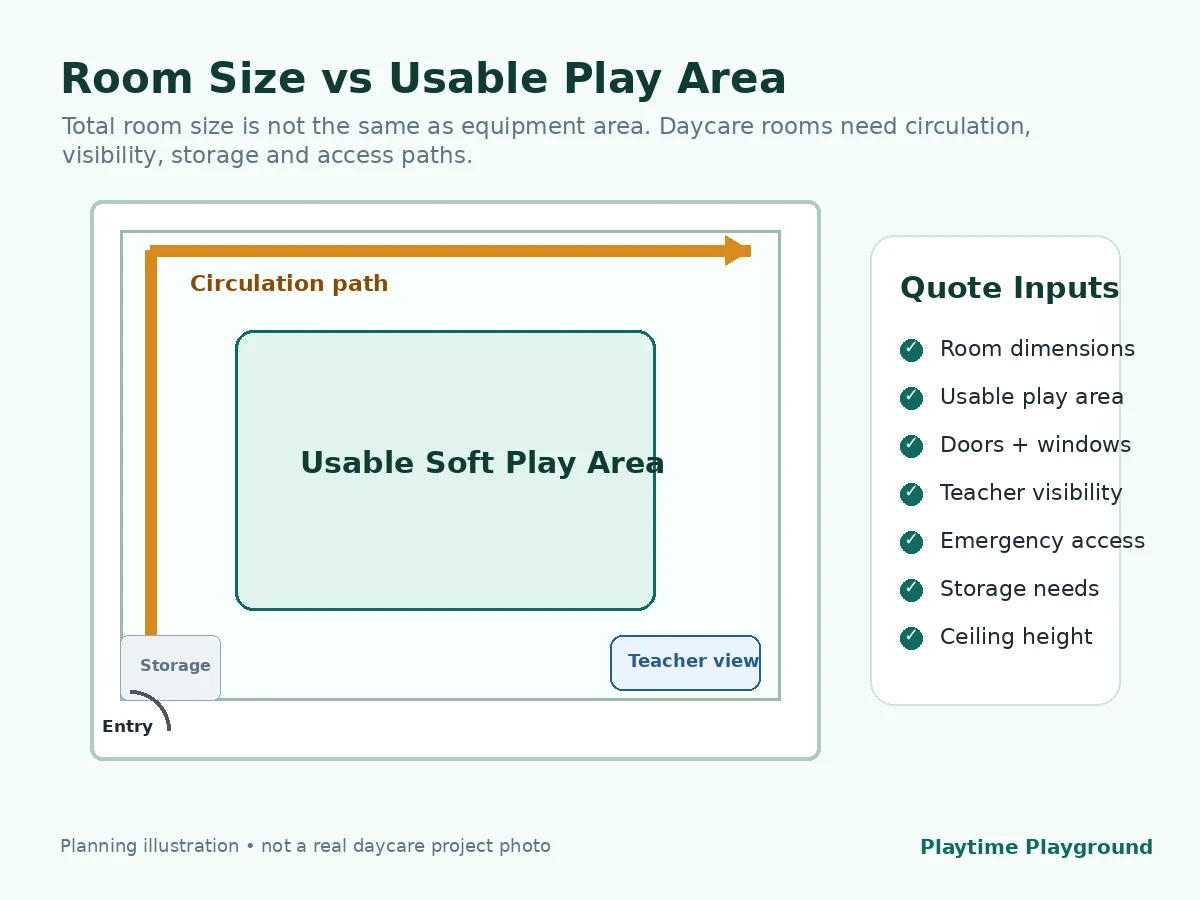
A common planning problem occurs when a buyer gives only the room’s length and width. After a concept is prepared, the team discovers that an outward-opening door, storage cabinet, radiator or teacher work area occupies part of the proposed equipment zone. The layout must then be reduced or redesigned. A marked floor plan prevents this avoidable revision.
Another frequent error is filling the perimeter with tall or bulky pieces. This may create hidden corners and make cleaning behind the equipment difficult. In a compact daycare room, low open equipment, wall activity panels and a limited number of well-spaced movement elements often provide better operating value than maximum equipment density.
Playtime recursos de planejamento de playground can help buyers organize the room brief before requesting a final quote.
Infant, Toddler and Preschool Rooms Need Different Equipment
“Daycare children” is not a precise design group. A crawler room, a toddler room and a preschool activity room have different movement abilities, supervision patterns and product requirements. A quotation should state which age group each component is intended to serve.
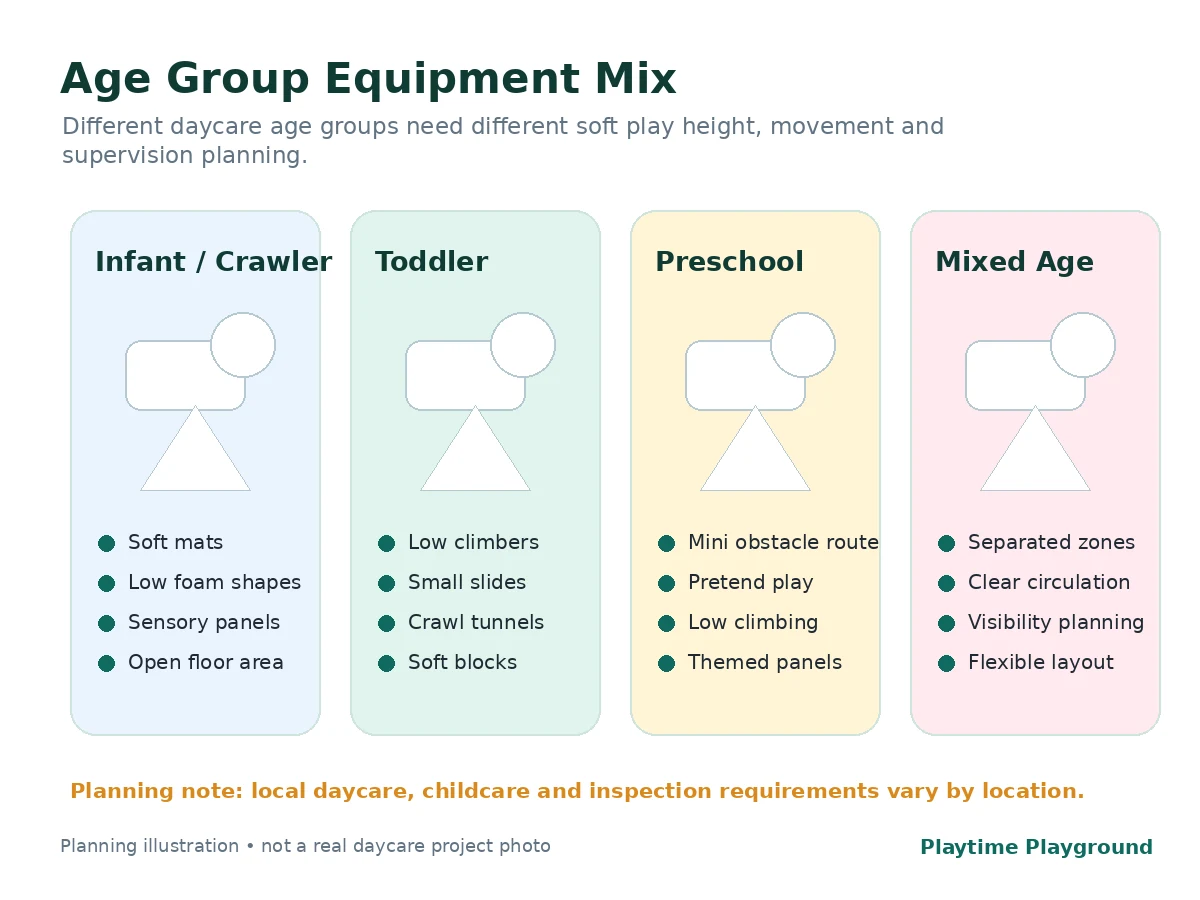
| User Group | Direção Típica do Equipamento | Design and Cost Impact | Prioridade do Comprador |
|---|---|---|---|
| Bebê / engatinhante | Open padded floor, very low forms and selected sensory activity | Requires separate product-suitability and local early-care review; products for older children cannot be assumed suitable | Direct supervision, mouthing behavior, hygiene, low access and local licensing requirements |
| Crianças pequenas | Low climbers, short slides, crawl routes, soft steps and open-ended foam forms | Requires clear sightlines, controlled movement and adequate space around active elements | Age-appropriate height, predictable circulation and cleaning access |
| Pré-escola | Low obstacle sequences, pretend play, varied climbing and themed activity panels | A broader activity mix increases layout and equipment detail | Variety without creating blind spots or conflicting movement paths |
| Idade mista | Clearly separated zones or scheduled use for different activity levels | Additional zoning, dividers, signage and operational planning may be needed | Preventing younger children from entering faster or more difficult play routes |
ASTM F1918-21 addresses soft contained play equipment for users from the 5th-percentile two-year-old through the 95th-percentile twelve-year-old. It should not be presented as automatic coverage for an infant room. ASTM F2373-24 addresses certain public-use play equipment for children six through twenty-three months in early-care and other public settings, but its scope excludes soft contained play equipment. The practical conclusion is that an infant-room proposal needs a product-specific and jurisdiction-specific review rather than a simple transfer of one standard label.
Equipment Mix: Compare Play Value, Supervision and Cleaning
A daycare does not automatically need a large indoor playground structure. In many rooms, a focused soft-play arrangement is easier to supervise, rotate, clean and maintain. Each item should have a clear purpose in the daily program.
Modular Foam Forms
Useful for flexible movement activities and room reconfiguration. Confirm dimensions, weight, surface material, storage method and whether covers or components can be replaced.
Low Climbers, Steps and Slides
Suitable for controlled gross-motor activity when the age group, surrounding space and supervision plan are appropriate. Confirm the complete landing and floor-protection scope.
Crawl Tunnels and Soft Obstacles
Add route variety but can block sightlines if placed poorly. Check teacher viewing positions, cleaning access and whether children can enter from conflicting directions.
Sensory and Wall Activities
Can add play value without using much floor space. Confirm mounting responsibility, wall condition, cleaning method and whether small detachable parts are involved.
Ball Areas
Require defined boundaries, ball management and a practical cleaning routine. Ask how balls, base surfaces and surrounding padding will be accessed and maintained.
Flooring and Wall Padding
These are separate scope items, not automatic accessories. Confirm coverage drawings, seams, edges, transitions, wall conditions and local installation responsibility.
Larger facilities may combine soft play with compact indoor playground equipment. That decision should follow the primary age group, clear height, supervision model and local requirements rather than the desire to add more components.
Matriz de Adequação para Salas de Creche
The best quote is the one that fits the actual operating scenario. The matrix below helps buyers decide which scope is more appropriate before asking suppliers to price it.
| Cenário de Creche | Direção de Equipamentos Mais Adequados | Cost-Scope Tendency | Key Supplier Question |
|---|---|---|---|
| Infant or crawler room | Open padded area and separately reviewed very-low activity products | Limited equipment quantity, but hygiene, flooring and product suitability remain important | What evidence supports suitability for the stated age range and local setting? |
| Pequena sala para bebês | Low modular forms, short slide, crawl element and selected wall activity | Compact equipment scope with meaningful flooring and padding coverage | Can staff see and reach every active area? |
| Sala de atividades para pré-escola | Low obstacle route, pretend-play pieces, varied movement and themed panels | More component variety and design coordination | Which parts are fixed, modular or removable for room changes? |
| Centro de cuidados infantis para diversas idades | Separated zones, scheduled access or distinct rooms for different abilities | Additional zoning, barriers and operating controls | How does the layout prevent cross-traffic between age groups? |
| Larger daycare or preschool facility | Soft play plus a compact project-specific indoor play zone | Higher design, shipping and installation coordination | Is the quote based on a complete room plan and responsibility matrix? |
Conjunto padrão de soft play vs. Design personalizado de sala de creche
A standard or modular set may be sufficient when the room is regular, the age group is clear and the buyer can maintain adequate circulation. A custom layout becomes more useful when the room has unusual dimensions, fixed obstacles, multiple age groups, continuous floor or wall treatment, or a defined visual identity.
| Opção | Adequado para | Cost and Project Impact | Pergunta do comprador |
|---|---|---|---|
| Standard modular set | Simple rooms and limited equipment requirements | More predictable product scope, but the buyer must still verify fit and age suitability | Does the complete set fit while preserving circulation and sightlines? |
| Room-based modular layout | Programs that want flexible pieces arranged for a specific room | Adds layout work without creating a fully built-in environment | Can the pieces be safely rearranged and stored? |
| Custom fitted playroom | Irregular rooms, continuous flooring or padding, fixed components and branded interiors | Higher design, production and installation coordination | What drawings, revisions, graphics and site work are included? |
| Mixed soft play and indoor play structure | Larger preschool or childcare facilities with appropriate users and space | Greater structural, zoning and compliance complexity | Are the age groups and operating rules clearly separated? |
A common quotation mistake occurs when one supplier prices a loose standard set while another prices a fitted room with flooring, wall pads and custom panels. The totals do not represent the same deliverable. Compare the approved layout and equipment schedule line by line.
Materials, Padding, Hygiene and Cleaning Access
Daycare buyers need more than a broad statement that a product is “easy to clean.” The room should be designed so staff can reach high-touch surfaces, seams, edges, gaps, the backs of fixed pieces and the floor beneath or around equipment. The supplier should also state which cleaning products or methods are compatible with the quoted surfaces.
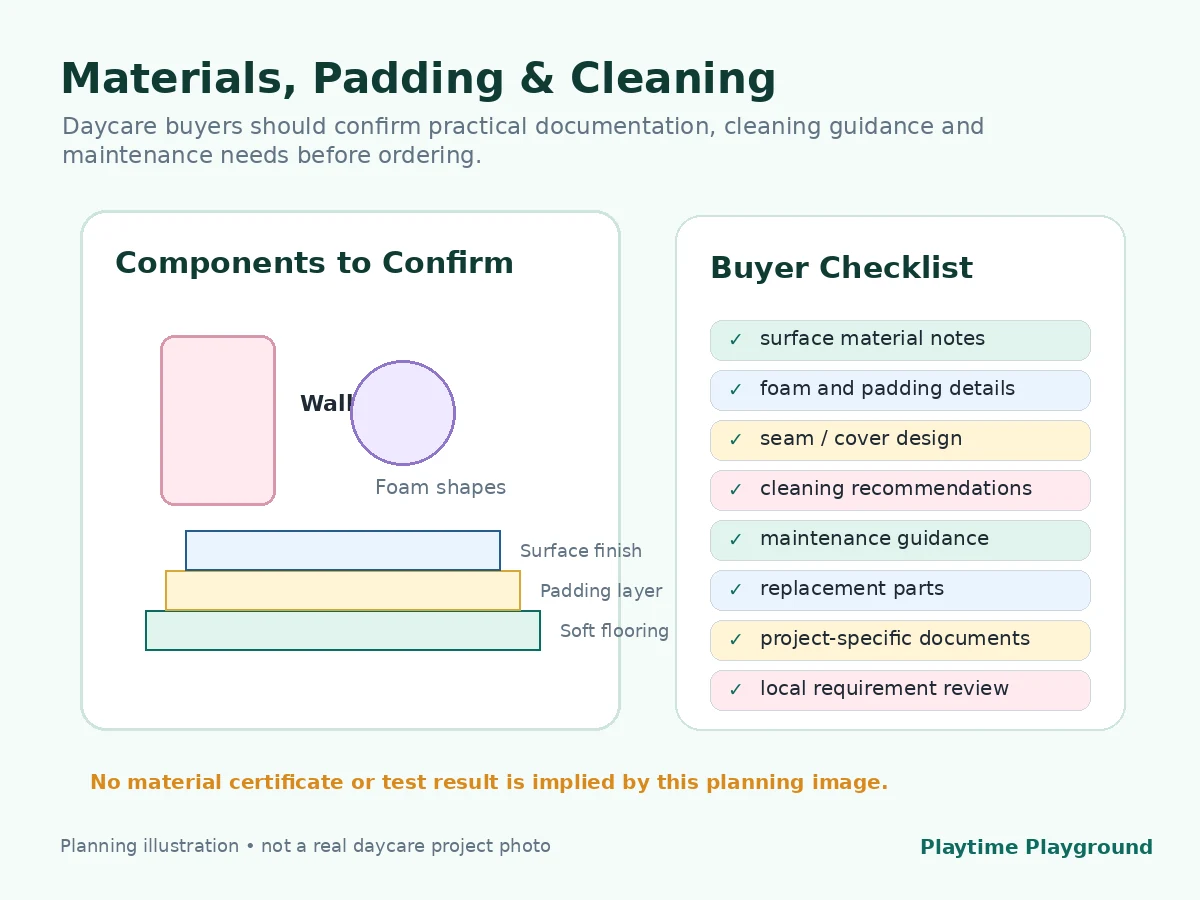
Material and Cleanability Questions
- What surface material is used on each quoted component?
- Where are seams, fasteners, zippers or access openings located?
- Can covers or high-wear components be removed or replaced where applicable?
- What cleaning, sanitizing or disinfecting products are compatible with the surfaces?
- Can staff access the floor, walls and gaps around fixed equipment?
- How should ball areas, tunnels and enclosed spaces be emptied or opened for cleaning?
- What maintenance frequency and inspection points does the supplier recommend?
- What material notes, test information or project documents are available for the final quoted scope?
CDC guidance for early-care and education settings distinguishes cleaning from sanitizing and disinfecting and advises users to follow product instructions and manufacturer compatibility. The equipment supplier should therefore provide surface-specific guidance rather than one universal cleaning claim.
Authoritative References for Buyer Review
These sources support planning discussions; they do not certify Playtime or prove that one product automatically complies in every jurisdiction.
- ASTM F1918-21 for soft contained play equipment — relevant to equipment within its stated product and user scope.
- ASTM F2373-24 for public-use play equipment for children 6–23 months — relevant context for certain early-care play equipment, while explicitly excluding soft contained play equipment.
- CPSC Public Playground Safety Handbook, 2025 edition — voluntary U.S. public-playground guidance for purchasers, installers, maintainers and childcare personnel.
- Supervisão Ativa do Head Start — early-childhood guidance supporting visibility, staff positioning and intentional observation.
- CDC cleaning and disinfection guidance for early-care settings — practical context for cleaning, sanitizing and disinfecting surfaces and objects.
Shipping, Delivery Access and Installation Support
Soft-play products can use substantial container or vehicle volume even when individual pieces are lightweight. A reliable logistics discussion should identify packed dimensions, estimated volume, labeling, freight basis, destination charges, inland delivery, unloading and the party responsible for moving the packages into the room.
Delivery access matters. A common installation problem occurs when a large padded piece or preassembled panel cannot pass through the building entrance, corridor or elevator. The team then has to repack, disassemble or modify the installation sequence. Provide door, corridor, stair and elevator dimensions before final packing is approved.
Site readiness also affects installation cost. Flooring conditions, wall preparation, moisture, electrical work, skirting, fixed furniture and room access should be completed or clearly coordinated before the installation team starts. A second visit caused by an unfinished room is normally an owner-side cost unless the contract says otherwise.
| Scope Item | Por que é importante | O que Confirmar |
|---|---|---|
| Export packing | Foam shapes, floor panels and custom pieces can create significant volume | Packing method, estimated volume, labels and component list |
| Freight basis | EXW, FOB, CIF, DAP and other terms allocate costs and risks differently | Incoterm, named place, freight validity and excluded charges |
| Final delivery access | Doors, lifts, stairs and unloading restrictions affect handling | Largest packed item, access dimensions, unloading equipment and delivery hours |
| Suporte de instalação | Loose modular sets and fitted rooms require different support | Drawings, manuals, remote guidance, on-site support and local labor responsibility |
| Site readiness | Unfinished floors, walls or utilities can delay installation | Buyer-side prerequisites, inspection hold points and opening schedule |
For broader coordination, review Playtime’s serviços de projeto de playground da Playtime before the final equipment and logistics scope is confirmed.
O que os compradores devem enviar antes de solicitar um orçamento
A supplier can give only a rough product reference when the room and operating requirements are unknown. A layout-based quotation needs a clear project brief.
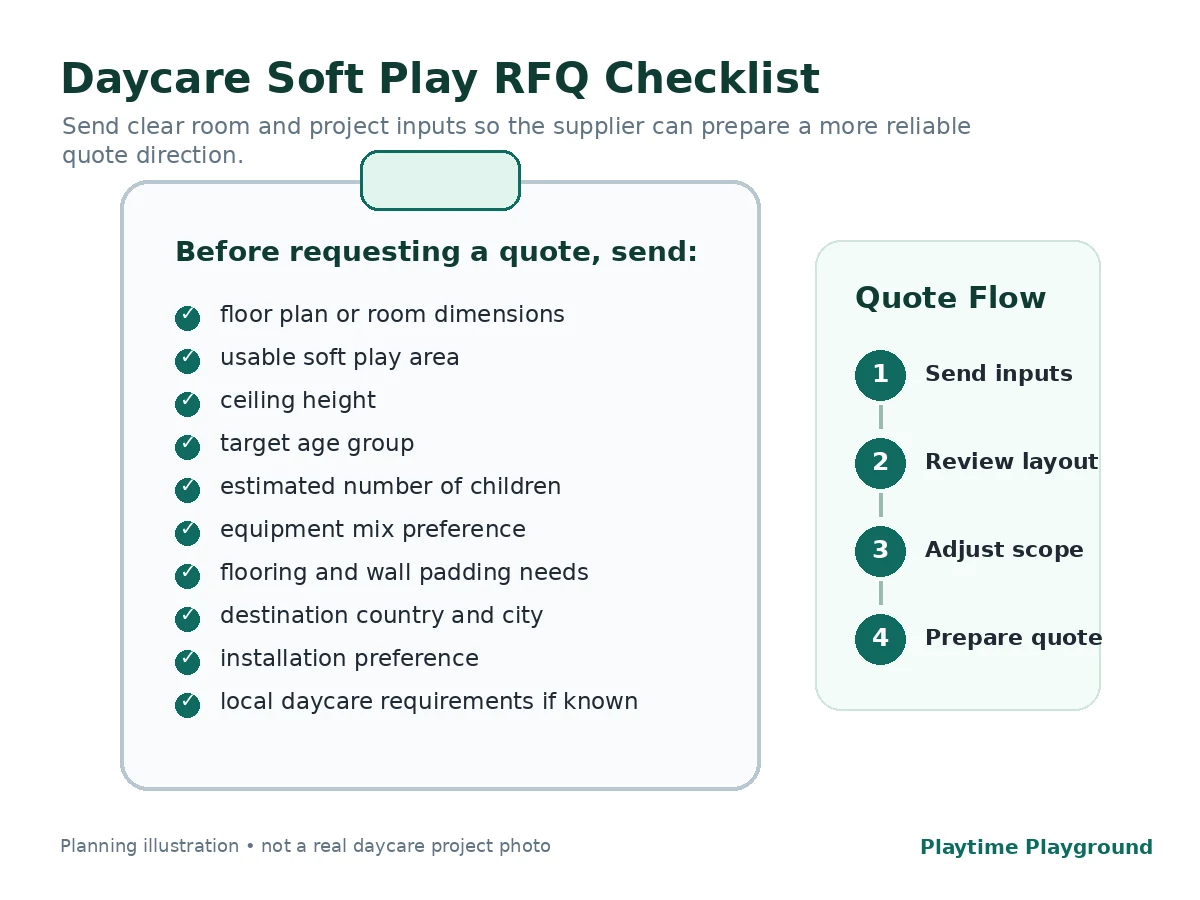
Daycare Soft Play RFQ Checklist
- Dimensioned floor plan, CAD file or accurate room sketch
- Gross room area and marked usable equipment area
- Clear ceiling height and any low beams or ceiling equipment
- Doors, windows, columns, radiators, outlets, cabinets and restricted areas
- Exact target age group for each room or zone
- Expected simultaneous user range and staff supervision model
- Required fixed, modular and movable equipment
- Soft-flooring and wall-padding coverage
- Cleaning, hygiene or material requirements from the operator
- Theme, color or brand direction
- Destination country, city and requested delivery basis
- Door, corridor, stair, elevator and unloading access
- Installation preference and available local labor
- Opening timeline and site-readiness date
- Known daycare licensing, fire, accessibility or inspection requirements
- Budget direction, clearly stating whether it covers equipment only or the landed scope
Buyers can also use Playtime’s checklist de RFQ para playground indoor to structure supplier submissions and document responsibilities.
How to Compare Daycare Soft Play Supplier Quotes
Place supplier quotations beside the same approved floor plan and compare included, optional and excluded items. A lower total is not meaningful when the equipment schedule, surface coverage or logistics basis is different.
| Item do orçamento | O que verificar | Por que é importante |
|---|---|---|
| Layout aprovado | Same usable area, doors, fixed obstacles and circulation assumptions | Prevents suppliers from pricing different room boundaries |
| Cronograma de equipamentos | Dimensions, quantity, fixed or modular status and age-group assignment | Shows whether the play value and installation scope are comparable |
| Flooring and wall pads | Coverage area, edge details, seams, substrate assumptions and installation | These items can represent a substantial part of a fitted room |
| Materials and cleanability | Surface notes, cleaning compatibility, replaceable parts and maintenance guidance | Supports daily daycare operation and lifecycle planning |
| Design and revisions | 2D layout, 3D concept, graphics and number or basis of revisions | Prevents later charges or design misunderstandings |
| Documentação | Equipment list, layout, material notes, packing list, manuals and maintenance information | Supports installation, handover and local review |
| Logistics | Packing, Incoterm, destination, freight validity, duties, local delivery and unloading | Separates factory price from landed cost |
| Instalação | Local labor, tools, wall or floor preparation, remote support and on-site support | Clarifies who owns execution risk |
| Commercial terms | Lead time, payment terms, warranty, spare parts and after-sales process | Allows comparison beyond the initial purchase number |
For a wider supplier review, use Playtime’s indoor playground supplier checklist e checklist para compradores de playground comercial.
Sinais de alerta em orçamentos que os compradores devem observar
- One total price with no marked layout or equipment schedule
- A design prepared without the exact age group or daycare-room use
- Infant products described as covered by a standard whose stated user range begins at age two
- Flooring and wall pads described only as “standard” with no coverage drawing
- Material claims such as “non-toxic,” “antibacterial,” “fireproof” or “easy to clean” without scope-specific evidence or instructions
- No explanation of fixed, modular and movable pieces
- No cleaning, maintenance or replacement-part discussion
- “Shipping included” without an Incoterm, named destination or excluded-charge list
- “Installation included” without local labor, tools, travel and site-preparation responsibilities
- No delivery-access review for doors, corridors, stairs or elevators
- Claims that one product or layout meets all daycare requirements worldwide
- Pressure to approve production before local requirements and final drawings are confirmed
Como a Playtime Apoia Projetos de Soft Play para Creches
Playtime Playground can discuss daycare soft-play projects using the actual room, age group and requested equipment scope rather than a universal package price. Support should be confirmed project by project in the final quotation.
Share the marked floor plan, age group, operating needs and destination.
Review access, circulation, staff sightlines, cleaning space and fixed obstacles.
Separate core movement, sensory, flooring and wall-protection requirements.
Confirm layout, equipment list, design, packing, freight basis and exclusions.
Review site readiness, delivery access, installation support and handover documents.
Buyers can review Playtime’s projetos de playground, serviços de projeto e recursos de planejamento before submitting the formal room brief.
Request a Layout-Based Daycare Soft Play Quote
Send the dimensioned room plan, marked usable play area, clear height, exact age group, expected simultaneous users, equipment priorities, flooring and wall-padding scope, destination, delivery access and installation preference. Playtime can review the project inputs and discuss a quotation based on the defined room and responsibility scope.
Send Daycare Project DetailsDaycare Soft Play Equipment Cost FAQ
Quanto custa o equipamento soft play para uma creche?
Não há um preço universal confiável sem um escopo de sala e equipamentos definidos. O custo depende da área útil, faixa etária, lista de equipamentos, piso, acolchoamento de parede, trabalho de design, volume embalado, destino e responsabilidade de instalação. Solicite um orçamento baseado em layout e confirme se ele representa o preço do equipamento, o custo do equipamento entregue ou o orçamento completo para a montagem da creche.
Qual a diferença entre o preço do equipamento e o custo total de montagem para creche?
O preço do equipamento cobre apenas os produtos e serviços do fornecedor listados na cotação. O custo total de montagem pode incluir frete, impostos de importação, entrega local, instalação, reforma, mobiliário, serviços elétricos e de incêndio, licenciamento, seguro, pessoal e despesas pré-abertura. Essas categorias devem ser orçadas separadamente.
O piso emborrachado está incluído no orçamento de um soft play para creche?
Somente quando a cotação listar. Confirme a área coberta, material, costuras, transições, premissas de substrato, responsabilidade de instalação e requisitos locais. Não assuma que pisos emborrachados ou contínuos de soft flooring estão incluídos com as peças do equipamento.
Quais equipamentos soft play são adequados para bebês e crianças pequenas?
A adequação depende da idade exata e da categoria do produto. Salas para crianças pequenas podem usar escaladores baixos, escorregadores curtos, túneis de rastejo e formas modulares macias. Salas para bebês ou engatinhadores exigem revisão específica do produto e licenciamento local; equipamentos destinados a crianças de dois anos ou mais não devem ser especificados automaticamente para bebês.
Qual o espaço necessário para uma área de soft play em creche?
O espaço não pode ser calculado apenas pela área do equipamento. O local também deve comportar circulação de professores, linhas de visão, portas, armazenamento, acesso de emergência, limpeza e quaisquer requisitos de espaçamento locais. Envie uma planta do espaço marcada em vez de apenas os metros quadrados ou pés quadrados totais do local.
Quais informações de limpeza o fornecedor deve fornecer?
Solicite instruções de limpeza e manutenção específicas para a superfície, produtos ou métodos compatíveis, acesso a costuras e áreas ocultas, peças removíveis ou substituíveis quando aplicável, e orientações para componentes de alto contato. A creche deve, então, alinhar essas instruções com os procedimentos locais de saúde pública e licenciamento.
O custo do equipamento soft play inclui frete e instalação?
Não automaticamente. Confirme embalagem, Incoterm, taxas de destino, entrega interna, descarregamento, acesso por porta ou elevador, mão de obra local, ferramentas, preparação do local, manuais, suporte remoto e qualquer assistência no local. A cotação final deve declarar todas as inclusões e exclusões.
Quais normas e requisitos locais os compradores de creches devem revisar?
A resposta depende do produto e da faixa etária. A norma ASTM F1918-21 abrange equipamentos de playground indoor (soft contained play) dentro da faixa de dois a doze anos especificada. A norma ASTM F2373-24 abrange certos equipamentos de uso público para crianças de seis a vinte e três meses, mas exclui equipamentos de playground indoor (soft contained play). Os compradores também devem confirmar os requisitos locais de licenciamento de creches, construção, incêndio, acessibilidade, saúde pública, seguro e inspeção.